
Why Is the First Sales Conversation So Important in B2B Sales?
A B2B prospect can enter the first sales conversation with a preferred vendor, tough questions, and limited time. If your representative starts with a generic pitch, the buyer may leave without answers. Effective discovery establishes trust, confirms fit, and creates a clear next step.
Why Is the First Sales Conversation Important in B2B Sales?
The first sales conversation is important because it helps B2B buyers decide whether a vendor understands their business, can solve their problems, and deserves further consideration. An effective first interaction builds trust, identifies purchase intent, confirms customer fit, answers important questions, and establishes the next step. It can improve qualification and sales pipeline quality, although it does not guarantee a closed deal.
The first conversation is often the seller’s earliest opportunity to understand what the buyer already knows, what they still need to learn, and what might prevent a purchase.
For sales development representatives (SDRs), account executives (AEs), and revenue leaders, this interaction provides information that can shape every later stage of the sales process.
A strong conversation can reveal the buyer’s business problem, purchasing timeline, decision-making responsibilities, and remaining concerns.
A weak conversation may leave these questions unanswered, leading to repeated discovery, poor qualification, and unnecessary follow-ups.
The goal is not to complete every sales activity in one meeting. It is to help the buyer make meaningful progress.
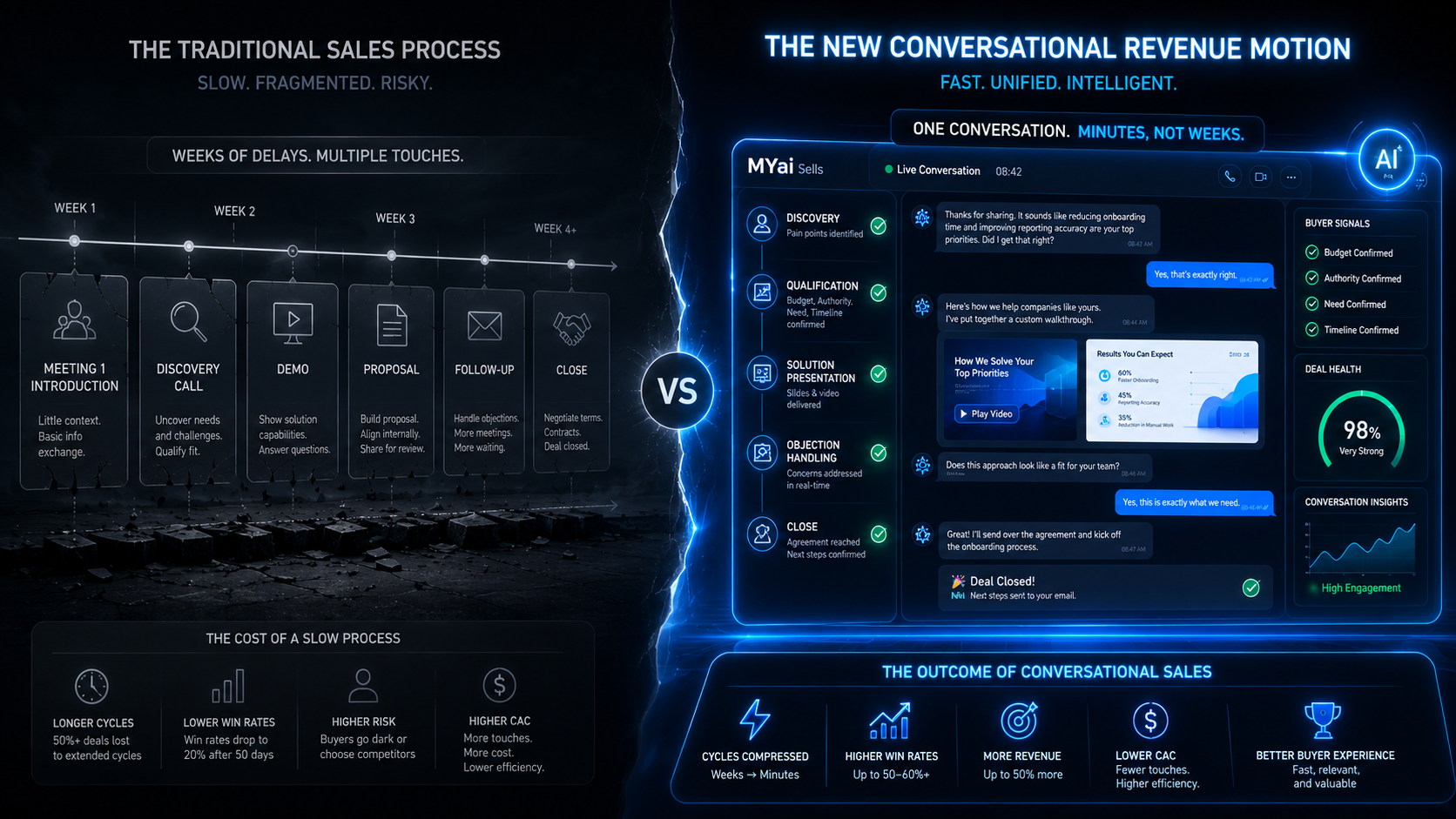
What Happens Before the First B2B Sales Conversation?
Many B2B buyers begin evaluating vendors long before speaking with a salesperson.
They research products, compare pricing, read customer reviews, consult colleagues, and identify possible solutions.
By the time they contact sales, they may already have a preferred vendor.
Buyers Research Vendors Independently
The 2025 6sense Buyer Experience Report studied nearly 4,000 B2B buyers across North America, Europe, the Middle East, Africa, and Asia-Pacific.
The research found that:
-
94% of buying groups ranked vendors before their first sales conversation.
-
77% ultimately purchased from their preferred vendor.
-
79% initiated their first seller engagement themselves.
-
The average point of first seller contact occurred approximately 61% of the way through the buying journey.
These results show that the first sales conversation often happens after substantial buyer research.
The salesperson is not necessarily introducing the product for the first time.
Instead, they may be helping the customer verify an existing preference.
The First Conversation Helps Buyers Validate Their Choice
A buyer may enter the first call with questions about security, pricing, implementation, or product capabilities.
The representative’s responsibility is to provide reliable answers and understand which concerns matter most.
For example, a company evaluating customer relationship management software may already know its preferred platform.
However, the IT team may still need confirmation about data migration and integration requirements.
The first conversation provides an opportunity to address those concerns.
A vendor that fails to explain important requirements may lose buyer confidence.
Being First Does Not Guarantee Winning
The 6sense research also provides an important warning.
Buyers often contact their preferred vendor first.
Therefore, the high win rate associated with first seller contact does not prove that speaking first caused the purchase.
Brand reputation, previous experience, product fit, and independent research influence customer preferences before sales engagement begins.
The first conversation matters because it can confirm or challenge an existing preference, not because it automatically determines the winner.
What Do B2B Buyers Expect From Their First Sales Conversation?
Modern B2B buyers often want specific answers rather than a standard product presentation.
They may already understand the product category and expect the representative to address their particular situation.
Relevant Answers to Business Problems
A buyer researching sales automation software may not need a general explanation of what automation means.
They may want to know whether the product works with Salesforce, supports their qualification process, or meets their security requirements.
A useful representative starts by understanding the buyer’s immediate question.
The discussion can then expand into related business needs.
Trust Through Accurate Information
Buyers need confidence that a vendor’s claims are accurate.
If a representative cannot confirm an integration, implementation timeline, or technical requirement, they should acknowledge the uncertainty and arrange verification.
Unsupported promises may create problems during later evaluation stages.
Trust develops when the buyer receives useful, accurate information and clear expectations.
Control Over the Buying Experience
Not every visitor wants to speak with sales immediately.
In March 2026, Gartner reported that 67% of surveyed B2B buyers preferred a sales experience without direct representative involvement.
The study included 646 buyers surveyed in August and September 2025.
This finding highlights the importance of giving customers choices.
Some buyers prefer self-service information. Others want a product specialist or account executive.
A good first sales interaction respects the buyer’s preferred approach rather than forcing an unnecessary meeting.
What Makes a Successful First B2B Sales Conversation?
An effective first conversation combines active listening, useful discovery questions, relevant product information, and a clear next action.
It should feel like a business discussion rather than a scripted interview.
Understanding the Buyer’s Problem
Begin by identifying what the customer wants to change.
For example, a VP of Sales may explain that representatives spend too much time qualifying unsuitable leads.
That information creates a starting point.
The seller can then investigate the current process, business impact, and desired outcome.
This is more useful than immediately describing every feature of a sales platform.
Asking Relevant Discovery Questions
Discovery questions help representatives understand why a buyer is evaluating solutions.
The questions should follow the conversation naturally.
For example, if a buyer says that lead follow-up is too slow, the representative might ask how the company currently assigns inquiries.
The answer may reveal a routing problem, a staffing constraint, or poor CRM integration.
Each situation requires a different solution.
Listening Before Presenting
Active listening helps sales representatives understand both the buyer’s words and the meaning behind them.
A useful response may involve clarifying the problem, summarizing a concern, or confirming a requirement.
For example:
“So your main problem isn’t the number of leads. It’s the time your team spends determining which leads are ready for sales. Is that correct?”
This allows the buyer to confirm or correct the interpretation.
Providing Value Before Asking for Commitment
A first conversation should help the buyer make progress.
That value may involve explaining an implementation requirement, identifying a possible solution, or clarifying the next stage of evaluation.
An immediate demo request is not always necessary.
For some buyers, receiving accurate technical information may be the most useful outcome.
Ineffective vs. Effective First Conversations
| Ineffective first conversation | Effective first conversation |
|---|---|
| Begins with a generic sales pitch | Starts with the buyer’s needs |
| Repeats questions already answered | Uses available customer context |
| Focuses only on product features | Connects capabilities to business problems |
| Pushes for a meeting immediately | Identifies readiness before suggesting a meeting |
| Treats every prospect the same | Adapts to the buyer’s role and requirements |
| Ignores competitor comparisons | Addresses relevant evaluation criteria |
| Ends without clear next steps | Establishes an agreed next action |
| Records limited CRM information | Preserves useful discovery findings |
How to Make the First Sales Conversation More Effective
Improving first-contact quality requires a repeatable process.
The following seven steps help SDRs, account executives, and AI sales agents turn initial interest into meaningful buyer engagement.
Step 1: Engage the Buyer at the Right Moment
Respond promptly when a prospect requests relevant sales assistance.
A high-intent inquiry about pricing, implementation, or a product demonstration should receive appropriate attention.
However, responding quickly does not mean sending an aggressive sales message.
The first response should address the buyer’s actual question.
Step 2: Use Existing Buyer Context
Before asking questions, review available CRM records and previous interactions.
For example, a prospect may have already shared their company size, preferred CRM, and primary challenge.
Repeating these questions can waste time.
The representative should use verified information to make the conversation more relevant.
Step 3: Understand the Business Problem
Ask what prompted the buyer to evaluate a solution.
Then explore how the current problem affects the organization.
Useful questions include:
-
What challenge are you trying to solve?
-
How are you handling this process today?
-
What happens when the current approach fails?
-
What would a successful improvement look like?
These questions help identify the buyer’s needs and business goals.
Step 4: Qualify the Buyer Naturally
Qualification should establish whether the organization is a suitable customer and what purchasing process applies.
BANT and MEDDICC can support structured discovery.
However, representatives do not need to complete every qualification field immediately.
Ask relevant questions about business needs, timing, decision-makers, and budget when the discussion makes them appropriate.
For example:
“Who else would need to review a solution before your organization could move forward?”
The answer helps identify the buying group without turning the discussion into an interrogation.
Step 5: Answer Questions and Address Concerns
Buyers may raise objections about price, implementation, integration, or expected value.
Understand the specific concern before responding.
For example, a buyer worried about implementation may be concerned about downtime, IT resources, or employee training.
Each problem requires different information.
Use verified product details and provide human technical support when needed.
Step 6: Confirm Customer Fit and Buying Readiness
Before recommending a sales opportunity, review what has been established.
Confirm whether the product can address the buyer’s problem.
Identify relevant requirements, available purchasing information, and any unresolved concerns.
A prospect may be suitable but not ready to purchase.
That buyer may benefit from additional information or a later conversation rather than immediate opportunity creation.
Step 7: Agree on a Useful Next Step
End the conversation with a clear action that reflects the buyer’s needs.
This may involve arranging a technical demonstration, providing pricing information, sending documentation, or scheduling a follow-up.
For example:
“Would it be useful to review the integration requirements with our technical specialist next week?”
A mutually agreed next step is more meaningful than simply recording that the representative will follow up.
What Does Research Say About Sales Discovery Questions?
Sales discovery research supports asking relevant questions and allowing buyers to explain their needs.
Gong Labs analyzed more than 519,000 B2B sales call recordings.
Its research, originally published in 2017 and updated in March 2026, found an association between successful discovery calls and the use of targeted questions.
The analysis identified a range of 11 to 14 questions as effective within the calls studied.
However, this should not be treated as a fixed requirement.
A short conversation with a highly informed buyer may need only a few questions.
A complex enterprise discussion may require more discovery.
The important factors are question relevance, buyer participation, and the quality of the information collected.
The research is observational and does not prove that asking a specific number of questions causes a sale.
Why Does Timing Matter Before the First Sales Conversation?
The timing of initial engagement can influence whether a business connects with an interested prospect.
Buyers who request information may continue evaluating alternatives while waiting.
What Does Lead Response Research Show?
A 2011 Harvard Business Review study examined approximately 1.25 million sales leads received by 42 U.S. companies.
The research found that companies attempting contact within one hour were nearly seven times as likely to qualify a lead as those waiting at least another hour.
They were more than 60 times as likely to qualify leads as companies waiting 24 hours or longer.
The study measured qualification through meaningful contact with a decision-maker.
It did not establish equivalent increases in closed revenue.
Because the research is historical, companies should also measure their own response times and conversion performance.
Speed-to-Contact vs. Speed-to-Value
Speed-to-contact measures how quickly a representative reaches a prospect.
Speed-to-value measures how quickly the buyer receives useful assistance.
For example, an immediate automated acknowledgment may confirm that an inquiry was received.
However, it provides limited value if the actual question remains unanswered.
A strong first interaction combines timely engagement with relevant information.
That is especially important when buyers are comparing technical requirements or planning a purchase.
Why Do First Sales Conversations Fail?
First conversations can lose momentum when the seller focuses on internal sales activities instead of helping the customer.
Generic Product Presentations
A standard sales pitch may provide information the buyer already knows.
The representative should first understand the buyer’s current knowledge and requirements.
A focused explanation is usually more relevant than presenting every product feature.
Poor Discovery and Listening
Some representatives ask several questions but fail to investigate the answers.
For example, a buyer may mention a serious implementation concern, but the salesperson quickly moves to pricing.
That leaves an important purchasing barrier unresolved.
Repetitive Qualification Questions
Buyers can become frustrated when they repeat the same information across forms, SDR calls, and account executive meetings.
Connected CRM records and better handoffs can reduce this problem.
Ignoring Buyer Research
A prospect may have already evaluated competitors and formed a preferred shortlist.
Sales representatives should acknowledge that research rather than assume the customer is unfamiliar with the market.
Useful questions include:
“Which alternatives are you comparing?”
“What matters most in that comparison?”
These questions help identify relevant decision criteria.
Asking for Commitment Too Early
Not every first conversation should end with a proposal or purchasing decision.
Buyers may still need technical reviews, budget approval, or discussions with other stakeholders.
Pushing for a commitment before the buyer is ready can create unnecessary pressure.
A better outcome may be an agreed evaluation plan.
How Can AI Improve the First B2B Sales Conversation?
Conversational AI can support initial sales engagement by collecting buyer information, answering approved questions, and preparing useful context for human representatives.
Its effectiveness depends on reliable information, appropriate configuration, and clear qualification standards.
Real-Time Buyer Engagement
AI sales agents can engage prospects through supported communication channels and respond to routine inquiries.
A properly configured system may operate outside normal business hours.
This can help companies handle initial interest when representatives are unavailable.
However, the platform must support the relevant communication channel.
Conversational Qualification
AI can ask questions about customer needs, company fit, purchasing timelines, and relevant requirements.
Unlike a fixed questionnaire, a generative AI system can adapt its follow-up questions to earlier answers.
For example, if a buyer identifies integration requirements, the AI can ask which existing system the company uses.
The collected information can support an appropriate qualification decision.
Context-Aware Product Assistance
An AI agent connected to approved product knowledge can explain relevant capabilities and answer supported questions.
If the buyer asks about a technical requirement that cannot be verified, the system should acknowledge the limitation and offer human assistance.
Accurate information matters more than producing an immediate answer to every question.
AI-to-Human Sales Handoffs
When a buyer is ready for a human conversation, the AI can prepare a structured summary.
Useful handoff information includes the buyer’s business problem, relevant product requirements, purchase timeframe, known stakeholders, outstanding concerns, and agreed next action.
The account executive should receive enough context to continue the conversation without unnecessary repetition.
Why Human Sales Representatives Still Matter
In May 2026, Gartner reported that 69% of surveyed B2B buyers preferred validating AI-generated information with sales representatives.
The research involved 645 buyers surveyed in August and September 2025.
This finding shows why AI-assisted engagement and human expertise should work together.
Buyers may use digital tools for convenience while relying on people for complex decisions, reassurance, and commercial discussions.
What Does an Effective First Sales Conversation Look Like?
Consider a fictional B2B SaaS company evaluating AI sales automation.
The prospect is a VP of Sales managing a growing revenue team.
This example illustrates effective discovery and qualification. It is not a verified customer transcript or a guaranteed sales outcome.
Sales Representative:
“What prompted your team to look at sales automation?”
Buyer:
“We have enough incoming leads, but our SDRs spend too much time on qualification. Follow-up is inconsistent.”
Sales Representative:
“How are those inquiries currently handled?”
Buyer:
“Everything enters Salesforce. Our SDRs review the records and contact prospects manually.”
Sales Representative:
“Which part creates the biggest problem: delayed responses, unsuitable prospects, or repeated qualification work?”
Buyer:
“Mostly repeated qualification. Some leads clearly aren’t suitable, but our reps still spend time on them.”
Sales Representative:
“Are you looking to change that process soon?”
Buyer:
“Yes. We want a solution this quarter.”
Sales Representative:
“Who else would participate in the decision?”
Buyer:
“Our revenue operations director and CRO.”
Sales Representative:
“Based on what you’ve shared, it may be useful to review how qualification could work with your existing Salesforce process. Would you like a technical discussion with someone from our team?”
Buyer:
“Yes, but integration is important. We can’t afford duplicate records.”
The conversation has identified a business problem, existing technology, purchasing timeframe, stakeholders, and a technical concern.
It has also produced a useful next step.
The representative has not confirmed the available budget or demonstrated that the solution meets every requirement.
Therefore, the appropriate outcome is a qualified discovery opportunity, not an assumed completed sale.
How Does the First Sales Conversation Improve Pipeline Quality?
A strong first conversation helps sales teams decide which prospects should move forward and what information is still needed.
This can improve pipeline quality by reducing poorly qualified opportunities.
Better Opportunity Qualification
A prospect should not become sales-qualified merely because they attended a meeting.
The conversation should establish enough information to justify further sales resources.
For example, a company matching the ICP with a clear business problem and relevant purchasing timeline may qualify for a more detailed evaluation.
Stronger SDR-to-AE Handoffs
When the first conversation is handled by an SDR or AI agent, the account executive should receive the relevant findings.
This prevents repeated discovery questions and improves preparation.
CRM tools such as Salesforce and HubSpot can help store and share buyer context, depending on available features and integrations.
Clearer Sales Forecasting
Reliable qualification helps sales managers distinguish active opportunities from early research.
A prospect with an identified need, confirmed next step, and realistic evaluation plan may provide stronger pipeline evidence than someone who simply downloaded a guide.
However, first-call qualification does not remove uncertainty from revenue forecasting.
Customer decisions can still change.
How Do You Measure First Sales Conversation Effectiveness?
Sales leaders should evaluate both conversation quality and downstream business outcomes.
A high meeting-booking rate does not necessarily mean the first interaction is effective.
The relevant question is whether those meetings turn into qualified opportunities and customers.
| KPI | What it measures |
|---|---|
| First-contact response time | Time before a meaningful first response |
| Conversation engagement rate | Meaningful buyer conversations ÷ initiated conversations |
| Qualified conversation rate | Conversations meeting qualification criteria ÷ evaluated conversations |
| First-conversation-to-opportunity rate | Qualified opportunities ÷ eligible first conversations |
| Next-step commitment rate | First conversations with an agreed next action ÷ eligible conversations |
| Sales handoff acceptance rate | Accepted qualified handoffs ÷ submitted handoffs |
| First-to-second-meeting rate | Buyers progressing to a second meeting ÷ eligible first meetings |
| Opportunity win rate | Closed-won opportunities ÷ completed won and lost opportunities |
| Buyer experience score | Feedback about relevance, clarity, and helpfulness |
How Do You Calculate First-Conversation-to-Opportunity Conversion?
Use:
First-Conversation-to-Opportunity Rate = (Qualified Opportunities ÷ Eligible First Conversations) × 100
Suppose a B2B sales team completes 200 first conversations in one month.
Of those conversations, 60 create qualified opportunities.
The conversion rate is:
60 ÷ 200 × 100 = 30%
If the team later creates 70 qualified opportunities from 200 comparable conversations, the rate becomes 35%.
That represents a five-percentage-point increase.
These figures are illustrative, not established B2B benchmarks.
Sales leaders should also track whether the resulting opportunities convert into paying customers.
How Can Companies Test Better First Conversations?
Compare the existing first-contact process with an improved discovery approach.
Use consistent qualification criteria and similar buyer groups.
Measure opportunity creation, sales acceptance, meeting completion, and later win rates.
Where practical, use controlled tests rather than comparing unrelated customer segments.
Also review conversation recordings or transcripts where permitted.
This helps managers identify which changes improve buyer experience and sales outcomes.
How Can Teams Improve First Conversations Without Hiring More SDRs?
Businesses can increase initial engagement capacity by removing repetitive work and improving how representatives use their time.
For example, CRM automation can reduce manual lead assignment.
AI agents can support approved first-contact conversations and qualification.
Structured handoffs can prevent account executives from repeating discovery already completed by an SDR.
Sales enablement teams can prepare answers to common implementation, security, and product questions.
These changes may help existing representatives handle more suitable opportunities.
However, automation should be evaluated through qualified pipeline and actual commercial results rather than message volume alone.
The objective is not to eliminate human involvement from every sales stage.
It is to reserve human attention for activities requiring expertise, judgment, and relationship building.
How Does XYNEXI Support Better First Sales Conversations?
XYNEXI is an autonomous AI SDR and BDR platform built around its AIRPEC multi-agent reasoning engine.
According to XYNEXI’s official platform overview, its Human AI technology supports outbound prospecting, personalized engagement, buyer discovery, qualification, objection handling, and intent verification.
The platform focuses on conducting adaptive conversations rather than relying only on fixed outreach sequences.
Understanding Buyer Context From the First Interaction
XYNEXI describes using buyer roles, industries, and expressed requirements to guide its sales conversations.
Its AIRPEC engine coordinates lead intelligence, personalized outreach, qualification, and verified buyer handoffs.
This approach can help identify which prospects require further sales attention.
Qualifying Buyers Through Natural Conversations
Rather than treating qualification as a separate questionnaire, XYNEXI’s stated approach incorporates discovery into the conversation.
The AI can adapt its questions and responses based on what buyers share.
Its published capabilities also include personalized solution presentations and initial objection handling.
Preparing Qualified Prospects for Human Representatives
XYNEXI describes a Human-In-The-Loop model in which AI handles parts of the pre-close outbound sales cycle.
Human teams remain responsible for strategy, important commercial decisions, relationships, and contract execution.
The platform is positioned around delivering qualified, intent-confirmed prospects with relevant conversation context.
XYNEXI’s published product information primarily emphasizes outbound AI sales development. Companies evaluating specific website chat integrations should verify those capabilities separately.
The value of this approach is not simply faster outreach. It is making the first meaningful buyer conversation more relevant, informative, and useful for sales qualification.
Explore how XYNEXI works to learn more about its conversational AI sales model.
Conclusion
The first sales conversation is important in B2B sales because it creates an opportunity to establish trust, understand buyer needs, validate product fit, and agree on the next meaningful action.
Modern buyers often research vendors and develop preferences before contacting sales.
That makes the first conversation a critical opportunity to answer remaining questions and demonstrate relevant expertise.
Sales representatives should prioritize discovery, active listening, accurate information, and natural qualification rather than generic product pitches.
AI can support this process through real-time engagement, conversational qualification, and structured handoffs.
However, complex purchases still require human judgment and buyer approval.
The first conversation does not need to close every deal.
It needs to give the buyer a clear reason to continue and provide the sales team with reliable information for what happens next.
Frequently Asked Questions
1. Why Is the First Conversation Important in B2B Sales?
The first B2B sales conversation helps establish trust, identify customer needs, and determine whether a product is suitable. Buyers may already have researched vendors and formed preferences before speaking with sales. A useful first interaction provides accurate information, addresses concerns, and establishes an appropriate next step. It can improve qualification and pipeline quality without guaranteeing a completed sale.
2. Can the First Sales Conversation Determine Whether a Deal Closes?
The first conversation can influence a buyer’s confidence and willingness to continue evaluating a vendor, but it does not determine every purchasing decision. Product fit, pricing, buying-group approval, security requirements, and existing vendor preferences also matter. Research from 6sense shows that many buyers rank vendors before their first sales contact, making early reputation and buyer research important influences.
3. What Should a Salesperson Ask During the First Buyer Conversation?
A salesperson should ask about the buyer’s main business problem, current process, desired outcome, relevant requirements, purchasing timeline, and decision-making responsibilities. Questions should follow the buyer’s responses rather than a rigid checklist. The goal is to understand the situation and determine whether further evaluation would be useful, not collect every possible qualification detail immediately.
4. How Can Sales Teams Build Trust During Initial Customer Interactions?
Sales teams can build trust by listening carefully, asking relevant questions, providing accurate product information, and acknowledging limitations. Representatives should avoid unsupported claims and unnecessary pressure. They should also respect the buyer’s existing research and communication preferences. A clear explanation of what happens next helps customers understand how the vendor can support their evaluation.
5. Can AI Sales Agents Handle the First Conversation With a Prospect?
Yes. Appropriately configured AI sales agents can support initial buyer engagement, ask discovery questions, collect qualification information, and answer approved product questions. Some platforms also support structured handoffs to human representatives. However, AI capabilities vary by provider. Complex technical issues, commercial negotiations, and sensitive purchasing decisions may still require experienced human employees.
6. How Do You Measure the Success of a First Sales Conversation?
Measure success through qualified conversation rates, opportunity creation, sales acceptance, agreed next steps, buyer feedback, and eventual win rates. Response time and meeting bookings provide useful supporting information. However, a high meeting count is not enough if the opportunities lack genuine purchasing potential. Compare similar buyer groups and follow opportunities through the complete sales cycle.