
How Does a Real-Time AI Sales Conversation Turn a Website Visitor Into a Qualified Buyer?
A B2B website visitor may explore pricing, ask about integrations, and leave before a salesperson responds. Real-time AI sales conversations can answer useful questions, uncover business needs, and identify sales-ready prospects while preserving the context human representatives need for the next step.
How Does a Real-Time AI Sales Conversation Turn Visitors Into Qualified Buyers?
A real-time AI sales conversation turns a website visitor into a qualified buyer by identifying their needs, asking relevant discovery questions, assessing customer fit and purchase intent, answering product questions, and recommending the appropriate next step. When the visitor meets defined qualification criteria, the AI can prepare a structured sales handoff or offer a meeting.
Unlike a traditional lead capture form, conversational AI can collect information through a two-way discussion.
The buyer explains what they need, and the AI uses those answers to guide the interaction.
This helps businesses distinguish between visitors researching general information and prospects with a genuine business problem.
However, a qualified buyer is not automatically a paying customer. Complex purchases may still require a product evaluation, budget approval, security review, or contract negotiation.
The purpose of conversational qualification is to help the right buyers progress without unnecessary delays.
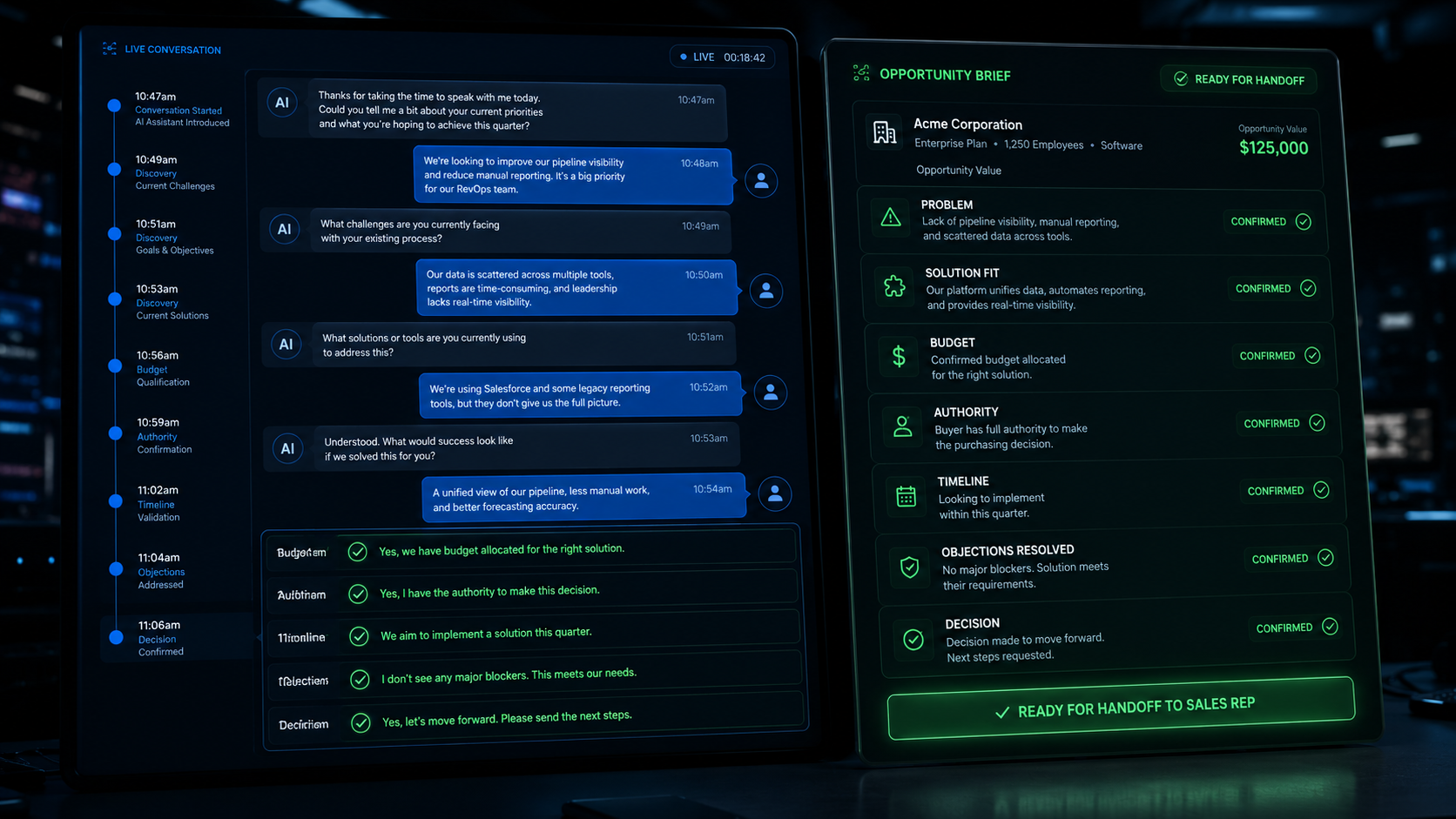
What Happens When a Buyer Starts an AI Sales Conversation?
A typical B2B website receives visitors at different stages of the purchasing journey.
Some are comparing products. Others are researching pricing, checking technical requirements, or looking for a sales representative.
A real-time AI sales agent can offer assistance when a visitor chooses to engage.
Recognizing Buyer Intent From Website Activity
Website behavior can provide useful context about what a visitor might need.
For example, someone visiting a pricing page may have questions about subscription plans.
A visitor reading integration documentation may be checking whether the product works with an existing system.
A person requesting a demonstration may be further along in the evaluation process.
These behaviors are buyer intent signals, not proof of purchasing readiness.
The AI should use them to offer relevant assistance rather than assume every visitor wants a sales call.
Starting a Helpful Conversation
The opening message should match the visitor’s likely purpose.
For example, a visitor on a product pricing page might see:
“Hi! Are you comparing plans, checking product features, or looking for help with a specific requirement?”
This gives the visitor a clear choice.
It also allows the conversation to start without requiring a lengthy registration form.
Visitors who prefer browsing independently should still have access to product information without being forced into a chat.
Understanding First-Time and Returning Visitors
A first-time visitor may need a simple explanation of the product.
A returning prospect may already have discussed requirements or evaluated specific features.
If the business has appropriate permissions and reliable CRM records, an AI agent can use available context to avoid repeating questions.
For example, a returning buyer who previously mentioned Salesforce integration should not need to explain the same requirement during every interaction.
However, the system should verify that the information belongs to the correct person and remains accurate.
How Does AI Qualify Buyers During a Live Conversation?
Conversational AI qualification uses buyer responses to determine whether a prospect meets the company’s sales criteria.
Instead of depending only on website behavior or lead scores, the system collects information directly from the visitor.
Discovering the Buyer’s Business Problem
A good qualification conversation begins with the problem the buyer wants to solve.
For example, an AI agent might ask:
“What is the biggest challenge with your current sales process?”
If the prospect says that inbound leads receive delayed follow-ups, the next question can explore the size of the problem.
“How are those leads currently assigned to your sales team?”
This approach allows qualification to develop naturally.
It also helps identify the business outcome the customer wants rather than collecting information without understanding its purpose.
Checking Ideal Customer Profile Fit
An ideal customer profile (ICP) describes organizations that are a suitable match for a product.
Qualification criteria may include company size, industry, geographic market, existing technology, or business requirements.
For example, a company selling enterprise sales software may need to know whether the buyer manages a sales team and which CRM the organization uses.
The AI can ask relevant questions without requesting every company detail immediately.
Identifying Budget, Authority, Need, and Timing
BANT is a common B2B qualification framework.
It examines four areas:
-
Budget: Whether funding is available or requires approval.
-
Authority: Who participates in or approves the purchase.
-
Need: Whether the organization has a problem the product can solve.
-
Timing: When the company expects to evaluate or implement a solution.
Not every buyer can provide all four answers during the first conversation.
For example, a department manager may understand the problem and timeline but not control the purchasing budget.
That does not automatically make the prospect unqualified.
The system should record confirmed information, identify missing details, and recommend an appropriate next step.
Distinguishing Research Interest From Purchase Readiness
A visitor downloading a guide may be interested in learning about a subject.
A buyer discussing implementation requirements, internal approval, and an upcoming purchase deadline may be further along.
An AI agent can use those differences to recommend a suitable action.
Research-focused visitors may receive educational resources.
Sales-ready prospects may be offered a discovery meeting or introduced to a representative.
Qualification should reflect actual buyer evidence rather than simply the number of questions answered.
How Does AI Handle Buyer Questions and Sales Objections?
During a live conversation, buyers often raise questions that affect whether they continue evaluating a product.
These may involve pricing, integrations, implementation, security, or competing solutions.
Answering Product Questions With Verified Information
A reliable AI sales agent should use approved product documentation and current business information.
For example, if a buyer asks whether software supports HubSpot integration, the AI should consult verified integration details.
If it cannot confirm compatibility, it should explain that the requirement needs verification.
Inventing a feature to maintain the conversation can create serious problems later in the sales cycle.
Handling Pricing and ROI Questions
A buyer may ask whether a product fits the organization’s budget.
The AI can explain verified pricing information, available packages, and relevant value considerations.
However, it should not invent discounts, promise financial returns, or make unauthorized contractual commitments.
For example, if enterprise pricing depends on company requirements, the appropriate response may be to offer a discussion with a sales specialist.
Addressing Competitor Comparisons
B2B buyers often evaluate multiple vendors.
The AI can explain factual product differences using approved comparison information.
It should avoid unsupported claims about competitors.
For example, a buyer may ask whether one product provides stronger reporting capabilities than another.
A useful response explains the available features and identifies which requirements matter to the buyer.
Recognizing When Human Assistance Is Necessary
Some questions require deeper expertise.
Examples include complex integrations, security policies, contractual requirements, unusual pricing, and legal terms.
The AI should recognize these situations and provide an appropriate escalation.
This protects accuracy while helping the buyer continue the evaluation.
Real Example: From Website Click to Qualified Sales Opportunity
The following fictional example demonstrates how a properly configured AI sales conversation could work on a B2B software website.
It is an illustrative scenario, not a verified customer transcript or a measured XYNEXI conversion result.
The buyer is a revenue operations manager at a growing B2B SaaS company. The organization wants to improve qualification and reduce manual sales work.
10:02 AM: The Buyer Visits a Product Page
A visitor arrives after researching sales qualification software.
The website offers a conversational assistant.
AI Sales Agent:
“Hi! Are you exploring ways to improve lead qualification, or would you like details about a specific product capability?”
Buyer:
“We’re looking at ways to reduce the time our team spends qualifying inbound leads.”
The AI now has an initial problem to investigate.
It does not yet know whether the visitor represents a suitable customer.
10:04 AM: AI Begins Discovery
AI Sales Agent:
“How many inbound leads does your team usually handle each month?”
Buyer:
“About 220. We have five sales representatives, and they spend too much time on prospects who aren’t ready.”
AI Sales Agent:
“Which CRM does your team currently use?”
Buyer:
“Salesforce.”
The conversation has identified a measurable workload problem and relevant technology context.
The prospect has provided information that can guide the next question.
10:06 AM: AI Identifies Buying Intent
AI Sales Agent:
“Are you evaluating a solution for an upcoming project, or researching possible improvements for later?”
Buyer:
“We want to make a change this quarter. Our sales leadership has asked us to improve qualification before we increase hiring.”
This response indicates a potential purchasing timeline.
It also suggests the organization is considering an operational change rather than simply collecting general information.
However, purchasing approval has not been confirmed.
10:08 AM: AI Checks Decision-Making Responsibilities
AI Sales Agent:
“Who else would be involved in choosing and approving a solution?”
Buyer:
“Our VP of Sales and the finance team. I’m responsible for evaluating the technical options.”
The AI now understands part of the buying committee.
The prospect is involved in evaluation but does not claim final approval.
This information helps determine who should join a later sales discussion.
10:10 AM: The Buyer Raises an Objection
Buyer:
“My main concern is implementation. We already have several Salesforce workflows, and I don’t want another tool creating duplicate records.”
AI Sales Agent:
“That makes sense. Avoiding duplicate records and protecting existing workflows would be important requirements. I can include those concerns in a technical review with a specialist. Are there any other systems that would need to connect?”
Buyer:
“Mostly our scheduling platform.”
Instead of promising an unsupported integration, the AI captures the requirements.
The system identifies a technical question that needs further review.
10:12 AM: AI Offers the Next Appropriate Action
AI Sales Agent:
“Based on what you’ve shared, a technical discovery session could help determine whether the solution fits your Salesforce setup. Would you like me to arrange a conversation with a specialist?”
Buyer:
“Yes. Please include the implementation questions so we don’t have to repeat everything.”
At this stage, the visitor has expressed interest in a meaningful next step.
A calendar integration, if configured, could offer available meeting times.
Otherwise, the system could request permission for a representative to follow up.
10:14 AM: Qualification Summary and Handoff
The AI prepares a structured summary for the sales team.
| Qualification field | Confirmed buyer information |
|---|---|
| Buyer role | Revenue Operations Manager |
| Business type | B2B SaaS |
| Inbound lead volume | Approximately 220 per month |
| Sales team | Five representatives |
| Primary problem | Too much time spent qualifying unsuitable prospects |
| Current CRM | Salesforce |
| Purchase timeframe | Current quarter |
| Decision stakeholders | VP of Sales and finance team |
| Budget | Not confirmed |
| Technical concerns | Duplicate CRM records and scheduling integration |
| Buyer intent | Interested in technical evaluation |
| Recommended action | Specialist-led discovery meeting |
The buyer is qualified for a focused discovery discussion, not automatically approved as a closed-won opportunity.
The sales representative can review the requirements before the meeting.
The next conversation can focus on product fit, implementation feasibility, commercial details, and remaining decision criteria.
What Did This Conversation Accomplish?
In this fictional 12-minute interaction, the AI collected information that might otherwise require several emails or an initial discovery call.
It identified the business problem, organization context, purchasing timeframe, relevant stakeholders, and technical concerns.
It also established an agreed next action.
The buyer received a useful response without being forced through a lengthy form.
Most importantly, the human representative received structured context.
The result is a better-prepared sales conversation, not a guaranteed completed purchase.
How Does a Qualified Conversation Become a Sales Meeting?
A qualified conversation becomes commercially useful when the system connects buyer information with a clear next action.
Booking a Meeting
If the buyer wants to speak with sales, an integrated scheduling tool can offer available meeting times.
The system should check the correct representative’s calendar and avoid confirming an appointment without actual availability.
A buyer should also have the option to continue researching without booking.
Updating Salesforce or HubSpot
A CRM integration can connect the conversation with the appropriate lead, contact, account, or opportunity.
Useful information includes the buyer’s stated requirements, known concerns, purchase timeframe, and agreed next step.
Salesforce’s Agentforce Qualification documentation describes AI-generated qualification ratings, summaries, missing information, and recommended actions for representatives.
The exact records and updates depend on the platform’s configuration.
Preserving Context During Human Handoffs
A good handoff prevents unnecessary repetition.
The account executive should understand what the buyer has already explained and which questions remain unanswered.
For example, the representative might begin with:
“I understand you’re evaluating ways to improve qualification for your five-person sales team, and Salesforce integration is a major consideration. Let’s review those requirements first.”
That creates continuity between the AI interaction and the human sales conversation.
What If the Buyer Does Not Book Immediately?
Not every qualified prospect wants an immediate meeting.
Some need to compare vendors, consult colleagues, or confirm purchasing authority.
The AI can offer relevant documentation or an appropriate follow-up option.
Any later outreach should respect the buyer’s preferences and applicable communication rules.
What Happens After AI Qualification?
AI qualification is an early sales milestone.
It does not remove the commercial activities required to complete a B2B purchase.
Human Discovery and Product Evaluation
An account executive or specialist may need to verify requirements, explain technical capabilities, and demonstrate relevant workflows.
The AI’s qualification summary should support the discussion rather than replace every part of human discovery.
Buying Committee Approval
Enterprise buyers may need agreement from several departments.
Finance may assess costs. IT may review security. Procurement may examine vendor requirements.
The sales team should identify these stakeholders and provide suitable documentation.
Proposal and Contract Review
A qualified buyer may request commercial terms, implementation details, or a formal proposal.
Authorized employees should handle negotiations and approvals that fall outside the AI system’s permitted role.
Closed-Won or Closed-Lost Outcome
The opportunity becomes closed-won only when the company’s defined purchasing and booking requirements are met.
A positive conversation, verbal expression of interest, or scheduled meeting does not automatically count as revenue.
The CRM should preserve the connection between the initial AI interaction and the eventual opportunity outcome.
What Research Supports Real-Time AI Sales Conversations?
Recent buyer research and published implementations help explain why conversational engagement can be useful.
6sense: Buyers Often Arrive With Vendor Preferences
The 2025 6sense Buyer Experience Report found that 79% of surveyed B2B buyers initiated their first engagement with sellers.
It also found that 94% had already ranked vendors on their shortlist before contacting sales.
These findings suggest that buyers often arrive with established knowledge and requirements.
An AI assistant should therefore discover what the prospect already knows rather than assume the conversation is their first introduction to the category.
Gartner: Buyers Still Value Human Validation
In May 2026, Gartner reported that 69% of surveyed B2B buyers preferred validating AI-generated information with sales representatives.
The same research found that 70% preferred a fully digital, self-service buying experience.
The study surveyed 645 buyers in August and September 2025.
These preferences are not mutually exclusive.
Buyers may want convenient AI-assisted information while still relying on people for reassurance, complex questions, and important purchasing decisions.
Salesforce: A Documented Website AI Implementation
Salesforce’s Agentforce website case study, published in May 2025, describes using conversational AI to answer product questions and connect visitors with sales.
Salesforce reported:
-
A 40% year-over-year reduction in time to qualify.
-
More than 100,000 chats initiated since launch at the reported milestone.
-
More than 30,000 chats that influenced lead creation.
The company also described transferring conversations and summaries to sales representatives.
These are Salesforce-reported results from its own implementation.
They do not establish a standard conversion rate for every business using conversational AI. They also do not mean that every chat produced a paying customer.
How Do You Measure AI Sales Conversations From Click to Revenue?
Revenue leaders should measure more than the number of initiated chats.
A useful conversion dashboard connects website engagement with qualification quality, sales acceptance, and eventual customer outcomes.
| KPI | How to calculate it |
|---|---|
| Visitor-to-conversation rate | Meaningful conversations ÷ eligible website visitors × 100 |
| Conversation engagement rate | Substantive buyer conversations ÷ initiated conversations × 100 |
| Qualified conversation rate | Qualified conversations ÷ evaluated conversations × 100 |
| Conversation-to-meeting rate | Qualified meetings booked ÷ eligible conversations × 100 |
| Meeting completion rate | Completed meetings ÷ scheduled meetings × 100 |
| Sales acceptance rate | Accepted handoffs ÷ submitted qualified handoffs × 100 |
| Conversation-to-opportunity rate | Created qualified opportunities ÷ eligible conversations × 100 |
| Opportunity win rate | Closed-won opportunities ÷ completed won and lost opportunities × 100 |
| Conversation-to-customer rate | New customers attributable to AI conversations ÷ eligible conversations × 100 |
Example: Measuring Conversation Qualification
Suppose a B2B website receives 2,000 eligible visitors.
During the month, 200 visitors begin meaningful AI conversations.
The visitor-to-conversation rate is 10%.
If 60 conversations meet the company’s qualification criteria, the qualified conversation rate is 30%.
Suppose 24 qualified opportunities are created.
The conversation-to-opportunity rate is 12% when measured against all 200 conversations.
These are illustrative figures, not established B2B conversion benchmarks.
The business should continue tracking the opportunities to determine how many become customers.
How Can You Calculate AI Sales Conversation ROI?
A financial evaluation should include incremental gross profit, verified operating savings, and total implementation costs.
Use:
ROI = [(Incremental Gross Profit + Verified Cost Savings − Program Costs) ÷ Program Costs] × 100
For example, suppose a conversational AI pilot costs $5,000 and generates $9,000 in additional attributable gross profit.
If there are no separate verified savings, its calculated ROI is 80%.
This is a hypothetical calculation.
To measure actual incremental performance, compare similar buyer groups using the existing website process and the new AI-assisted process.
Account for lead quality, traffic source, buying intent, and sales cycle length.
How to Implement Real-Time AI Sales Conversations on a B2B Website
A reliable implementation requires clear qualification rules, accurate product information, suitable integrations, and ongoing monitoring.
Step 1: Define Sales Qualification Criteria
Identify what makes a buyer suitable for sales engagement.
Use your ideal customer profile, purchasing requirements, and historical customer data.
Define what should happen when a visitor is qualified, unqualified, or not ready to purchase.
Step 2: Select Appropriate Website Engagement Points
Review where visitors request product information or sales assistance.
Potential locations include product pages, pricing pages, integration documentation, and demonstration request pages.
Offer helpful conversational assistance without blocking normal browsing.
Step 3: Connect an Approved Knowledge Base
Provide the AI with accurate product details, pricing policies, supported integrations, and frequently asked questions.
Establish rules for topics it cannot answer independently.
Keep product information updated and test responses when documentation changes.
Step 4: Configure CRM and Calendar Integrations
Connect the AI system with supported sales tools.
Define how contacts are matched, qualification information is stored, and opportunities are created.
Where meeting scheduling is supported, connect the appropriate calendars and ownership rules.
Test the system for duplicate records and incorrect assignments.
Step 5: Establish Human Escalation Rules
Define which conversations require immediate human attention.
These may include complex technical questions, security requests, contractual terms, and buyer requests for a representative.
Preserve the conversation summary and outstanding questions during the handoff.
Step 6: Test Real Buyer Scenarios
Evaluate the system using realistic customer questions.
Include first-time visitors, returning buyers, unsuitable leads, technical questions, pricing concerns, and visitors who do not want a meeting.
Check whether the AI provides accurate responses and avoids unsupported promises.
Step 7: Measure and Improve Performance
Track conversation quality, qualification accuracy, sales acceptance, and eventual revenue outcomes.
Review interactions that lead to confusion, abandoned conversations, or poor handoffs.
Use the findings to improve the knowledge base, qualification questions, and routing rules.
Expand the deployment only when results support doing so.
What Mistakes Should Companies Avoid With AI Sales Conversations?
Several common mistakes can reduce the effectiveness of conversational sales.
Forcing every visitor into a sales conversation: Some buyers only need product information and prefer self-service.
Asking too many qualification questions: Long interviews can interrupt the experience before the buyer receives any useful answer.
Treating every conversation as a qualified lead: General questions do not automatically demonstrate purchasing intent.
Using outdated product information: Incorrect answers about integrations, pricing, or security can damage trust.
Promising instant purchasing decisions: A meaningful first conversation may advance the process, but enterprise deals often require further approvals.
Losing context during handoff: Buyers should not need to repeat information already collected.
Ignoring privacy and consent: Conversation records may contain personal or confidential business information.
The NIST AI Risk Management Framework provides guidance for evaluating AI risks, reliability, transparency, and accountability.
Companies should apply appropriate privacy safeguards, provide human oversight, and review automated outputs.
How Does XYNEXI Support Real-Time AI Sales Conversations?
XYNEXI is an autonomous AI SDR and BDR platform built around its AIRPEC multi-agent reasoning engine.
Its published product information describes AI-powered prospect research, outbound engagement, buyer discovery, qualification, objection handling, and purchase intent verification.
Unlike a basic rule-based chatbot, XYNEXI’s stated approach focuses on conducting adaptive sales conversations rather than only generating scripted messages.
AI Discovery and Qualification
According to XYNEXI’s official platform overview, AIRPEC supports conversations that adapt to buyer roles, expressed needs, and purchasing signals.
The platform describes using these interactions to identify customer requirements and determine when a prospect is ready for further sales engagement.
Buyer Context and Sales Handoff
XYNEXI’s Human AI model is designed to manage portions of early sales development while passing qualified, intent-verified prospects to human sales teams.
Its published approach keeps humans responsible for strategic relationships, pricing decisions, and contract execution.
The platform also describes using buyer conversation information to improve future engagement and qualification.
How Does XYNEXI Relate to Website AI Sales Conversations?
XYNEXI’s current public positioning emphasizes outbound sales conversations, including engagement through email and SMS.
Its published materials do not establish that every website chat workflow described in this article is available as a native XYNEXI feature.
Businesses seeking website-triggered AI conversations, calendar booking, or specific CRM integrations should confirm these capabilities before deployment.
The shared principle is conversational qualification: understanding the buyer’s needs through direct engagement, capturing useful context, and preparing an appropriate human handoff.
Explore how XYNEXI works to see its published approach to AI-powered sales engagement.
Conclusion
A real-time AI sales conversation can turn an interested website visitor into a qualified B2B prospect by combining immediate engagement, relevant discovery, verified product information, and a clear next step.
The process begins when a visitor chooses to ask a question or request assistance.
AI can then identify business needs, collect qualification information, address supported questions, and prepare a useful sales handoff.
However, qualification is not the same as closing a sale.
Human representatives may still need to manage product evaluations, stakeholder approvals, negotiations, and contracts.
Businesses should measure the entire process, from website engagement through qualified opportunities and closed revenue.
The value of real-time AI sales conversations comes from helping buyers make progress while giving sales teams accurate information and more time for high-value work.
The goal is not to turn every website visit into a sales pitch. It is to turn genuine buyer interest into a useful conversation and the right commercial next step.
Frequently Asked Questions
1. What Happens During a Real-Time AI Sales Conversation?
During a real-time AI sales conversation, a visitor can ask product questions, explain business requirements, and discuss possible solutions. The AI uses relevant information to answer supported questions and ask follow-ups. It may also collect qualification details and recommend a next step, such as additional information or a meeting with a representative.
2. How Does an AI Sales Agent Qualify a Website Visitor?
An AI sales agent qualifies a visitor by assessing customer fit, business needs, purchase intent, relevant stakeholders, and expected timing. It collects this information through a conversation rather than relying only on a static form. The prospect becomes sales-qualified when the available evidence meets the company’s predefined criteria for human sales engagement.
3. What Questions Should AI Ask to Identify Sales-Ready Buyers?
Useful questions explore the buyer’s main business problem, current process, company requirements, purchasing timeframe, and decision-making responsibilities. Budget questions may also be relevant when appropriate. The AI should adapt its questions to the buyer’s responses and avoid requesting unnecessary information. Missing answers should be recorded rather than invented.
4. Can AI Sales Agents Answer Objections and Book Meetings?
Yes, appropriately configured AI sales agents can respond to common objections using approved product information. Some also support calendar integrations for booking qualified meetings. However, capabilities vary between platforms. AI should escalate complex technical questions, unusual commercial terms, and unsupported claims to a human representative rather than promise an outcome it cannot verify.
5. What Happens When AI Transfers a Qualified Buyer to a Salesperson?
When AI transfers a qualified buyer, the sales representative should receive the available conversation context, confirmed business requirements, identified stakeholders, purchase timeframe, unresolved concerns, and agreed next step. This allows the representative to prepare for the meeting and avoid repeating basic questions. The salesperson then continues discovery, evaluation, and the remaining purchasing process.
6. Can AI Sales Conversations Lead Directly to Closed Deals?
AI sales conversations can support purchases and, in some simple buying processes, may help customers complete transactions when the system has authorized transaction capabilities. However, complex B2B sales commonly involve human approval, contract reviews, security assessments, and negotiation. A qualified conversation or buyer expressing interest should not be counted as a closed-won deal until the company’s actual sales completion requirements are met.