
B2B sales teams often mark lost deals as pricing problems while buyers remember weak discovery, missing features, or stalled approvals. When CRM loss reasons reflect seller guesses instead of buyer evidence, revenue leaders cannot reliably improve win rates, forecasting, or competitive positioning.
Why Don’t B2B Sales Teams Know Why They Win or Lose Deals?
B2B sales teams often misunderstand why they win or lose deals because CRM records rely on incomplete information, salesperson assumptions, and limited buyer feedback. Structured win-loss analysis solves this problem by combining buyer interviews, sales conversation evidence, and CRM outcomes to identify purchasing decisions, recurring objections, and opportunities to improve sales performance.
Understanding a deal’s outcome is different from understanding the buyer’s decision.
A customer relationship management (CRM) system such as Salesforce or HubSpot records whether an opportunity was won or lost. However, the recorded loss reason may not explain what actually influenced the buyer.
That missing information affects sales strategy, product development, pricing, and revenue forecasting.
B2B win-loss analysis helps companies identify why customers choose their solution, select a competitor, delay purchasing, or decide not to buy anything.
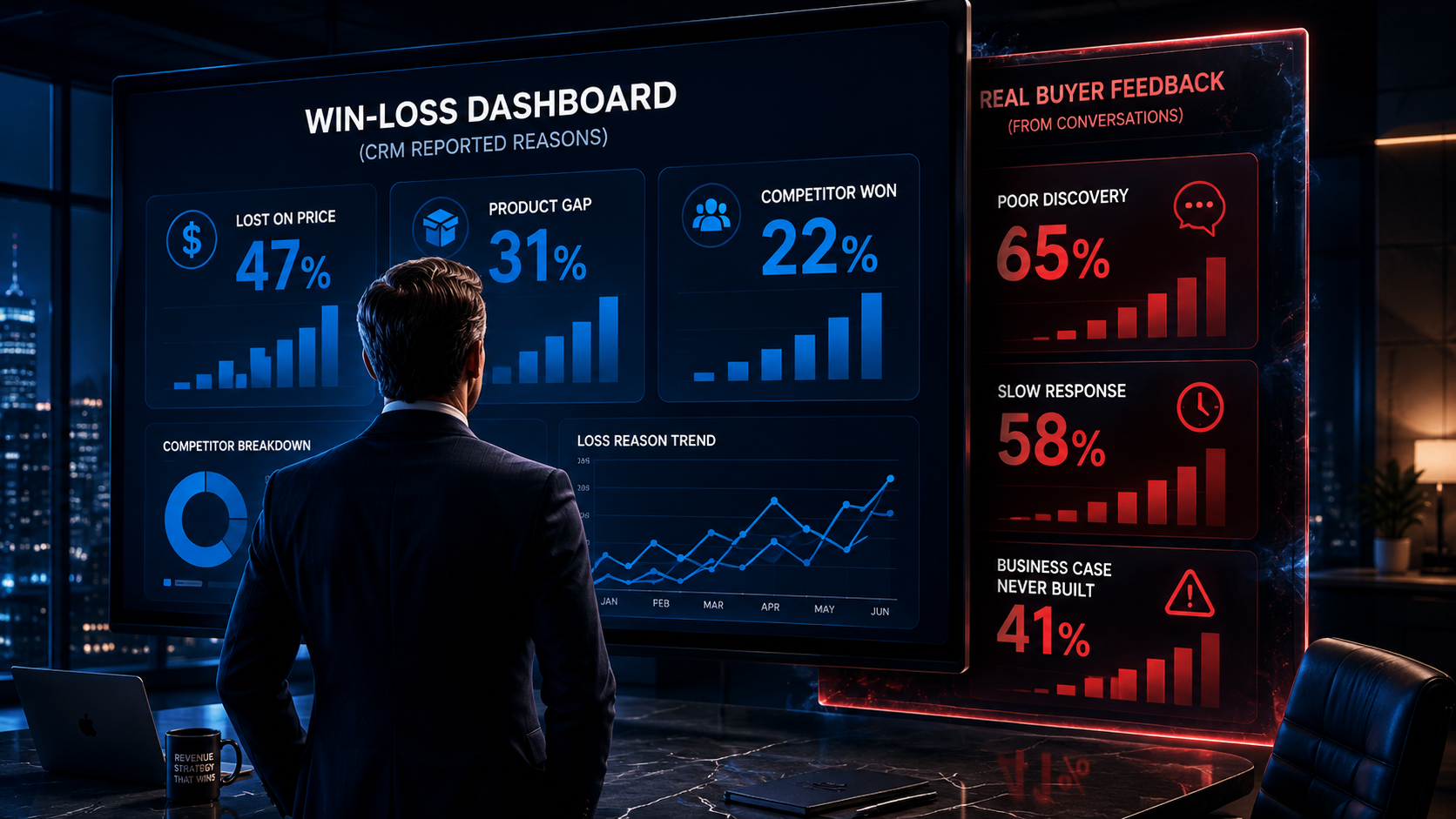
Why Traditional Win-Loss Reporting Often Misses the Truth
Traditional sales reporting explains what happened to an opportunity but often fails to reveal why the buyer made that decision.
A closed-lost record may contain a competitor’s name, an estimated deal value, and a selected reason. However, that information might reflect the representative’s interpretation rather than direct customer feedback.
In December 2025, Forrester highlighted this problem in its research on B2B win-loss programs. Forrester explained that CRM records and sales anecdotes can overlook the underlying reasons behind purchasing decisions.
It recommended combining post-deal interviews, surveys, and sales call transcripts to understand buyer decisions more accurately.
CRM Loss Reasons Often Lack Buyer Context
Most CRM systems allow representatives to select reasons such as budget, pricing, timing, product limitations, or competitor selection.
These categories help organize records, but they rarely capture the complete purchasing decision.
For example, a representative may record a $40,000 software opportunity as lost because of price.
However, an interview might reveal that the buyer could afford the product but could not demonstrate its expected return on investment to the finance department.
The difference matters.
Lowering prices may not solve a problem caused by unclear business value.
A reliable CRM record should distinguish the primary decision driver from other contributing factors.
Sales Representatives May Misinterpret Buyer Feedback
Sales representatives experience deals from the seller’s perspective.
They hear objections, discuss product capabilities, and attempt to move opportunities forward.
However, they may not participate in internal buyer meetings or know which stakeholders ultimately influenced the decision.
This creates room for incomplete interpretations.
For example, a prospect may tell a representative that the organization has postponed its purchase because of budget constraints.
The underlying issue might be that the project lacks executive support or competes with a higher-priority initiative.
That does not mean the representative intentionally entered false information.
It means the explanation was never independently verified.
How Often Do CRM Loss Reasons Disagree With Buyers?
Win-loss research provider Clozd reports that buyer-reported and seller-reported reasons for lost deals aligned in only 15% of the cases examined in its research.
That suggests an 85% disagreement rate within its analyzed data.
This is a vendor-reported finding. It should not be interpreted as proof that 85% of every company’s CRM loss reasons are incorrect.
However, it highlights why sales leaders should verify important conclusions using direct buyer feedback rather than relying on CRM dropdowns alone.
In October 2026, Gartner’s updated Market Guide for Win/Loss Analysis Solutions also identified reducing internal bias and understanding purchasing decision drivers as key purposes of win-loss research.
No-Decision Deals Are Often Misunderstood
Not every lost opportunity ends with a competitor winning.
Sometimes the customer does not purchase any solution.
A competitive loss occurs when the buyer selects another vendor.
A no-decision outcome occurs when the organization does not complete a purchase within the evaluated buying process.
These outcomes require different explanations.
A competitive loss may involve missing capabilities, pricing differences, or stronger competitor positioning.
A no-decision outcome may result from unclear business value, unresolved stakeholder concerns, limited urgency, or a postponed project.
Sales leaders should track these outcomes separately.
This helps prevent businesses from changing competitor messaging when their real problem is helping customers justify a purchase.
What Actually Determines Whether B2B Deals Are Won or Lost?
B2B purchasing decisions usually involve several connected factors rather than one isolated issue.
Understanding those factors helps sales leaders identify which problems they can address.
Product Fit and Business Requirements
Buyers need confidence that a product can solve their business problem.
Product fit includes relevant capabilities, technical compatibility, implementation requirements, and practical business value.
For example, a company evaluating customer support software may require integrations with existing systems.
If those integrations are unavailable, the product may be unsuitable regardless of the sales representative’s performance.
However, companies should verify whether the missing capability was essential or simply preferred.
That distinction helps product teams prioritize genuine purchasing barriers.
Pricing and Return on Investment
Price affects purchasing decisions, but price objections can have different meanings.
A customer may believe the product is too expensive compared with alternatives.
Another may consider the price reasonable but lack approved funding.
A third may have sufficient funds but struggle to justify the investment internally.
These are different situations.
Win-loss interviews should investigate the buyer’s value expectations, financial approval process, and comparison criteria.
A pricing adjustment should be based on evidence that price itself affected the decision.
Competitive Positioning
Prospects often compare several vendors before selecting a solution.
Competitor analysis should identify which capabilities, services, or commercial conditions influenced the outcome.
For example, a buyer might choose a competitor because of implementation support rather than a lower subscription price.
Sales teams should also record whether the competitor was actually evaluated or simply mentioned during discovery.
This improves competitive intelligence and prevents teams from preparing responses to threats that did not materially affect the deal.
Buyer Trust and Internal Consensus
Enterprise purchasing decisions may involve finance, IT, operations, procurement, and executive leadership.
These stakeholders can have conflicting goals.
In May 2025, Gartner reported that 74% of surveyed B2B buying teams experienced unhealthy conflict during their purchasing decisions.
The study surveyed 632 buyers in August and September 2024. It also found that buying groups reaching consensus were 2.5 times as likely to report a high-quality deal.
This does not prove that stakeholder conflict causes every lost opportunity.
However, it demonstrates why sales teams should investigate buyer alignment rather than focusing only on product objections.
Sales Execution and Purchasing Friction
The seller’s process can also influence deal outcomes.
Problems may include incomplete discovery, delayed responses, weak product demonstrations, unclear next steps, or failure to involve the correct decision-makers.
Procurement requirements and contract reviews may create additional delays.
Sales leaders should compare these factors across similar won and lost opportunities to identify repeated problems.
For related improvements, read What Should You Change First in Your B2B Sales Process?.
How to Discover the Real Reasons You Win or Lose Deals
Effective B2B win-loss analysis combines structured CRM information, direct buyer evidence, and sales conversation analysis.
The following seven-step process helps revenue teams understand deal outcomes and turn findings into business improvements.
Step 1: Collect Won, Lost, and No-Decision Opportunities
Start by reviewing completed opportunities in your CRM.
Collect records from a period long enough to represent normal sales cycles.
Include successful purchases, competitive losses, and opportunities that ended without a decision.
Record the deal size, industry, customer segment, product, competitor, sales cycle length, and opportunity owner.
Preserve the original CRM loss reason so it can later be compared with customer feedback.
Avoid reviewing only large deals or opportunities managed by top-performing representatives.
A broader sample helps reveal problems across the entire sales operation.
Step 2: Interview Buyers After Their Decisions
Contact customers and lost prospects after the purchasing outcome becomes known.
Request feedback while the decision is reasonably fresh, often within a few weeks when practical.
Forrester recommends interviews lasting approximately 15 to 30 minutes and short surveys that take less than five minutes.
It also recommends interviewing buyers from both won and lost opportunities.
An independent interviewer can sometimes help buyers feel more comfortable sharing critical feedback.
However, third-party interviews are not automatically unbiased. Interview questions, participant selection, and interpretation still require care.
What Questions Should You Ask During a Win-Loss Interview?
Use open-ended questions that encourage buyers to explain their decisions.
-
What business problem originally led you to evaluate a solution?
-
Which vendors or alternatives did you seriously consider?
-
What were the most important decision criteria?
-
Which product capabilities influenced your evaluation?
-
How did pricing and expected business value affect your decision?
-
Which internal stakeholders participated in the final decision?
-
What concerns remained unresolved during the buying process?
-
What could our company have done differently?
-
If you selected another vendor, what made that option more suitable?
-
If you postponed the purchase, what prevented your organization from moving forward?
Avoid leading questions such as asking whether the buyer rejected the product because it was too expensive.
Allow the buyer to explain the decision in their own words.
Step 3: Analyze Sales Conversations and Discovery Calls
Review available call recordings, transcripts, email exchanges, and other permitted buyer interactions.
Identify recurring concerns and statements about business needs, product capabilities, pricing, competitors, and purchasing requirements.
Pay particular attention to questions that remained unanswered.
For example, several buyers may have requested implementation details that representatives could not provide.
That pattern may point to a sales enablement problem, a product documentation gap, or an actual implementation limitation.
Conversation evidence provides useful context, but it may not contain everything discussed during the buyer’s internal decision process.
Step 4: Compare Buyer Feedback With CRM Records
Review the recorded loss reason alongside the buyer’s explanation.
Keep both records instead of replacing the original entry.
This creates a way to measure differences between seller interpretations and verified buyer feedback.
A structured comparison might look like this:
|
CRM reason |
Buyer feedback |
Possible underlying issue |
|---|---|---|
|
Price too high |
Expected ROI was unclear |
Value communication |
|
Competitor won |
Competitor offered a required integration |
Product fit |
|
No budget |
Project lacked executive approval |
Buying-group alignment |
|
Timing changed |
Implementation concerns remained unresolved |
Purchasing risk |
|
No response |
Buyer selected another vendor earlier |
Follow-up or competitive positioning |
This comparison helps identify whether reporting errors follow a pattern.
For example, one team may repeatedly record pricing objections when buyers are actually concerned about implementation costs.
Step 5: Segment Deals by Customer Characteristics
Different customer groups may make purchasing decisions for different reasons.
Analyze results by industry, company size, product, deal value, buyer role, competitor, and sales stage.
A company serving both small businesses and enterprises may discover that smaller customers are more sensitive to upfront cost.
Enterprise buyers may focus more heavily on compliance, integration requirements, and internal approval.
Do not combine these groups into one conclusion without examining the differences.
Also compare lost opportunities with similar won opportunities.
This helps identify factors associated with successful purchases rather than studying failures in isolation.
Step 6: Validate Recurring Decision Drivers
A few customer comments should not automatically determine business strategy.
Look for patterns across multiple independent accounts.
Check whether the issue appears consistently in similar segments and whether it is associated with won, lost, or stalled opportunities.
Also consider selection bias.
Buyers who agree to interviews may differ from those who refuse. A small set of respondents may not represent the full customer population.
Use conversation evidence, survey feedback, CRM outcomes, and other customer research together.
The goal is to develop well-supported explanations, not claim perfect knowledge of every purchasing decision.
Step 7: Apply Findings and Measure Results
Assign validated problems to the teams best positioned to address them.
Sales leaders can improve discovery and qualification.
Marketing can revise positioning and customer education.
Product teams can investigate missing features or integrations.
Revenue operations can improve reporting, deal stages, and forecasting rules.
Each action should have a responsible owner, a measurable outcome, and a review date.
For example, if buyers repeatedly report unclear ROI, marketing and sales can develop a stronger business case and test whether it improves opportunity progression.
How Can AI Conversation Intelligence Improve Win-Loss Analysis?
AI conversation intelligence can help sales teams review larger volumes of customer interactions and identify patterns that manual analysis might miss.
However, AI should support buyer research rather than replace verification.
Identifying Recurring Buyer Objections
Large language models can analyze transcripts and classify statements related to customer concerns.
For example, AI may identify repeated mentions of implementation complexity, unclear pricing, or missing product capabilities.
These categories help managers locate relevant conversations.
The system should preserve supporting transcript passages so employees can verify each finding.
Detecting Competitor and Pricing Discussions
AI tools can identify competitor names and pricing-related discussions in supported conversation records.
They may also help distinguish between objections, information requests, and positive buying signals.
However, simply mentioning a competitor does not prove that the competitor won the deal.
The analysis must consider what the buyer said and how the final decision unfolded.
Comparing Won and Lost Conversations
Conversation intelligence platforms can connect sales interactions with CRM opportunity outcomes.
For example, Gong provides win-loss analytics that allow authorized users to analyze closed-deal patterns.
Gong’s documentation describes comparisons involving deal outcomes, sales activity, and other recorded factors. Its analytics also require sufficient qualifying closed-deal data to generate certain insights.
These tools can help identify relationships between sales behaviors and outcomes.
However, an observed relationship does not establish that the behavior caused the win or loss.
Validating AI Findings Against Buyer Evidence
AI systems can misinterpret statements, confuse speakers, or miss important context.
For example, a buyer may mention a high price while explaining why a competitor was rejected.
An AI system could incorrectly classify that discussion as a pricing objection against the seller.
Important findings should be reviewed against original transcripts and, when possible, direct buyer feedback.
Use human review for high-impact conclusions involving pricing strategy, product investment, or major changes to sales processes.
For broader applications, see How Can B2B Companies Turn Buyer Conversations Into Actionable GTM Insights?.
How Can Win-Loss Insights Improve Sales and GTM Strategy?
Reliable win-loss intelligence can help several business functions make more informed decisions.
Strengthen Sales Qualification
Buyer feedback may reveal that certain opportunities entered the pipeline before the organization had a clear business need or purchase plan.
Sales teams can use that evidence to improve qualification criteria.
For example, representatives may need to identify financial approval requirements earlier or confirm whether the buyer has established an implementation timeline.
Better qualification can reduce time spent on unsuitable opportunities.
It can also improve pipeline forecasting by reducing the number of deals classified as active without sufficient supporting evidence.
Learn more in How to Improve B2B Sales Pipeline Quality Without More Leads or Headcount.
Improve Discovery and Sales Enablement
Win-loss interviews can reveal questions representatives failed to ask or concerns they did not fully address.
Sales enablement teams can respond through discovery training, objection-handling guides, and product demonstrations.
For example, if enterprise buyers frequently misunderstand how implementation works, representatives may need clearer technical material and better access to solution engineers.
Training should address verified problems rather than simply increasing the number of sales activities.
Refine Marketing and Competitive Positioning
Lost buyers can explain which product differences influenced their vendor selection.
Marketing teams can use this information to improve product comparisons, landing pages, customer case studies, and competitive messaging.
For example, buyers may consistently favor a competitor because its onboarding process is easier to understand.
If the company’s actual onboarding capabilities are competitive, clearer messaging may help.
If the capability is genuinely missing, the issue belongs with product development rather than advertising.
Improve Product and Pricing Decisions
Recurring feature concerns can inform product research and prioritization.
However, not every lost deal should result in a new feature.
Product managers need to assess demand, development costs, customer value, and whether the issue affects the target market.
Pricing decisions require similar care.
A buyer saying the product is expensive does not automatically justify discounting.
The company should first determine whether the underlying problem involves affordability, product fit, expected ROI, or purchasing authority.
What Do Real B2B Win-Loss Case Studies Show?
A documented example comes from AuditBoard, a software company that worked with Clozd to improve its win-loss research.
According to a Clozd case study published on April 24, 2026, AuditBoard discovered that some opportunities were ending without a purchase because buyers could not clearly understand or communicate the solution’s expected business value.
The company used buyer feedback to improve value messaging, sales training, customer stories, and ROI-focused materials.
After several quarters of coordinated improvements, one struggling product experienced a win-rate increase of more than five percentage points.
This is a vendor-reported case study involving multiple business changes, not evidence that win-loss interviews alone caused the improvement.
The example illustrates how identifying a real purchasing barrier can support practical changes across sales and marketing.
Which Metrics Should B2B Sales Leaders Track?
Win-loss programs should measure both the accuracy of buyer intelligence and the business outcomes influenced by resulting decisions.
|
Metric |
Calculation or measurement |
Business purpose |
|---|---|---|
|
Opportunity win rate |
Won deals ÷ (won + lost deals) × 100 |
Sales conversion performance |
|
Competitive win rate |
Wins ÷ wins and losses against a specific competitor × 100 |
Competitive performance |
|
No-decision rate |
No-decision outcomes ÷ evaluated completed opportunities × 100 |
Purchasing indecision |
|
Verified loss-reason coverage |
Deals with verified reasons ÷ eligible completed deals × 100 |
Buyer intelligence coverage |
|
CRM reason agreement |
Matching buyer and seller reasons ÷ compared deals × 100 |
Reporting accuracy |
|
Average sales cycle |
Average time from opportunity creation to outcome |
Deal progression |
|
Win-loss insight implementation |
Completed actions ÷ approved actions × 100 |
Whether insights lead to change |
Use consistent definitions so that no-decision outcomes are not accidentally counted differently across reports.
How Do You Calculate B2B Sales Win Rate?
The common formula is:
Win Rate = [Closed-Won Deals ÷ (Closed-Won + Closed-Lost Deals)] × 100
Suppose a sales team wins 30 deals and loses 70.
Its win rate is 30%.
If the team later wins 35 out of 100 comparable completed opportunities, its win rate increases to 35%.
That represents a five-percentage-point increase, or approximately 16.7% relative improvement.
These figures are illustrative.
Actual comparisons should account for deal size, customer segment, sales cycle length, and opportunity definitions.
How Can Revenue Leaders Calculate Win-Loss Analysis ROI?
A useful calculation is:
ROI = [(Incremental Gross Profit + Verified Cost Savings − Program Costs) ÷ Program Costs] × 100
For example, suppose a company spends $20,000 on buyer interviews, analysis software, and related implementation work.
If changes supported by the program generate $50,000 in additional attributable gross profit, with no other verified savings, the calculated ROI is:
($50,000 − $20,000) ÷ $20,000 × 100 = 150%
This is a hypothetical example, not a reported win-loss program result.
Revenue teams should compare similar opportunity groups and avoid attributing every improvement to the research program.
How Do You Build a Repeatable Win-Loss Analysis Program?
Win-loss intelligence should be an ongoing business process rather than a one-time quarterly report.
Revenue operations can coordinate CRM data and reporting. Product marketing can lead buyer research and competitive analysis. Sales leadership should help implement improvements.
A practical operating rhythm includes regular collection of completed deal records, prompt buyer feedback requests, conversation review, and a cross-functional findings meeting.
Every review should identify which conclusions are supported by evidence and which require further research.
Store findings in a searchable repository connected to relevant accounts and opportunity outcomes.
For recurring issues, assign a responsible team and review the result after implementation.
This helps companies avoid collecting customer feedback that never influences business decisions.
What Mistakes Should Companies Avoid in Win-Loss Analysis?
Several common mistakes reduce the reliability of win-loss findings.
Relying only on sales rep explanations: Internal feedback is valuable, but it may not reflect the buyer’s full decision process.
Interviewing only lost customers: Won deals also reveal what buyers value and why they select a solution.
Ignoring no-decision outcomes: These opportunities may reveal problems with urgency, purchasing risk, or internal approvals.
Using leading interview questions: Questions should allow buyers to describe the reasons for their choices without being directed toward a preferred explanation.
Generalizing from a small sample: A few interviews can reveal useful hypotheses but may not represent the broader customer population.
Treating AI summaries as verified facts: Automated findings require supporting evidence and human review.
Failing to act on feedback: Research has limited commercial value if the organization does not use it to improve decisions.
Companies must also protect buyer information.
The Reporters Committee recording law guide explains that U.S. recording consent requirements vary by state and circumstance.
Before recording or analyzing conversations, organizations should establish appropriate consent practices, access controls, retention rules, and data security safeguards.
How Can XYNEXI Help Capture Better Buyer Decision Intelligence?
XYNEXI provides Human AI technology designed to conduct buyer conversations and support sales engagement.
According to its official website, XYNEXI captures and analyzes buyer interactions to identify customer motivations, objections, decision drivers, and messaging effectiveness.
These capabilities can help organizations preserve useful information during buyer engagement rather than relying entirely on a salesperson’s later recollection.
For example, information collected during an AI qualification conversation may help reveal which business problems the prospect considers important.
That context can support more informed sales handoffs and subsequent analysis.
However, capturing buyer conversations is not the same as independently verifying why a deal was won or lost.
A reliable win-loss program should still connect conversation records with final purchasing outcomes and direct buyer feedback.
Organizations evaluating XYNEXI should confirm its available conversation analytics, CRM integrations, evidence retention, reporting capabilities, and human review controls.
The value to measure is whether the system provides trustworthy buyer information that helps sales, marketing, and product teams make better decisions.
Explore XYNEXI to learn about its buyer engagement and decision intelligence approach.
Conclusion
B2B sales teams often struggle to understand why they win or lose deals because traditional reporting captures outcomes more reliably than purchasing decisions.
CRM loss reasons, sales representative interpretations, and incomplete feedback can hide the factors that actually influence buyers.
Structured win-loss analysis addresses this problem by combining CRM records, direct customer interviews, surveys, and permitted sales conversation evidence.
AI can help identify patterns across larger volumes of interactions, but important findings still require verification.
Revenue leaders should use these insights to improve qualification, discovery, competitive positioning, product decisions, and sales execution.
The goal is not to create more detailed reports. It is to understand what buyers value, why purchasing decisions succeed or fail, and which business changes can improve future outcomes.
Frequently Asked Questions
1. Why Don’t B2B Sales Teams Know the Real Reasons They Lose Deals?
B2B sales teams often rely on CRM loss reasons and salesperson interpretations rather than direct buyer feedback. Representatives may not know about internal disagreements, competitor advantages, or purchasing concerns discussed outside sales meetings. Structured buyer interviews and conversation analysis help reveal additional decision factors and improve the accuracy of win-loss reporting.
2. What Is B2B Win-Loss Analysis?
B2B win-loss analysis is the process of researching why customers choose a vendor, select a competitor, or decide not to purchase. It combines deal outcomes, buyer interviews, surveys, and sales conversation evidence to identify decision drivers. Companies use these findings to improve sales strategy, product positioning, qualification, and customer experience.
3. Why Are CRM Loss Reasons Often Inaccurate?
CRM loss reasons may be incomplete because they rely on fixed categories and information available to the salesperson. Buyers can have several reasons for a purchasing decision, including concerns they never share directly with the seller. Recording multiple contributing factors and comparing CRM explanations with buyer feedback helps improve reporting reliability.
4. How Can AI Conversation Intelligence Identify Lost-Deal Reasons?
AI conversation intelligence can analyze permitted sales transcripts to identify repeated objections, competitor mentions, pricing discussions, and buyer requirements. These findings can be compared with CRM outcomes to identify patterns. However, AI cannot automatically determine every final purchasing reason. Human review and direct buyer feedback remain important for confirming conclusions.
5. What Questions Should You Ask Buyers After Winning or Losing a Deal?
Ask buyers what problem prompted their search, which alternatives they considered, what criteria mattered most, who participated in the decision, and what influenced the final outcome. Also ask what your company could have done differently. Open-ended questions generally provide more useful explanations than questions that suggest a specific reason for the decision.
6. How Can Win-Loss Analysis Improve B2B Sales Win Rates?
Win-loss analysis can help improve sales win rates by identifying recurring problems in qualification, discovery, product fit, competitive positioning, and buyer decision processes. Sales and marketing teams can use verified feedback to address those problems and test improvements. Higher win rates are possible, but the results depend on how effectively the findings are implemented and measured.