
B2B companies can spend thousands acquiring leads, only to lose momentum while sales teams verify customer fit and purchasing needs. Delayed qualification leaves interested buyers waiting, increases manual work, and creates revenue risk that CRM reports often fail to explain clearly.
How Much Does Delayed Lead Qualification Cost B2B Companies?
Delayed lead qualification can cost B2B companies thousands of dollars in potential revenue each month, depending on lead volume, conversion rates, deal value, and qualification delays. The financial impact includes missed sales opportunities, wasted SDR capacity, higher customer acquisition costs, and slower pipeline progression. Companies can estimate the cost by comparing qualification rates, downstream win rates, and gross profit across similar buyer groups.
There is no reliable universal dollar amount for the cost of delayed qualification.
A company receiving 100 qualified inquiries each month will have different financial exposure from an enterprise SaaS company processing thousands of leads.
The real cost depends on how delays affect the number of suitable buyers who progress into sales opportunities and eventually become customers.
A lead waiting in the CRM is not automatically lost revenue. The financial impact must be established through actual conversion data and reasonable comparisons.
For chief revenue officers (CROs), sales directors, and revenue operations leaders, the first priority is identifying where qualification slows down and which delays affect business results.
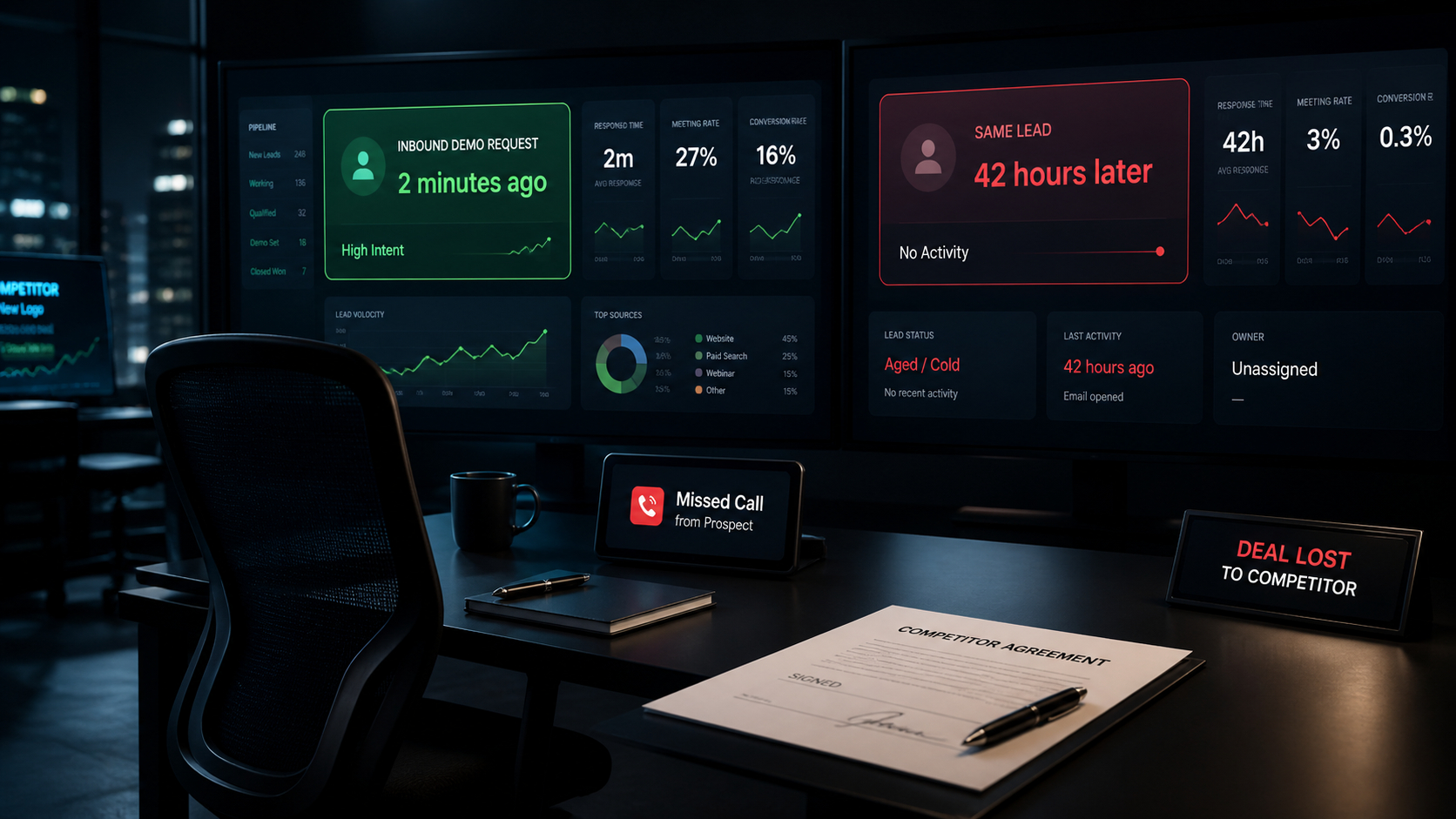
What Is Delayed Lead Qualification in B2B Sales?
Delayed lead qualification occurs when a business takes too long to determine whether an interested prospect is a suitable potential customer.
The process typically involves understanding the buyer’s business problem, company fit, product requirements, purchasing timeline, and decision-making responsibilities.
For example, a prospect may request a product demonstration on Monday.
Marketing captures the inquiry immediately, but an SDR does not begin qualification until Wednesday.
The buyer has expressed interest, yet the company has not established whether the prospect meets its sales criteria.
This delay can prevent timely access to useful information or a suitable sales representative.
Lead Response Time vs. Lead Qualification Time
These measurements are related but different.
Lead response time measures how long a buyer waits before receiving a meaningful initial response.
Lead qualification time measures how long it takes to reach a supported qualification decision.
A company can respond within seconds and still take several days to complete qualification.
For example, an automated email may confirm that a demo request was received.
However, if the buyer waits two days for discovery, the main qualification delay remains unresolved.
What Is a Sales Handoff Delay?
A sales handoff delay occurs after the prospect has met qualification criteria but before the appropriate representative accepts or acts on the opportunity.
For example, an SDR may confirm the buyer’s requirements and timeline on Tuesday.
If the account executive receives the information on Friday, the buyer experiences another delay.
These three timing problems should be measured separately.
| Type of delay | What happens | Main business risk |
|---|---|---|
| First-response delay | Buyer waits for meaningful contact | Questions remain unanswered |
| Qualification delay | Buyer engages but waits for a qualification decision | Suitable prospects may disengage |
| Sales handoff delay | Qualified prospect waits for the next sales action | Opportunity progression slows |
How Does Delayed Qualification Cause Lost Sales Opportunities?
Qualification delays can create revenue risk at different stages of the buyer journey.
The impact depends on how the buyer responds, whether their needs remain active, and how the company’s sales process handles the opportunity.
Buyers May Continue Evaluating Competitors
B2B customers frequently compare several vendors before purchasing.
When one company delays qualification, the buyer may continue gathering information from alternatives.
A competing vendor could answer an important question or schedule a useful discussion sooner.
However, faster engagement does not guarantee that the competing vendor will win.
Product fit, price, reputation, and existing customer preferences also influence the purchasing decision.
High-Intent Prospects Can Remain Unworked
Some inquiries contain specific purchasing signals.
For example, a prospect may request pricing for 50 software licenses and explain that implementation must happen before an existing contract expires.
If the inquiry remains in an unassigned queue, the company may miss an opportunity to evaluate an active project.
This is particularly concerning when the prospect has already requested assistance.
Slow Qualification Can Reduce Meeting Conversion
Buyers may lose interest in scheduling a meeting when the process requires repeated forms, unnecessary calls, or lengthy delays.
For example, a prospect may explain their requirements in a website form but be asked to repeat the same information during an SDR call.
Poor handoffs add friction without helping the buyer.
A more efficient process preserves relevant information and connects the customer with the appropriate next action.
Pipeline Quality Can Suffer
Delayed qualification can also affect CRM reporting.
When prospects remain in unclear stages, sales leaders may struggle to determine whether they represent active demand or early research.
Poor qualification records can result in opportunities being created without enough supporting evidence.
This may inflate the apparent value of the sales pipeline.
Sales Forecasting Becomes Less Reliable
Forecasting depends on accurate opportunity information.
If a company cannot distinguish an unqualified inquiry from an active buying process, projected revenue becomes less reliable.
Clear qualification criteria and timely CRM updates help revenue leaders understand which opportunities deserve attention.
What Does Research Say About Slow Lead Response and Qualification?
Research supports an association between timely lead engagement and stronger qualification outcomes.
However, the strongest widely cited studies examine the timing of initial contact, not the independent financial cost of delays after discovery has begun.
That distinction is important.
Harvard Business Review: The First Hour Matters
The 2011 Harvard Business Review study, The Short Life of Online Sales Leads, examined approximately 1.25 million online sales leads received by 42 companies.
Researchers found that businesses attempting contact within one hour were nearly seven times as likely to qualify a lead as those waiting at least another hour.
They were more than 60 times as likely to qualify leads as companies waiting 24 hours or longer.
The research defined qualification around meaningful contact with a decision-maker.
It did not establish that faster contact produced equivalent increases in closed revenue.
The study is also historical and should not be presented as a measured 2026 industry average.
InsideSales: The Five-Minute Response Window
The InsideSales 2021 Lead Response Study reviewed more than 55 million sales activities involving 5.7 million inbound leads across over 400 companies.
The vendor reported that conversion rates were approximately eight times higher when contact was attempted during the first five minutes compared with attempts between five minutes and 24 hours.
This is vendor-reported observational research.
It does not mean that every B2B company will generate eight times more revenue by responding within five minutes.
Nevertheless, the study supports investigating whether slow engagement is limiting qualification opportunities.
6sense: Buyers Often Have Preferences Before Sales Contact
The 2025 6sense Buyer Experience Report found that:
-
94% of buying groups ranked vendors before their first seller conversation.
-
79% of buyers initiated their first interaction with sellers.
-
The vendor preferred before sales engagement ultimately won approximately 77% of purchases.
These findings show that B2B buyers often conduct substantial research before requesting sales assistance.
They also challenge the popular claim that responding first automatically wins the deal.
Buyers frequently contact their preferred vendor first because they already favor that company.
The lesson for sales teams is to respond helpfully when buyers seek assistance, not assume that speed alone changes vendor preference.
What Do These Studies Not Prove?
The available research does not establish one universal percentage of revenue lost due to delayed qualification.
It also does not prove that every unanswered inquiry would have become a customer.
Businesses should use their own qualification and revenue data to estimate financial exposure.
How to Calculate the Financial Cost of Delayed Lead Qualification
A useful financial model connects qualification delays with downstream sales outcomes.
The following process estimates potential revenue differences rather than treating every delayed lead as a lost deal.
Step 1: Measure the Qualification Conversion Gap
Separate comparable buyers based on how quickly they received a qualification decision.
For example, one group may be qualified within the company’s agreed service standard.
Another may experience longer delays.
Calculate each group’s qualification rate.
Qualification Rate = (Qualified Buyers ÷ Eligible Leads) × 100
Then calculate the difference:
Qualification Gap = Timely Qualification Rate − Delayed Qualification Rate
Suppose timely qualified inquiries have a 20% qualification rate, while delayed inquiries have a 16% rate.
The gap is four percentage points.
That difference may represent an opportunity for improvement, but the company must investigate whether the groups had similar customer fit and purchase intent.
Step 2: Estimate Additional Qualified Buyers
Multiply the eligible inquiry volume by the qualification gap.
Potential Additional Qualified Buyers = Eligible Leads × Qualification Gap
Use the qualification gap as a decimal.
For example:
1,000 × 0.04 = 40 potential additional qualified buyers.
This is a modeled difference, not proof that 40 customers were lost.
Step 3: Estimate Additional Sales Opportunities
Not every qualified buyer becomes an accepted sales opportunity.
Apply the observed qualified-buyer-to-opportunity conversion rate.
Potential Additional Opportunities = Additional Qualified Buyers × Opportunity Conversion Rate
If 50% of qualified buyers become opportunities:
40 × 0.50 = 20 potential additional opportunities.
Step 4: Apply the Opportunity Win Rate
Use the relevant historical win rate to estimate how many of those opportunities might become customers.
Expected Additional Deals = Potential Additional Opportunities × Win Rate
If the opportunity win rate is 25%:
20 × 0.25 = 5 expected additional deals.
This is an expected-value estimate, not five verified lost customers.
Step 5: Calculate the Potential Revenue Difference
Multiply the expected additional deals by average revenue per won deal.
Expected Revenue Difference = Expected Additional Deals × Average Deal Revenue
If average deal revenue is $6,000:
5 × $6,000 = $30,000.
This represents a possible monthly revenue difference under the model’s assumptions.
For subscription businesses, use a consistent revenue measure, such as first-year contract revenue or recognized revenue.
Do not confuse annual contract value with monthly revenue.
Step 6: Convert Revenue Into Gross Profit
Revenue does not equal profit.
Apply the company’s gross margin.
Expected Gross Profit Difference = Expected Revenue Difference × Gross Margin
If gross margin is 70%:
$30,000 × 0.70 = $21,000.
This gives an estimated monthly gross profit difference before the additional expenses of improving qualification.
Example: How Much Could Delayed Qualification Cost a B2B SaaS Company?
Consider a hypothetical SaaS company receiving 1,000 eligible inbound inquiries every month.
It wants to estimate the possible financial effect of improving qualification speed.
| Metric | Illustrative value |
|---|---|
| Eligible monthly inquiries | 1,000 |
| Timely qualification rate | 20% |
| Delayed qualification rate | 16% |
| Qualification rate difference | 4 percentage points |
| Potential additional qualified buyers | 40 |
| Qualified buyer-to-opportunity conversion | 50% |
| Potential additional opportunities | 20 |
| Opportunity win rate | 25% |
| Expected additional closed deals | 5 |
| Revenue per closed deal | $6,000 |
| Expected monthly revenue difference | $30,000 |
| Assumed gross margin | 70% |
| Expected monthly gross profit difference | $21,000 |
Important: These figures are hypothetical, not industry benchmarks or verified XYNEXI results.
The calculation assumes that the four-percentage-point qualification gap is caused by delay and that downstream conversion rates remain unchanged.
Actual outcomes could be lower or higher.
For example, the timely group might contain more high-intent buyers, which could explain part of its higher qualification rate.
Does This Mean the Company Is Losing $21,000 Every Month?
Not necessarily.
The calculation identifies a potential financial opportunity.
It does not prove that $21,000 in gross profit was lost specifically because of qualification delays.
To strengthen the estimate, the company should compare similar leads or run a controlled test of its qualification process.
How Does Delayed Qualification Affect Customer Acquisition Cost?
Customer acquisition cost (CAC) measures the cost of acquiring new customers.
CAC = Total Applicable Acquisition Costs ÷ New Customers Acquired
Suppose a business spends $50,000 on customer acquisition and gains 25 customers.
Its CAC is $2,000.
If it acquires 30 comparable customers with the same acquisition spending, CAC falls to approximately $1,667.
That represents a reduction of about 16.7%.
However, if the improved process requires additional software or labor expenses, those costs must be included.
Qualification efficiency does not automatically reduce CAC unless it improves the full acquisition economics.
Where Do B2B Companies Experience the Largest Qualification Delays?
The biggest qualification bottleneck may appear before, during, or after the first meaningful conversation.
Revenue operations teams should investigate each stage separately.
Manual Lead Assignment
Some companies rely on employees to review incoming inquiries and assign them to SDRs.
This can create delays when lead volume rises or employees are unavailable.
Automated routing based on territory, account ownership, and customer fit can reduce unnecessary waiting.
Lengthy Qualification Forms
Buyers may abandon a process that requests too much information before providing assistance.
A prospect asking about an integration may not want to complete a long form about budget and company revenue.
Progressive qualification allows businesses to collect relevant information during a conversation rather than requiring everything upfront.
Repetitive Discovery Questions
Marketing, SDRs, and account executives may ask the same questions during separate interactions.
This wastes employee time and creates a poor buyer experience.
Connected CRM records and structured summaries can preserve information already shared.
Poor CRM Data Quality
Duplicate contacts, missing company information, outdated records, and incorrect ownership can prevent efficient routing.
For example, a new inquiry may be assigned to the wrong territory because the account information is incomplete.
Data quality checks can reduce these problems.
Unclear Marketing-to-Sales Responsibilities
Some companies do not have a shared definition of a sales-qualified lead.
Marketing may consider a high engagement score sufficient.
Sales may require a confirmed business problem and active purchasing context.
Without agreement, qualified prospects may sit in the CRM waiting for additional review.
Delayed SDR-to-AE Handoffs
An SDR may finish qualification but fail to assign the opportunity promptly.
The prospect then waits for another representative to respond.
This can happen even when the qualification conversation itself was efficient.
How Can Sales Teams Prevent Qualification Handoff Delays?
Handoffs require clear ownership, accurate buyer information, and agreed response standards.
Establish Service-Level Agreements
A service-level agreement (SLA) defines what one team must deliver before another accepts an opportunity.
It can also specify assignment rules, response expectations, escalation conditions, and responsibility for rejected opportunities.
In its November 2025 report, Buying Group Service-Level Agreements 101, Forrester recommends documented agreements for moving buying-group opportunities between revenue teams.
Forrester emphasizes that both sending and receiving teams should agree on the requirements.
Define Sales Qualification Clearly
HubSpot’s lifecycle stage documentation distinguishes marketing-qualified leads, sales-qualified leads, opportunities, and customers.
An MQL is a prospect that marketing considers ready for sales attention.
An SQL is a prospect that sales considers a potential customer.
An opportunity is associated with a potential deal.
These stages should not be treated as interchangeable.
A qualified lead waiting for assignment is not necessarily a closed-lost opportunity.
Preserve Buyer Context
A useful handoff should include the buyer’s business problem, company information, relevant requirements, purchase timeline, known stakeholders, unresolved concerns, and agreed next action.
This helps the receiving representative prepare without repeating basic discovery.
How to Reduce Delayed Lead Qualification in 7 Steps
Reducing qualification delays requires better process design, clear sales ownership, and suitable technology.
The following seven steps provide a practical improvement framework.
Step 1: Measure Current Time to Qualification
Start with actual CRM timestamps.
Record when a suitable inquiry arrives, when the first meaningful response occurs, and when a qualification decision is documented.
Also record when the qualified opportunity is accepted by sales.
Measure median times and investigate unusually long delays.
Step 2: Prioritize High-Intent Inquiries
Not every visitor needs immediate direct sales qualification.
Prioritize suitable prospects requesting demonstrations, proposals, pricing information, or assistance with active purchasing projects.
Combine buyer intent with ICP fit.
A high-urgency prospect who cannot use the product may not justify the same attention as a suitable buyer with an active evaluation.
Step 3: Establish Shared Qualification Criteria
Marketing, SDRs, account executives, and revenue operations should agree on what makes a prospect sales-qualified.
The criteria may include business need, company fit, purchasing context, and appropriate next steps.
Frameworks such as BANT and MEDDICC can help organize discovery.
However, missing information should not be invented simply to complete a checklist.
Step 4: Provide Timely Buyer Assistance
Make it easy for interested buyers to ask questions and receive relevant information.
Options may include accessible product documentation, website assistance, qualified representatives, or conversational AI.
Avoid forcing every visitor into a sales interaction.
The objective is to provide useful assistance when the buyer needs it.
Step 5: Automate Appropriate Qualification Tasks
AI and workflow automation can help collect initial requirements, organize prospect information, update permitted records, and route inquiries.
For example, a properly configured AI agent may ask about the buyer’s business problem and implementation timeline.
It can then prepare a qualification summary.
However, the system should escalate uncertain or complex issues to humans.
Step 6: Improve CRM Routing and Handoffs
Assign clear ownership for each inquiry and qualification outcome.
Use automated notifications and appropriate escalation rules where supported.
Make sure account executives receive verified customer context.
Test workflows to prevent duplicate records, missed assignments, and incorrect stage updates.
Step 7: Test Conversion and Revenue Impact
Compare the improved workflow with the previous process using similar buyers.
Measure qualification completion, sales acceptance, opportunity conversion, and eventual closed revenue.
Track implementation and operating costs.
Continue monitoring after the initial pilot to determine whether the improvements remain consistent.
How Can AI Reduce B2B Lead Qualification Delays?
AI sales agents can support several parts of the qualification process, but their effectiveness depends on system design and information quality.
Real-Time Buyer Conversations
Conversational AI can respond to supported buyer questions and begin collecting requirements without waiting for a representative.
For example, a buyer may ask about product capabilities outside normal business hours.
The system can provide approved information and help identify the appropriate next step.
Conversational Intent Detection
Natural language processing and large language models can help identify stated business needs, evaluation activity, timelines, and other purchasing signals.
For example, the statement “We need to implement a solution next month” provides a potential urgency signal.
However, that statement does not prove the buyer has budget approval.
The AI should clarify missing details when necessary.
Context-Aware Qualification
AI can adapt its questions using the buyer’s previous responses.
This may reduce repetitive discovery.
For example, if a prospect has already provided their company size and CRM, the system should not ask for the same information again without a reason.
Intelligent Sales Routing
Where integrations permit, a qualification system can prepare buyer summaries and assign suitable prospects to the appropriate sales representative.
This can reduce manual handling after qualification.
Human Review and Accuracy Controls
Fast qualification is not useful if it produces inaccurate opportunities.
AI may misunderstand statements, assign incorrect intent, or overlook important requirements.
Businesses should test qualification accuracy, maintain clear escalation rules, and review important decisions.
Which KPIs Reveal the Cost of Delayed Qualification?
A useful qualification dashboard should connect time-based performance with sales outcomes.
| KPI | What it measures |
|---|---|
| Median first-response time | Typical wait before meaningful buyer contact |
| Median time to qualification | Typical time from eligible inquiry to qualification decision |
| Qualification completion rate | Eligible leads receiving documented qualification outcomes |
| High-intent lead coverage | Suitable high-intent inquiries receiving appropriate qualification activity |
| Sales handoff delay | Time between qualification and sales acceptance or action |
| Qualification-to-opportunity conversion | Qualified buyers progressing to accepted opportunities |
| Conversion by delay group | Conversion rates for buyers qualified within different time ranges |
| Unworked inquiry rate | Eligible inquiries receiving no qualification action within the defined period |
| Qualified pipeline value | Value of opportunities meeting agreed qualification criteria |
| Closed-won revenue | Revenue from completed purchases |
| Incremental gross profit | Attributable financial gain after delivery costs |
How Do You Calculate Median Time to Qualification?
Record the elapsed time between inquiry creation and documented qualification for eligible leads.
Arrange those times from shortest to longest.
The median is the middle value.
For example, five buyers may be qualified after 10, 20, 30, 60, and 300 minutes.
The median qualification time is 30 minutes.
The average is 84 minutes.
Both measurements are useful, but they describe different aspects of performance.
Revenue teams should also examine the 90th percentile to understand how long the slowest group of buyers waits.
How Can Companies Compare Conversion by Delay?
Group comparable inquiries according to their qualification time.
For example, a company might examine:
-
Qualified within 15 minutes.
-
Qualified between 15 minutes and two hours.
-
Qualified between two and 24 hours.
-
Qualified after more than 24 hours.
Compare accepted opportunities and eventual purchasing outcomes.
These are analytical categories, not universal service standards.
Importantly, record when a buyer became eligible for qualification so that the timing comparison uses a consistent starting point.
Why Can Simple Comparisons Be Misleading?
Sales teams may prioritize the most promising prospects.
Those buyers can receive faster qualification and have higher conversion rates because they were already better opportunities.
This creates selection bias.
A company should not assume that the entire conversion difference was caused by qualification speed.
Use comparable cohorts or a controlled test to strengthen the analysis.
How to Audit Qualification Delays in 30 Days
A focused 30-day audit can help businesses identify the most important bottlenecks.
It may take longer to confirm final revenue impact for companies with extended sales cycles.
Days 1 to 7: Collect Baseline Data
Review recent CRM records in Salesforce, HubSpot, or the existing sales platform.
Measure first-response time, qualification time, handoff delay, and opportunity conversion.
Identify leads that remain unassigned or have incomplete qualification outcomes.
Days 8 to 14: Find the Largest Delay
Compare performance across lead sources, qualification stages, customer segments, and assigned teams.
Determine whether the main problem involves initial contact, discovery, lead ownership, or sales handoffs.
Choose one high-impact workflow for improvement.
Days 15 to 21: Test a Faster Process
Introduce clearer ownership, streamlined discovery, or appropriate automation.
For example, a company may automate routing for suitable demo requests while keeping technical qualification under human control.
Record response accuracy and buyer feedback.
Days 22 to 30: Evaluate Early Results
Compare qualification speed and conversion against the baseline or a suitable control group.
Review whether more prospects meet the company’s actual sales criteria.
Check that faster processing does not generate poor-quality opportunities.
Continue tracking the same prospects through the sales cycle before assigning a final revenue impact.
What Mistakes Should Companies Avoid When Improving Qualification Speed?
Speed is useful only when it helps buyers receive relevant assistance and produces reliable sales decisions.
Counting automatic replies as qualification: An acknowledgment does not establish customer fit or purchasing readiness.
Prioritizing every lead equally: General research inquiries may not require the same response as active purchasing requests.
Using long qualification scripts: Excessive questioning can create unnecessary buyer friction.
Ignoring missing information: AI and sales representatives should not assume budget approval or purchasing authority without evidence.
Measuring only meeting volume: More meetings do not automatically mean stronger pipeline or greater revenue.
Treating pipeline value as lost revenue: A potential opportunity is not the same as a completed purchase.
Removing human oversight: Complex technical, legal, and commercial questions may require experienced employees.
Ignoring buyer preferences: Some customers prefer self-service information instead of immediate direct sales contact.
In March 2026, Gartner reported that 67% of surveyed B2B buyers preferred a sales experience without direct representative involvement.
Companies should therefore offer useful self-service options while making expert assistance available when needed.
How Does XYNEXI Support Faster B2B Lead Qualification?
XYNEXI is an autonomous AI SDR and BDR platform built around its AIRPEC multi-agent reasoning engine.
Its published capabilities focus on outbound prospect research, personalized engagement, conversational discovery, qualification, objection handling, and purchase intent verification.
Reducing Manual Outbound Qualification Work
According to XYNEXI’s official platform overview, AIRPEC coordinates several stages of the outbound sales process.
These include lead enrichment, buyer engagement, qualification, and the delivery of qualified prospects to human sales teams.
This approach is designed to reduce manual SDR activity and help companies engage more prospects without requiring human employees to execute every early sales task.
Identifying Buyer Intent Through Conversations
XYNEXI describes using adaptive conversations to identify customer needs, purchasing signals, and objections.
Its Human AI™ technology is designed to respond to prospect context and conduct qualification through direct dialogue.
This relates to the cost of delayed qualification because conversational engagement can reduce the need for separate manual discovery steps where the supported workflow is appropriate.
Providing Context to Human Representatives
XYNEXI’s Human-In-The-Loop model keeps people responsible for strategy, relationships, pricing authority, and contract execution.
The platform describes transferring qualified, intent-confirmed buyers to human sales representatives with relevant conversation information.
A useful handoff can reduce repeated discovery and help the representative focus on unresolved requirements.
Can XYNEXI Eliminate Every Lead Qualification Delay?
No platform should be assumed to eliminate every delay.
XYNEXI’s public positioning primarily focuses on autonomous outbound sales development.
Businesses requiring particular inbound website workflows, CRM integrations, or scheduling capabilities should confirm those features before deployment.
Even when automation speeds up qualification, buyers may still need time for technical reviews, internal approval, or commercial negotiations.
The appropriate performance measures include qualification accuracy, accepted opportunities, sales cycle progression, and actual financial outcomes.
The goal is to reduce avoidable waiting and manual work while maintaining reliable qualification decisions.
Explore how XYNEXI works to learn more about its AI sales engagement and qualification approach.
Conclusion
Delayed lead qualification can create significant financial risk for B2B companies by leaving interested buyers unqualified, delaying sales handoffs, and consuming valuable selling capacity.
However, the exact cost is not a universal percentage or fixed dollar amount.
It depends on lead volume, buyer quality, qualification conversion, opportunity win rates, average deal value, and gross margin.
Research from Harvard Business Review and InsideSales supports the importance of timely initial engagement.
Modern buyer research from 6sense and Gartner also shows that customers conduct independent evaluations and value control over their purchasing experience.
The most effective response is not simply to make sales representatives work faster.
Companies should identify qualification bottlenecks, establish shared criteria, improve CRM routing, automate suitable tasks, and preserve buyer context.
Revenue leaders must also distinguish potential lost pipeline from verified revenue loss.
The financial value of faster qualification becomes clear when businesses can demonstrate that better-timed, accurate engagement produces more qualified opportunities and profitable customers.
Frequently Asked Questions
1. What Is the Cost of Delayed Lead Qualification in B2B Sales?
The cost of delayed lead qualification depends on the company’s lead volume, conversion performance, average deal value, gross margin, and sales process. Delays may contribute to missed opportunities, wasted selling capacity, and higher acquisition costs. Companies should estimate the impact using comparable qualification rates and completed sales outcomes rather than treating every delayed inquiry as lost revenue.
2. How Does Slow Lead Qualification Affect Conversion Rates?
Slow qualification can delay useful buyer conversations, create unnecessary friction, and postpone sales handoffs. Some prospects may continue evaluating alternatives or disengage before receiving assistance. Historical research shows an association between faster initial contact and stronger qualification outcomes. However, the independent effect of delayed qualification should be measured using the company’s own customer and sales data.
3. How Can Companies Calculate Revenue Lost From Delayed Qualification?
Estimate the difference between timely and delayed qualification rates for comparable leads. Multiply the difference by eligible lead volume, qualified-buyer-to-opportunity conversion, opportunity win rate, and average deal revenue. Apply gross margin to estimate the financial value. This produces a modeled revenue difference, not verified lost sales, unless the effect of delay is supported by reliable evidence.
4. What Causes Qualified Sales Opportunities to Be Missed?
Common causes include slow lead routing, unclear ownership, lengthy qualification forms, repetitive discovery questions, incomplete CRM records, and delayed SDR-to-account executive handoffs. Opportunities may also be overlooked when marketing and sales use different qualification standards. Shared lifecycle definitions, reliable customer information, documented SLAs, and clear escalation rules can help reduce these problems.
5. Can AI Sales Agents Reduce Lead Qualification Delays?
Yes. Appropriately configured AI sales agents can support buyer engagement, collect qualification information, identify purchasing signals, and prepare handoffs. Some systems also support CRM updates and automated routing. Their effectiveness depends on accurate product knowledge, reliable integrations, appropriate permissions, and human review. AI should not classify buyers as qualified without sufficient evidence.
6. How Can B2B Companies Measure and Improve Time to Qualification?
Track the time between an eligible inquiry and a documented qualification decision. Measure median response time, median qualification time, handoff delays, and conversion rates across comparable timing groups. Identify the largest bottleneck, introduce a focused improvement, and compare results with the previous workflow or a control group. Continue monitoring sales acceptance, customer experience, and closed revenue.