
B2B buyers research vendors, compare solutions, and ask questions long before sales teams respond. Delayed lead routing and disconnected marketing systems can miss those moments. A real-time go-to-market model connects buyer signals, conversations, and sales actions so qualified opportunities receive timely attention.
How Does a Real-Time GTM Model Turn Buyer Interest Into Qualified Leads?
A real-time go-to-market (GTM) model helps B2B companies turn buyer interest into qualified leads by detecting relevant buying signals, connecting customer data, starting useful conversations, and routing suitable prospects to sales. It combines CRM information, buyer intent, marketing automation, and AI-assisted engagement to deliver timely responses based on customer needs rather than fixed campaign schedules.
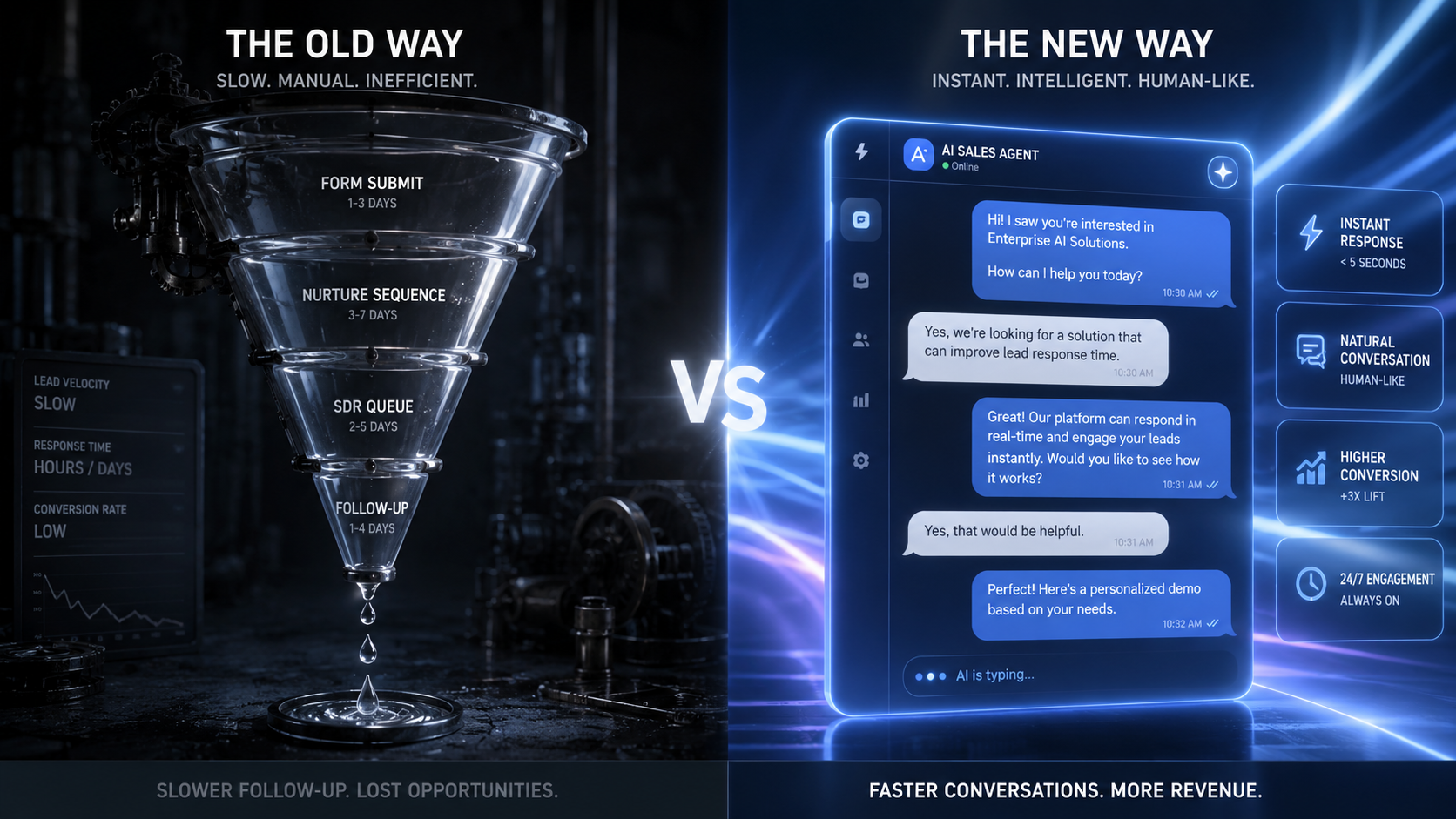
Traditional go-to-market strategies often rely on planned campaigns, lead capture forms, scoring systems, and scheduled follow-ups.
A real-time GTM approach connects these activities so the business can respond when relevant buyer signals appear.
For example, a prospect may ask about an integration while reviewing a product page.
Instead of waiting for a manual lead review, the system can provide approved product information, collect relevant requirements, and offer an appropriate next step.
The goal is not to contact every visitor immediately.
It is to identify genuine buyer needs and connect them with useful actions while the information remains relevant.
What Is a Real-Time Go-to-Market Model?
A real-time go-to-market model is a coordinated marketing and sales approach that uses current buyer signals, connected customer information, and timely actions to support purchasing decisions.
It connects the main parts of the revenue process: marketing, sales development, account management, customer data, and revenue operations.
Rather than treating every prospect as an isolated lead, the model examines available information about the buyer, their organization, and their current requirements.
This can help teams decide whether to provide information, begin qualification, schedule a meeting, or continue appropriate follow-up.
The term real-time GTM describes a practical operating approach, not a single universally standardized software category.
It overlaps with signal-driven marketing, revenue orchestration, conversational GTM, and account-based marketing.
Why Is Real-Time GTM Different From Traditional Lead Management?
Traditional lead management often follows a predetermined sequence.
A prospect submits a form, enters the CRM, receives a lead score, and waits for an assigned representative or marketing workflow.
This process can work when routing and response systems are well designed.
However, it may create delays when departments use disconnected tools or information is reviewed infrequently.
Real-time GTM focuses on reducing those gaps.
A meaningful buyer action can trigger a relevant response based on customer context and agreed qualification rules.
Does Real-Time GTM Mean Operating 24/7?
Not necessarily.
Real-time GTM means responding promptly when useful signals appear.
Some businesses use AI or automation to provide assistance outside office hours.
Others use immediate notifications, self-service resources, or scheduled human follow-up.
A complex technical request may require a specialist during business hours.
The important requirement is that the customer receives an appropriate response, not that every interaction becomes an automated sales pitch.
Why Are B2B Companies Moving Toward Signal-Driven GTM?
B2B buyers increasingly research solutions before contacting sales representatives.
By the time a buyer requests a demonstration, they may already understand the product category, have compared vendors, and know which requirements matter.
What Does Recent B2B Buyer Research Show?
The 2025 6sense B2B Buyer Experience Report found that:
-
94% of surveyed buying groups ranked vendors before their first sales interaction.
-
79% of buyers initiated their first engagement with sellers.
-
Buyers ultimately selected their preferred vendor from before seller contact in approximately 77% of purchases.
These findings show that buyers often control when they contact sales.
A real-time GTM strategy should therefore support independent research and provide useful engagement when the buyer requests assistance.
It should not assume that a salesperson can create purchasing intent simply by responding first.
Why Do Buyer Signals Matter?
In April 2024, Forrester explained how buying signals support revenue interactions.
Its analysis emphasized collecting, connecting, and interpreting information from customer behavior and buying groups.
A buyer’s needs can change as they research solutions, consult colleagues, and review new information.
A connected GTM process can help marketing and sales respond to those changes.
However, individual signals require context.
Visiting a pricing page may indicate interest, but it does not establish an approved budget or purchase deadline.
Real-Time GTM vs. Traditional GTM: What’s the Difference?
Both approaches can support revenue growth.
The main difference is how they use customer information to decide when and how to engage.
| Traditional GTM | Real-time GTM |
|---|---|
| Relies heavily on scheduled campaigns | Uses relevant buyer signals to trigger actions |
| Often reviews lead data in batches | Can process new information as events occur |
| Uses forms and predefined lead scores | Combines behavior, conversation, and customer fit |
| May separate marketing and sales workflows | Coordinates actions using shared customer context |
| Often starts qualification after lead capture | Can begin qualification during a conversation |
| Uses predetermined follow-up sequences | Can adjust responses to buyer requirements |
| May require manual lead assignment | Can automate suitable routing decisions |
| Focuses heavily on lead volume | Also measures qualification and opportunity quality |
| Reviews performance through periodic reporting | Can monitor operational events continuously |
These are differences in operating design, not absolute rules.
A well-managed traditional sales process may already include fast routing and useful engagement.
Similarly, real-time GTM does not eliminate planned campaigns, long-term content marketing, or human sales relationships.
The goal is to connect these activities so they respond more effectively to actual customer needs.
How Does a Real-Time GTM Model Work? Seven Key Steps
A real-time GTM workflow starts when a meaningful buyer signal appears.
The system then combines available customer information with qualification rules to decide what action should happen next.
Step 1: Detect Relevant Buyer Signals
The first stage is identifying customer activity that may deserve a response.
Possible signals include pricing inquiries, demo requests, product comparisons, responses to outbound messages, and questions about implementation.
For example, a visitor requesting information about Salesforce integration may be evaluating technical compatibility.
The signal can trigger relevant assistance.
However, the system should not assume that every product page visit represents a sales-ready buyer.
Step 2: Connect Customer and Account Information
The system checks available CRM records, previous conversations, account details, and other permitted information.
For example, a prospect may have already discussed product requirements with an SDR.
If those details are stored correctly, the next interaction can use that context.
This reduces repetitive discovery questions.
The system must also match the correct person and account.
Poor identity matching can lead to inaccurate personalization and duplicate sales records.
Step 3: Identify Buyer Intent and Readiness
The next stage is determining what the customer is trying to accomplish.
The system may examine:
-
The buyer’s stated business problem.
-
Current evaluation activity.
-
Company fit.
-
Product requirements.
-
Purchasing timeline.
-
Known decision-makers.
-
Missing qualification information.
A prospect asking for a formal proposal may be further along than someone reading an introductory guide.
However, even a proposal request does not guarantee purchasing approval.
The system should preserve unknown information instead of making unsupported assumptions.
Step 4: Choose the Next Useful Action
Once the available signals have been evaluated, the workflow selects an appropriate response.
A buyer may need educational information, a technical answer, further qualification, or a human sales conversation.
For example, an early-stage researcher might receive a comparison guide.
A buyer with a confirmed project and technical requirements might be offered a specialist-led demonstration.
The action should match the buyer’s needs rather than simply maximize meeting bookings.
Step 5: Engage Through the Appropriate Channel
Engagement can happen through email, website chat, SMS, a scheduled call, or another supported channel.
AI may assist with approved questions and routine discovery.
Human representatives may handle more complex requests.
The system should respect communication preferences and applicable outreach rules.
For example, a buyer who opts out of promotional email should not continue receiving automated commercial messages.
Step 6: Coordinate Marketing and Sales
When a prospect qualifies for direct sales engagement, the system should transfer useful information to the appropriate representative.
A qualified handoff may include the business problem, buyer role, known requirements, purchase timing, stakeholders, and unresolved questions.
The account executive can then focus on deeper discovery rather than repeating information already collected.
This requires agreed qualification rules and clear ownership.
Marketing and sales should not independently contact the same prospect with conflicting messages.
Step 7: Measure Results and Improve
The final stage connects engagement activity with sales outcomes.
Track whether the interaction created a meaningful conversation, qualified lead, accepted opportunity, or customer.
Also measure response accuracy, buyer satisfaction, and costs.
These findings help revenue operations identify which workflows improve outcomes and which require changes.
Real-time GTM becomes a repeatable system when customer signals lead to relevant actions and measurable results.
What Buyer Signals Should Trigger Real-Time GTM Engagement?
Not every signal deserves the same response.
A useful system considers the buyer’s behavior, the account’s requirements, and the available context.
Website and First-Party Signals
First-party data comes directly from a company’s interactions with customers and visitors.
It may include product inquiries, pricing requests, form submissions, and permitted website activity.
For example, a visitor may read a product integration guide and then ask a technical question.
The combination suggests an evaluation need.
It does not prove that the visitor has purchasing authority.
Conversational Intent Signals
Direct customer statements can provide more detailed information.
For example:
“We want to implement a new qualification system before the next quarter.”
This gives the sales team a stated timeline.
A follow-up question can clarify whether the project is funded and which stakeholders are involved.
Conversational intent detection uses language analysis and context to interpret these statements.
Account-Level Buying Signals
B2B purchases frequently involve several stakeholders.
A single contact may be researching security while another examines pricing.
Connecting verified activity to the correct account can help sales teams understand the broader evaluation.
However, organizations should not assume that every person engaging with content belongs to the same active buying group.
Account-level conclusions require appropriate evidence.
Customer and Expansion Signals
Real-time GTM also applies after the initial purchase.
For example, an existing customer may request information about additional licenses or a new integration.
That request can trigger a relevant account management conversation.
This makes the operating model useful across acquisition, retention, and customer expansion.
How Does AI Support Real-Time Go-to-Market Execution?
AI can help companies process buyer information and deliver appropriate responses without requiring manual work at every stage.
Its value depends on accurate knowledge, clear permissions, and reliable workflow design.
Real-Time Buyer Engagement
A configured AI agent can respond to supported inquiries, collect requirements, and provide relevant information.
For example, a prospect asking about product pricing may receive verified package information.
The system should clearly state when a question requires human review.
Conversational Lead Qualification
AI can ask relevant discovery questions based on the buyer’s responses.
This may include investigating business needs, current processes, implementation plans, and purchasing responsibilities.
The goal is to collect enough information for an appropriate next step, not force every visitor through a fixed questionnaire.
Next-Best-Action Recommendations
AI can also help sales representatives prioritize their work.
In May 2026, Gartner reported that surveyed sales organizations providing AI-enabled next-best-action recommendations were 2.6 times more likely to achieve commercial growth.
The research involved 227 chief sales officers.
This was a survey association, not proof that AI recommendations caused the growth.
The findings nevertheless support examining how AI can help representatives decide which opportunities deserve attention.
Human-AI Sales Collaboration
AI is useful for handling repeatable tasks and organizing information.
Human representatives remain important when customers need complex discovery, technical judgment, commercial negotiation, or reassurance.
In separate research published in May 2026, Gartner found that 69% of surveyed B2B buyers preferred validating AI-generated information with a sales representative.
This supports an operating model that combines digital convenience with access to knowledgeable employees.
What Technology Is Needed for a Real-Time GTM Model?
A connected GTM process needs technology that can receive signals, interpret customer information, and coordinate appropriate actions.
However, companies do not necessarily need to purchase an entirely new software stack.
Existing systems may already support many required functions.
CRM Software
Customer relationship management platforms such as Salesforce and HubSpot can store contact details, accounts, interactions, and opportunity records.
They help teams maintain shared customer context.
Reliable CRM data is important because incorrect or duplicated records can produce poor engagement decisions.
Event-Driven Workflow Automation
Event-driven automation responds when a defined action occurs.
For example, a prospect requesting a demonstration can trigger an assignment rule and notification.
This differs from a system that reviews new requests only during a scheduled batch process.
The workflow should include error handling and clear ownership when automation fails.
Customer Data Platforms and Identity Matching
A customer data platform (CDP) may help organizations combine information from several systems.
Identity matching connects interactions with the appropriate person or account.
This can be valuable when customers use multiple devices or communication channels.
However, identity matching can be imperfect.
Businesses should use reliable data and respect privacy preferences.
Conversational AI and Approved Knowledge
AI agents need accurate product information, qualification rules, and defined permissions.
A knowledge base may provide product details, integration requirements, and approved commercial information.
Human review is necessary when the system cannot confirm an answer.
Analytics and Revenue Reporting
Reporting tools should connect engagement events with CRM outcomes.
This allows revenue leaders to see whether timely interactions actually improve qualified opportunities, win rates, and profitable revenue.
Example: How a Real-Time GTM Model Works in Practice
Consider a fictional B2B SaaS business that sells sales automation software.
A prospect visits the website after researching lead qualification platforms.
The following example illustrates a possible real-time GTM workflow. It is not verified customer performance data.
The Buyer Signal
The visitor opens an integration guide and reviews product pricing.
The website provides an optional chat assistant.
The buyer asks:
“Does your platform work with HubSpot? We are considering an automated qualification system.”
This question provides a useful starting point.
The prospect has expressed a product requirement and possible evaluation activity.
Connecting the Conversation
The AI assistant responds:
“I can help with the available integration information. Are you evaluating a solution for a current project?”
The buyer explains:
“Yes. We have eight sales representatives and want to improve qualification this quarter.”
The conversation now contains information about company needs, team size, and timing.
Confirming Qualification
The AI asks:
“Who would be involved in deciding whether to move forward?”
The buyer replies:
“I’m the sales manager. Our VP of Sales and finance team will review the options.”
The assistant records that purchasing approval involves additional stakeholders.
It does not assume the budget is approved.
Selecting the Next Action
The buyer asks for a more detailed demonstration.
If the system supports integrated scheduling, it can offer available meeting times.
Otherwise, it can request permission for a representative to arrange the discussion.
The sales team receives a summary of the confirmed requirements.
Example Qualification Summary
| Field | Buyer information |
|---|---|
| Buyer role | Sales manager |
| Business need | Improve lead qualification |
| Sales team size | Eight representatives |
| Existing CRM | HubSpot |
| Product requirement | HubSpot compatibility |
| Target timeline | Current quarter |
| Other stakeholders | VP of Sales and finance |
| Approved budget | Not confirmed |
| Next action | Product or technical discovery |
The buyer has progressed from initial interest to a meaningful conversation and possible qualified sales opportunity.
However, the deal is not closed.
The business must still confirm product fit, purchasing approval, and any relevant commercial requirements.
The defining advantage is not the number of minutes saved. It is the connection between buyer signals, relevant dialogue, qualification, and the next sales action.
How Does Real-Time GTM Improve B2B Pipeline Quality?
Pipeline quality depends on whether recorded opportunities represent genuine commercial potential.
A real-time approach can support better quality by collecting buyer information earlier and reducing unnecessary handoffs.
More Relevant Qualification
Direct conversations can help identify business needs, requirements, and purchasing context.
This may prevent unsuitable prospects from becoming high-priority opportunities.
Faster Sales Routing
Connected workflows can assign suitable inquiries to the appropriate team without unnecessary manual delays.
This may reduce the time between buyer interest and meaningful engagement.
Better Buying-Group Visibility
Shared account information can help teams understand which stakeholders are involved in an evaluation.
This is particularly useful for complex enterprise purchases.
More Useful Sales Handoffs
Structured summaries allow account executives to prepare for customer discussions.
A good handoff identifies confirmed information, unknown details, and unresolved concerns.
However, improved qualification and routing do not guarantee higher revenue.
The business must measure whether these changes produce better sales outcomes.
How Do You Measure Real-Time GTM Performance and ROI?
Revenue leaders should evaluate real-time GTM through operational performance, opportunity quality, and financial returns.
A faster response time is useful, but it does not establish that the company generated additional profit.
| KPI | What it measures |
|---|---|
| Signal-to-action time | Time between a meaningful buyer signal and the appropriate response |
| Meaningful conversation rate | Substantive conversations divided by eligible initiated conversations |
| Qualified conversation rate | Conversations meeting qualification rules divided by evaluated conversations |
| Lead-to-opportunity conversion | Qualified opportunities divided by eligible leads |
| Sales handoff acceptance rate | Accepted handoffs divided by submitted qualification handoffs |
| Buying-group coverage | Relevant identified stakeholders involved in an opportunity |
| Sales velocity | Modeled revenue movement through the sales pipeline |
| Qualified pipeline value | Value of opportunities meeting documented qualification criteria |
| Buyer experience | Customer feedback about clarity, relevance, and usefulness |
| Incremental GTM ROI | Net attributable financial benefit relative to the complete program cost |
How Do You Calculate Lead-to-Opportunity Conversion?
Use:
Lead-to-Opportunity Conversion Rate = (Qualified Opportunities ÷ Eligible Leads) × 100
Suppose a company receives 1,000 eligible leads in one month and creates 100 qualified opportunities.
Its conversion rate is 10%.
After improving engagement and qualification, the company creates 120 opportunities from a comparable set of 1,000 leads.
Its conversion rate becomes 12%.
This represents a two-percentage-point increase, or a 20% relative improvement.
The example is hypothetical.
The company should still measure how many opportunities become customers.
How Can You Calculate Real-Time GTM ROI?
Use:
ROI = [(Incremental Gross Profit + Verified Cost Savings − Program Costs) ÷ Program Costs] × 100
Suppose an engagement program generates four additional attributable customers.
Each customer produces $5,000 in recognized revenue, and the gross margin is 80%.
Additional gross profit is $16,000.
If the full program costs $8,000 and no separate savings are claimed, calculated ROI is:
($16,000 − $8,000) ÷ $8,000 × 100 = 100%
This is an illustrative calculation, not a documented result.
Actual ROI should include implementation, software, integrations, employee oversight, and ongoing costs.
How Can Businesses Verify the Financial Impact?
Compare similar groups of prospects using the old and new workflows.
Measure qualification, sales acceptance, buyer experience, and completed purchases.
Where practical, run a controlled test.
Account for lead source, company size, purchasing intent, pricing changes, and sales cycle length.
A strong correlation between faster responses and higher conversion does not prove that response speed alone caused the improvement.
How to Implement a Real-Time GTM Model in 30 Days
Companies can begin with a focused pilot rather than redesigning their entire revenue organization.
A 30-day test can reveal whether the approach improves engagement and qualification.
Longer sales cycles may require additional time to measure final revenue impact.
Days 1 to 7: Audit the Existing GTM Process
Review how buyer information moves between marketing, sales development, and account executives.
Identify delayed lead routing, unanswered inquiries, duplicate CRM records, and incomplete handoffs.
Measure current response times and qualification rates.
Choose the biggest problem supported by actual data.
Days 8 to 14: Connect Signals and Establish Rules
Select one meaningful buyer signal, such as a demo request or active product inquiry.
Define what should happen when that signal appears.
Establish customer fit criteria, routing ownership, and human escalation requirements.
Connect the necessary systems and test data accuracy.
Days 15 to 21: Launch a Limited Pilot
Apply the improved workflow to a defined group of eligible inquiries.
Provide relevant responses through the appropriate channel.
Collect qualification information and preserve buyer context.
Review errors, incomplete records, and customer feedback.
Days 22 to 30: Measure and Improve
Compare the pilot with the existing process or a suitable control group.
Track response speed, meaningful conversations, qualified opportunities, and sales acceptance.
Review whether buyers received accurate information and useful next steps.
Continue tracking closed revenue as opportunities complete their sales cycles.
Expand only when the workflow produces reliable business value.
What Mistakes Should Companies Avoid With Real-Time GTM?
A real-time operating model can introduce problems when speed becomes more important than relevance.
Treating Every Signal as Purchase Intent
A page visit or content download does not confirm purchasing readiness.
Use buyer context, customer fit, and direct qualification when available.
Automating Poorly Designed Processes
Automation can make an inefficient workflow run faster without fixing its problems.
Review qualification rules, handoff responsibilities, and customer needs before adding technology.
Sending Too Many Messages
Responding to signals does not mean contacting buyers after every activity.
Excessive outreach can interrupt self-service research and reduce customer trust.
Respect communication preferences and applicable rules.
Losing Context Between Systems
Disconnected tools can create duplicated records and repeated qualification questions.
Test integrations and maintain clear account ownership.
Allowing AI to Make Unsupported Claims
AI-generated product answers may contain mistakes.
Use approved information, verify important details, and provide human escalation.
Measuring Activity Instead of Revenue
A system may produce more chatbot interactions or booked meetings without creating additional qualified customers.
Measure accepted opportunities and completed revenue alongside engagement activity.
How Does XYNEXI Fit Into a Real-Time GTM Strategy?
XYNEXI is an autonomous AI SDR and BDR platform designed to support B2B outbound sales development.
Its published product information describes the AIRPEC multi-agent reasoning engine, which supports prospect research, personalized outreach, conversational discovery, qualification, objection handling, and purchase intent verification.
Connecting Outbound Interest With Conversations
According to XYNEXI’s official platform overview, the platform uses Human AI™ to engage buyers through supported outbound channels, including email and SMS.
The system is designed to adapt its conversations based on buyer context and expressed requirements.
This relates to the real-time GTM principle of responding to meaningful buyer signals with relevant engagement.
Qualifying Prospects Through Direct Dialogue
XYNEXI describes using natural conversations to identify customer needs, buying context, objections, and intent.
Its stated workflow goes beyond sending personalized outreach messages.
The platform is designed to continue discovery, qualification, and supported solution discussions after a prospect engages.
However, qualification information should still be checked against actual customer fit and purchasing requirements.
Preparing Human Sales Handoffs
XYNEXI describes delivering qualified, intent-confirmed prospects to human sales teams with relevant conversation records.
Its Human-In-The-Loop model preserves human responsibility for strategy, pricing, relationships, and contract execution.
This division supports a GTM approach in which AI handles suitable early sales activities while employees manage complex commercial decisions.
Is XYNEXI a Complete Real-Time GTM Platform?
XYNEXI’s current public positioning focuses primarily on autonomous outbound sales engagement and qualification.
A full real-time GTM operating model also includes broader marketing signals, website interactions, account data, orchestration, and revenue reporting.
Businesses should verify specific inbound website features, CRM connections, scheduling tools, and data integrations before assuming they are included.
XYNEXI can be evaluated as a conversational outbound sales component within a wider GTM strategy.
Its business value should be measured through qualified opportunities, accurate handoffs, closed revenue, and complete operating costs.
Explore how XYNEXI works to understand its AI-powered outbound engagement and qualification approach.
Conclusion
A real-time go-to-market model helps B2B companies turn buyer interest into conversations and qualified leads by connecting customer signals, relevant data, timely engagement, and coordinated sales actions.
Unlike disconnected lead-management processes, a real-time approach allows marketing and sales teams to respond when useful information becomes available.
However, faster engagement is not enough.
Companies must understand buyer needs, distinguish curiosity from purchasing intent, qualify suitable prospects, and preserve context during sales handoffs.
AI can support these tasks through conversational qualification, approved product assistance, and workflow automation.
Human representatives remain important for complex decisions, relationship building, and commercial judgment.
Revenue leaders should evaluate success through qualified pipeline, customer experience, completed purchases, and financial returns rather than simply the number of automated interactions.
The value of real-time GTM is not responding to every signal. It is turning the right signals into useful customer actions and measurable business results.
Frequently Asked Questions
1. What Is a Real-Time Go-to-Market Strategy?
A real-time go-to-market strategy uses current buyer signals, connected customer information, and coordinated marketing and sales actions to respond to customer needs. It can combine CRM data, behavioral signals, conversational AI, and automated workflows. The objective is to provide timely, relevant engagement and move suitable buyers toward appropriate sales outcomes rather than relying only on scheduled campaigns.
2. How Is Real-Time GTM Different From Traditional GTM?
Traditional GTM often uses scheduled marketing campaigns, lead capture forms, predefined scoring, and planned follow-ups. Real-time GTM adds event-triggered actions that respond to relevant buyer signals as they occur. It also connects customer context across teams and can adapt qualification and engagement based on buyer needs. The two approaches can work together.
3. What Buyer Signals Are Used in a Real-Time GTM Model?
Common signals include pricing requests, product comparisons, demo inquiries, technical questions, outbound replies, and direct statements about purchasing requirements. Existing customer expansion requests may also be relevant. A reliable system evaluates these signals alongside account information, customer fit, and conversation context. No single signal automatically confirms purchase readiness.
4. How Does AI Support Real-Time Marketing and Sales Engagement?
AI can help classify buyer intent, answer approved product questions, collect qualification information, recommend next actions, and prepare sales handoffs. It may also support automated outreach and CRM workflows where appropriate integrations exist. Human employees remain important for complex requirements, strategic relationships, pricing decisions, and contract approvals. AI accuracy and permissions require ongoing monitoring.
5. What Technology Is Needed to Build a Real-Time GTM Model?
A real-time GTM model usually requires a CRM, connected customer data, event-triggered workflows, qualification rules, and reporting tools. Some organizations also use a customer data platform, conversational AI, and revenue orchestration software. The exact technology depends on the business. Reliable integrations, identity matching, data protection, and clear sales ownership are more important than buying numerous disconnected tools.
6. How Can Businesses Measure the ROI of Real-Time GTM?
Calculate real-time GTM ROI by adding incremental gross profit and verified cost savings, subtracting total program costs, dividing by those costs, and multiplying by 100. Supporting metrics include response time, meaningful conversations, qualified opportunities, sales acceptance, win rates, and customer satisfaction. Businesses should compare similar buyer groups and use completed sales outcomes to verify financial improvements.