
B2B marketing teams generate website visits, content downloads, and demo requests, yet sales pipelines remain thin. Slow responses, generic forms, and poor qualification turn buyer interest into missed opportunities. Timely conversations help revenue teams uncover needs, confirm intent, and identify sales-ready buyers.
How Can B2B Companies Turn Buyer Interest Into Qualified Leads?
B2B companies can turn buyer interest into qualified leads by identifying meaningful buying signals, offering timely two-way conversations, understanding customer needs, and verifying sales readiness. Marketing and sales teams should combine ideal customer profile (ICP) fit, conversational qualification, buyer intent, and clear CRM handoffs. AI sales agents can support this process by automating suitable engagement and qualification tasks.
Generating interest is only the beginning of the B2B sales process.
A website visit, content download, or email response may indicate curiosity, but it does not confirm that someone is ready to purchase.
The next stage is understanding what the buyer needs through a useful conversation.
Once the company confirms customer fit, business requirements, and purchasing context, the prospect may qualify for direct sales engagement.
This creates a practical three-stage process: Interest → Conversation → Qualified Buyer.
Each stage requires different information, different actions, and separate performance measurements.
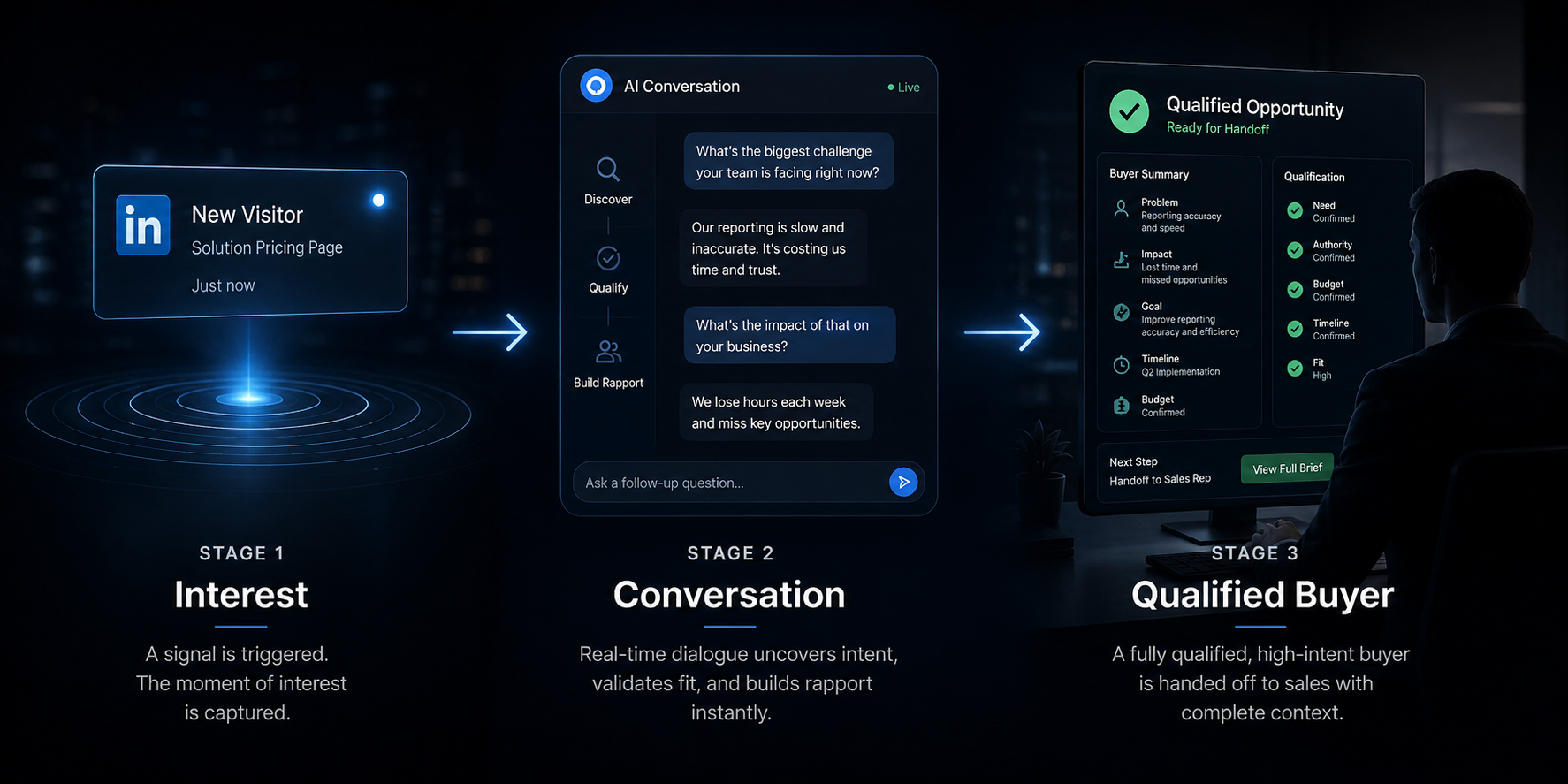
What Are the Three Stages of B2B Buyer Conversion?
The journey from initial interest to a qualified buyer involves three connected stages.
Understanding their differences helps marketing and sales teams avoid treating every interested contact as a sales opportunity.
Stage 1: Recognizing Buyer Interest
Buyer interest begins when someone interacts with a company, product, or relevant business topic.
Common examples include:
-
Visiting a product or pricing page.
-
Reading a solution comparison.
-
Downloading educational material.
-
Responding to an outbound email.
-
Clicking a relevant advertising campaign.
-
Requesting product information.
-
Attending a webinar.
These activities may indicate that the individual is researching a business problem.
However, the strength of the signal depends on context.
Someone reading a beginner’s guide may be learning about a subject.
A prospect requesting a proposal for 20 software licenses may be engaged in an active purchasing process.
Businesses should not assign the same sales priority to both.
Stage 2: Starting a Meaningful Conversation
A meaningful conversation occurs when the buyer participates in a two-way exchange that helps clarify their needs.
The conversation may happen through live chat, email, an AI sales agent, a discovery call, or another supported communication channel.
For example, a visitor may ask whether a product integrates with Salesforce.
A useful response answers the question and, when appropriate, asks about the buyer’s specific requirements.
This exchange reveals more information than a page visit alone.
A meaningful conversation should help the customer understand the solution or help the business understand the customer.
Simply opening a chatbot or sending an automated acknowledgment does not meet that standard.
Stage 3: Identifying a Qualified Buyer
A qualified buyer has provided enough reliable information to justify a defined sales action.
Depending on the business, qualification may involve:
-
Matching the ideal customer profile.
-
Having a relevant business problem.
-
Expressing interest in a suitable solution.
-
Demonstrating realistic purchasing intent.
-
Identifying a potential implementation timeframe.
-
Explaining the decision-making process.
Not every detail must be confirmed during the first conversation.
However, teams should distinguish confirmed information from assumptions.
A qualified lead is also not automatically an open opportunity or a paying customer.
Those are separate stages that require additional evidence.
Why Doesn’t B2B Buyer Interest Always Become Sales Pipeline?
Many companies generate significant marketing engagement without creating a proportional number of qualified opportunities.
The problem is often found in the transitions between interest, conversation, and qualification.
Buyer Interest Is Not the Same as Purchase Intent
A prospect may read several articles about sales automation without having an approved project.
Another may visit only one page before requesting a technical demonstration.
Engagement volume alone cannot explain the difference.
Buyer interest indicates attention. Purchase intent suggests that the person or organization is actively considering a buying decision.
Even explicit purchase intent requires verification.
A prospect may want a solution immediately but lack purchasing authority or have requirements the product cannot satisfy.
Long Forms Can Interrupt Buyer Engagement
Traditional lead capture forms often request several details before providing assistance.
Some information is necessary for routing or follow-up.
However, unnecessary fields can create friction, particularly when buyers only want an answer to a specific question.
For example, a visitor asking whether a product supports HubSpot integration may not want to provide a phone number, company revenue, and full purchasing timeline before receiving an answer.
A better experience can offer accessible product information alongside optional qualification.
Generic Responses Fail to Address Buyer Needs
An automatic email confirming a form submission may be useful, but it does not answer the buyer’s actual question.
Similarly, a generic chatbot greeting may fail to establish relevance.
A prospect evaluating enterprise software may want specific details about implementation, security, and pricing.
The conversation should reflect those requirements rather than deliver the same introduction to every visitor.
Marketing and Sales May Define Qualification Differently
Marketing teams sometimes prioritize engagement scores or content activity.
Sales representatives may expect confirmed business needs, purchasing authority, and suitable customer profiles.
When these expectations differ, marketing-qualified leads may be rejected by sales.
This creates unnecessary work and makes pipeline reporting less reliable.
Both departments should agree on the evidence required before a contact becomes sales-qualified.
What Does Current B2B Buyer Research Reveal?
Recent research shows that buyers frequently research products independently and may already have vendor preferences before starting a sales conversation.
This has important implications for how companies respond to interest.
6sense: Buyers Often Contact Their Preferred Vendor First
The 2025 6sense Buyer Experience Report examined responses from nearly 4,000 B2B buyers.
The research found that:
-
94% of buying groups ranked vendors before contacting sales.
-
79% of buyers initiated their first seller engagement themselves.
-
The first seller contact occurred approximately 61% of the way through the buying journey.
-
The vendor ultimately selected was already on the original shortlist in 95% of purchases.
These findings show why companies should not assume that an interested buyer is beginning their research.
A prospect may already know the product category, understand competitors, and have specific questions.
The first conversation should discover what remains unresolved rather than repeat information the buyer already knows.
Gartner: Buyers Want Self-Service and Human Support
In March 2026, Gartner reported that 67% of surveyed B2B buyers preferred a sales experience without direct representative involvement.
The survey included 646 buyers.
In separate research published in May 2026, Gartner found that 69% of surveyed buyers preferred validating AI-generated information with a sales representative.
These preferences are not necessarily contradictory.
Buyers may want independent access to information while still valuing human expertise for complex decisions.
B2B companies should therefore make useful conversations available without forcing every interested visitor into a sales meeting.
How to Turn Buyer Interest Into Qualified Conversations
The following seven-step process helps marketing and sales teams improve conversion between the first expression of interest and a qualified sales handoff.
It combines buyer intent, timely engagement, natural discovery, and agreed qualification standards.
Step 1: Identify Meaningful Buyer Signals
Start by reviewing how prospects engage with your business.
Useful signals may include demo requests, pricing questions, product comparisons, technical documentation visits, and responses to relevant outreach.
Separate general educational interest from stronger evaluation activity.
For example, someone downloading a guide about CRM automation may be researching a topic.
A prospect asking whether your software can support a 50-person sales team may have more specific requirements.
Prioritize signals based on buyer context rather than assigning fixed purchasing probabilities to individual clicks.
Step 2: Offer the Right Conversation Entry Point
Make it easy for buyers to request assistance when they need it.
Depending on the website or sales channel, options may include live chat, a product specialist, email, a demonstration request, or conversational AI.
Use calls to action that explain what the buyer will receive.
Examples include:
-
“Ask a product question.”
-
“Check integration compatibility.”
-
“Discuss your team’s requirements.”
-
“Talk to a sales specialist.”
A visitor who wants information should not be forced to schedule a meeting.
The objective is to create an accessible path from curiosity to useful dialogue.
Step 3: Respond While the Buyer Needs Assistance
Timely responses can reduce unnecessary waiting.
For high-intent questions, companies should aim to provide meaningful assistance as soon as practical.
However, speed should not come at the expense of accuracy.
For example, an immediate incorrect answer about security requirements can create more problems than a careful response from a qualified specialist.
Businesses operating across time zones may use approved automated assistance to answer supported questions outside normal working hours.
Complex requests should have a clear human escalation path.
Step 4: Discover the Buyer’s Real Business Problem
Once a conversation begins, focus on what the buyer wants to accomplish.
An effective opening question might be:
“What are you trying to improve in your current sales process?”
If the buyer explains that sales representatives spend too much time following up with unsuitable prospects, ask about the existing qualification process.
Relevant follow-up questions can reveal the scale of the problem and what a successful improvement would look like.
Avoid asking questions simply to complete CRM fields.
Each question should help the buyer or the business make progress.
Step 5: Evaluate Customer Fit and Buying Intent
Compare the buyer’s needs with your ideal customer profile.
Relevant criteria may include company size, industry, product requirements, geography, and existing technology.
Then assess available purchasing signals.
A prospect may have an urgent business problem but be outside the company’s target market.
Another may closely match the ICP while still conducting early research.
These prospects should not automatically receive the same qualification status.
Customer fit and purchase readiness are separate factors. Both matter when deciding how to prioritize sales engagement.
Step 6: Collect Missing Qualification Information
Ask relevant questions about the remaining details needed for the next sales action.
These may include:
-
When does the organization expect to make a decision?
-
Which departments will participate in the evaluation?
-
What technical requirements must be met?
-
Is funding already approved or still under review?
-
What would prevent the organization from moving forward?
Frameworks such as BANT and MEDDICC can support structured qualification.
However, buyers should not be required to complete a long questionnaire when the information is not yet necessary.
Use progressive qualification, collecting details as they become relevant.
Step 7: Route the Buyer to the Appropriate Next Step
Once enough information has been collected, determine the appropriate outcome.
A sales-ready prospect may qualify for a discovery meeting or account executive handoff.
An interested buyer with unresolved technical requirements may need product documentation or specialist assistance.
An early-stage researcher may benefit from educational content and optional future follow-up.
The decision should reflect the buyer’s needs and the company’s qualification criteria.
A useful handoff should include confirmed requirements, purchasing context, unresolved questions, and the agreed next action.
What Does a Buyer Interest-to-Qualification Conversation Look Like?
Consider a fictional B2B SaaS company selling sales automation software.
A sales manager visits the company’s website after researching methods to improve lead follow-up.
The following example illustrates a properly configured conversational qualification process. It is not a verified XYNEXI customer transcript.
Website Visitor:
“We’re looking for a better way to follow up with inbound leads. Can your platform help?”
AI Sales Assistant:
“I can help you explore that. What’s the biggest challenge right now: response time, lead qualification, or consistent follow-up?”
Website Visitor:
“Mostly response time. We get around 300 demo inquiries every month, but our five sales reps can’t respond to everyone quickly.”
AI Sales Assistant:
“That sounds like a significant workload. Which CRM does your team use?”
Website Visitor:
“HubSpot.”
AI Sales Assistant:
“Are you evaluating solutions for an upcoming project, or are you researching options for later?”
Website Visitor:
“We’d like to implement something this quarter. I manage the sales team.”
AI Sales Assistant:
“Thanks. Who else would be involved in evaluating and approving a solution?”
Website Visitor:
“Our VP of Sales and finance team.”
AI Sales Assistant:
“Would it be helpful to discuss your HubSpot workflow and lead response requirements with a specialist?”
Website Visitor:
“Yes. That would help.”
What Did This Conversation Reveal?
The conversation produced several useful qualification details:
-
Business problem: Slow follow-up to inbound demo inquiries.
-
Lead volume: Approximately 300 monthly inquiries.
-
Sales team: Five representatives.
-
Existing CRM: HubSpot.
-
Purchase timing: Current quarter.
-
Buyer role: Sales manager.
-
Other stakeholders: VP of Sales and finance.
-
Budget approval: Not yet established.
-
Recommended next action: Product discovery or workflow evaluation.
The buyer has moved beyond general curiosity into active solution evaluation.
However, the organization has not confirmed budget approval or completed its technical assessment.
The correct outcome is a potential qualified sales discussion, not an assumed closed deal.
What Makes a Buyer Sales-Qualified?
A sales-qualified lead (SQL) is a prospect that meets the organization’s agreed criteria for direct sales engagement.
The required evidence depends on the product, average deal value, and purchasing process.
Customer Fit and Business Need
A qualified buyer should have a relevant problem that the business can reasonably address.
For example, a company selling enterprise software may require prospects to meet minimum operational or technical criteria.
Strong interest without suitable product fit should not automatically create a high-priority opportunity.
Purchasing Context and Timing
A useful qualification process investigates whether the buyer has an active project or is still researching.
The system should also identify relevant stakeholders and unresolved purchasing requirements.
An approved budget may be important for some sales models but not required before every initial discovery discussion.
What Is the Difference Between a Lead, MQL, SQL, and Opportunity?
HubSpot’s lifecycle stage documentation distinguishes these stages.
| Lifecycle stage | Meaning |
|---|---|
| Lead | A contact or organization that has engaged beyond basic subscription activity |
| Marketing Qualified Lead (MQL) | A prospect marketing considers ready for sales attention |
| Sales Qualified Lead (SQL) | A prospect sales considers a potential customer |
| Opportunity | A contact or organization associated with a potential deal |
| Customer | A buyer associated with a completed sale |
Companies may customize these definitions to reflect their own sales process.
The important requirement is consistency.
A chatbot conversation should not automatically create a sales opportunity.
Likewise, booking a meeting does not prove the prospect is qualified.
When Should a Buyer Continue Receiving Educational Content?
Some interested prospects are not ready for direct sales engagement.
For example, a buyer may be exploring possible solutions without a planned purchasing timeline.
Another may need additional internal research before involving sales.
These prospects may benefit from relevant product information and optional follow-up.
The business should respect their communication preferences instead of repeatedly pushing for a sales meeting.
How Can AI Support the Interest-to-Qualification Journey?
AI sales agents can assist with initial engagement, buyer intent detection, qualification, and sales handoffs.
The available capabilities depend on the software, configuration, and integrations.
AI-Powered Initial Engagement
A properly configured conversational AI system can respond to supported customer questions and collect initial requirements.
This can be useful when human representatives are unavailable.
For example, a buyer may request information outside normal business hours.
The AI can provide approved answers or arrange an appropriate next step.
Context-Aware Buyer Conversations
Unlike a fixed questionnaire, an AI agent can adapt questions to the buyer’s responses.
If a prospect mentions Salesforce integration, the AI can ask which data or workflow needs to be synchronized.
If the buyer expresses concerns about implementation, it can request more detail or offer specialist assistance.
This creates a more relevant interaction than asking every visitor the same set of questions.
Conversational Intent Detection
Natural language processing and large language models can help classify buyer statements.
For example, an AI system may distinguish general research, vendor comparison, pricing inquiry, and purchasing preparation.
It can also identify information such as stated implementation timelines and technical requirements.
However, buyer intent classification is not a guaranteed prediction of purchasing behavior.
Important findings should be checked against the conversation evidence.
Automated Qualification and CRM Updates
AI can help organize collected information into structured qualification records.
Where supported, integrations with Salesforce or HubSpot can connect conversations with the correct contacts, accounts, and opportunities.
The system should preserve unknown information instead of inventing missing details.
Human Sales Handoffs
When a prospect meets the agreed qualification criteria, the AI can prepare a summary for the responsible sales representative.
A good handoff includes the buyer’s problem, relevant requirements, known stakeholders, purchasing timeline, and next action.
This helps the salesperson continue the discussion without repeating basic discovery.
What Does Salesforce’s 2026 Research Show?
In February 2026, Salesforce published its State of Sales research, based on a survey of 4,050 sales professionals.
It found that 54% of surveyed sellers had used AI agents.
Salesforce also reported that its own agents contacted 130,000 previously untouched leads and created 3,200 opportunities over four months.
This is a company-reported example of AI supporting prospecting and opportunity creation.
It does not establish that all AI implementations achieve similar conversion rates or closed revenue.
How Do You Measure Conversion From Buyer Interest to Qualified Leads?
B2B companies should measure each transition separately.
A higher number of website visits does not necessarily mean more meaningful conversations.
More conversations do not automatically mean more qualified buyers.
And more qualified buyers do not guarantee additional revenue.
Interest-to-Conversation Conversion Rate
Use:
Interest-to-Conversation Rate = (Meaningful Conversations ÷ Eligible Interested Visitors) × 100
Suppose a website identifies 1,000 eligible interested visitors during a month.
Of those, 150 start meaningful conversations.
The conversion rate is 15%.
A meaningful conversation should involve a relevant two-way exchange rather than a chatbot simply opening on the page.
Conversation-to-Qualified-Lead Conversion Rate
Use:
Conversation-to-Qualified-Lead Rate = (Qualified Leads ÷ Evaluated Conversations) × 100
Suppose 150 evaluated conversations produce 45 qualified leads.
The conversion rate is 30%.
This helps measure how effectively engagement produces suitable prospects.
Qualified-Lead-to-Opportunity Conversion Rate
Use:
Qualified-Lead-to-Opportunity Rate = (Created Opportunities ÷ Eligible Qualified Leads) × 100
Suppose 45 qualified leads create 20 accepted opportunities.
The conversion rate is approximately 44.4%.
This measure helps identify whether qualification standards align with actual sales opportunities.
Example: A Complete B2B Conversion Funnel
Consider the following hypothetical monthly results.
| Stage | Number | Conversion from previous stage |
|---|---|---|
| Website visitors | 10,000 | Not applicable |
| Eligible interested visitors | 1,000 | 10% |
| Meaningful conversations | 150 | 15% |
| Qualified leads | 45 | 30% |
| Created sales opportunities | 20 | 44.4% |
| Closed-won customers | 5 | 25% |
These figures are illustrative, not industry benchmarks or verified XYNEXI results.
The example demonstrates why each conversion rate needs its own denominator.
If the business wants more qualified leads, it should determine which transition offers the greatest realistic improvement.
Increasing conversation volume may help when interested visitors cannot easily request assistance.
Improving qualification may be more important when the company already has many conversations but few suitable opportunities.
Where Do B2B Companies Lose Potential Buyers?
The largest conversion problem is not always at the top of the funnel.
Each stage can create a different obstacle.
Interest to Conversation
Potential problems include long forms, unclear calls to action, slow responses, and missing product information.
Improvement: Make relevant assistance easy to access while preserving self-service choices.
Conversation to Qualification
Potential problems include generic questions, poor discovery, incorrect buyer assumptions, and weak ICP criteria.
Improvement: Use relevant discovery questions and confirm buyer fit and purchasing context.
Qualification to Sales Handoff
Potential problems include missing CRM information, duplicate records, unclear ownership, and disagreements between marketing and sales.
Improvement: Establish shared qualification definitions and structured handoff requirements.
Opportunity to Closed Revenue
Potential problems include weak product fit, unresolved objections, procurement delays, and buying-group disagreements.
Improvement: Use verified buyer information to support discovery, technical evaluation, and stakeholder decisions.
A reliable conversion strategy focuses on the actual bottleneck rather than assuming the company simply needs more leads.
How Can Marketing and Sales Agree on Qualified Buyer Definitions?
Marketing and sales alignment is essential when a company wants to improve the quality of its pipeline.
Marketing may generate interest through content, advertising, email campaigns, and other channels.
Sales then needs enough information to determine which contacts justify further engagement.
Without shared standards, the two teams may report different interpretations of success.
Establish Shared Qualification Criteria
Create a written definition of a qualified buyer.
Include relevant customer fit, business need, purchasing signals, and required information.
For example, a qualified B2B SaaS prospect may need to represent a suitable company and confirm an operational problem that the product addresses.
Budget or purchasing authority may remain subjects for deeper discovery, depending on the sales model.
Agree on Sales Acceptance Rules
Sales teams should define when an MQL becomes an SQL and when an opportunity should be created.
If a lead is rejected, the reason should be recorded.
This helps marketing understand whether the issue involves targeting, insufficient information, or poor purchasing readiness.
Consider Buying Groups, Not Only Individual Contacts
Enterprise purchasing often involves several stakeholders.
Forrester’s B2B Revenue Waterfall recommends organizing revenue processes around accounts, buying groups, and opportunities rather than relying only on individual lead records.
This matters because several contacts from the same company may be evaluating one shared purchase.
A company should avoid treating every engaged stakeholder as a separate sales opportunity.
Marketing, sales, and revenue operations should connect relevant contacts to the actual buying process.
How to Improve Buyer Interest-to-Lead Conversion in 30 Days
A 30-day pilot can help revenue teams identify conversion problems and test improvements.
It may not be long enough to prove final revenue impact for companies with long sales cycles.
Days 1 to 7: Review Current Conversion Data
Examine website engagement, lead capture forms, response times, conversation activity, and CRM qualification records.
Measure how many interested visitors become meaningful conversations.
Identify the main sources of drop-off.
Review whether marketing and sales use consistent lifecycle definitions.
Days 8 to 14: Improve Conversation Entry Points
Simplify forms where appropriate.
Make product information easier to access.
Add or improve relevant conversation options on high-intent pages.
Review opening messages to ensure they address actual buyer questions.
If AI assistance is used, connect it to approved product knowledge and define human escalation rules.
Days 15 to 21: Improve Qualification and Handoffs
Create shared customer fit and qualification criteria.
Test natural discovery questions.
Configure structured CRM handoffs where supported.
Review whether representatives receive enough context to continue conversations without unnecessary repetition.
Monitor incorrect AI responses and qualification mistakes.
Days 22 to 30: Compare Results
Compare the new process with the previous workflow or a suitable control group.
Track meaningful conversations, qualified leads, sales acceptance, and time to qualification.
Review buyer feedback and the quality of created opportunities.
Continue monitoring closed revenue as opportunities progress through the sales cycle.
Expand only the changes that demonstrate reliable improvements.
What Mistakes Should B2B Companies Avoid?
Several common mistakes weaken the conversion journey.
Treating every website visit as buying intent: Engagement is useful evidence, but it does not prove purchasing readiness.
Requiring long forms before answering questions: Unnecessary information requests can create friction.
Forcing conversations on self-service buyers: Customers should be able to research independently.
Counting every chatbot exchange as a qualified conversation: A useful interaction must provide meaningful buyer context or value.
Asking too many qualification questions: Collect information progressively and explain why it matters.
Assuming budget and authority without confirmation: Unknown details should remain unverified.
Sending incomplete handoffs to sales: Representatives need relevant context and clear next steps.
Measuring only lead volume: Qualified opportunities and completed purchases provide stronger evidence of commercial value.
Ignoring privacy and consent: Buyer conversations may contain personal and confidential information.
For U.S. commercial email, the Federal Trade Commission’s CAN-SPAM compliance guide explains requirements that apply to B2B commercial messages as well as consumer marketing.
Companies should also apply appropriate data security, consent, and access controls when collecting and analyzing customer conversations.
How Does XYNEXI Support the Journey From Interest to Qualified Buyer?
XYNEXI is an autonomous AI SDR and BDR platform built around its AIRPEC multi-agent reasoning engine.
Its published capabilities include outbound prospect research, personalized engagement, conversational qualification, objection handling, intent verification, and qualified buyer delivery.
Engaging Prospects Through Outbound Conversations
According to XYNEXI’s official platform overview, AIRPEC coordinates lead intelligence, buyer engagement, qualification, and objection handling within one outbound sales workflow.
XYNEXI describes using Human AI technology to engage prospects through supported channels, including email and SMS.
This can help companies move from initial prospect interest to a more informative two-way sales discussion.
Identifying Buyer Needs and Purchase Intent
XYNEXI describes using adaptive conversations to identify business challenges, purchasing signals, and relevant requirements.
Its reasoning engine is designed to adjust engagement based on buyer context rather than rely entirely on fixed scripts.
These capabilities support conversational qualification, where buyer readiness is assessed through direct dialogue.
Delivering Qualified Prospects to Human Sales Teams
XYNEXI’s published sales process includes verifying buyer intent and transferring suitable prospects to human representatives.
The platform follows a Human-In-The-Loop approach in which humans retain responsibility for strategy, relationships, pricing authority, and contract execution.
This allows AI to support early sales development while experienced representatives manage important commercial decisions.
Where XYNEXI Fits in the Three-Stage Model
The Interest → Conversation → Qualified Buyer framework applies across several B2B engagement channels.
XYNEXI’s current public positioning primarily emphasizes autonomous outbound sales engagement and qualification.
Its published materials do not establish that every inbound website chatbot feature described in this article is included as a native capability.
Businesses seeking website-triggered conversations, specific CRM synchronization, or automated scheduling should confirm the supported features and integrations before deployment.
The shared principle is simple: initial interest becomes more valuable when it leads to a relevant conversation, supported qualification, and an appropriate next sales action.
Explore how XYNEXI works to learn more about its conversational AI sales approach.
Conclusion
B2B companies can turn buyer interest into qualified leads by making meaningful conversations easy to start, understanding customer needs, and using clear qualification standards.
Interest alone does not establish purchasing readiness.
Website visits, content downloads, and email responses may reveal curiosity, but genuine sales qualification requires stronger evidence.
A conversation-first approach allows businesses to ask relevant questions, identify suitable customers, understand purchasing context, and recommend the next appropriate action.
AI can support initial engagement, intent detection, qualification, and structured handoffs.
However, automation must use accurate information and preserve human assistance for complex decisions.
Marketing and sales teams should measure each conversion stage independently and agree on when a contact becomes sales-qualified.
The goal is not to create the largest possible lead database.
It is to help interested buyers make progress and deliver reliable, well-qualified opportunities to the sales team.
Frequently Asked Questions
1. How Do You Turn B2B Buyer Interest Into a Sales Conversation?
B2B companies can turn interest into a sales conversation by offering timely, relevant assistance through website chat, email, product inquiries, or sales representatives. The first interaction should address the buyer’s question and identify their business needs. Low-friction conversation options and accurate product information help interested prospects decide whether further engagement is useful.
2. What Is the Difference Between an Interested Lead and a Qualified Buyer?
An interested lead has engaged with a company or product but may not have an active purchasing requirement. A qualified buyer meets defined customer fit and sales-readiness criteria. Qualification may include a relevant business need, suitable organization, purchasing context, and an appropriate next step. A qualified lead is not automatically a sales opportunity or paying customer.
3. How Can AI Convert Website Visitors Into Qualified Leads?
Conversational AI can engage willing website visitors, answer approved product questions, ask relevant discovery questions, and collect qualification information. It can help identify customer fit, business needs, purchasing timelines, and unresolved concerns. When connected to suitable systems, it may also support CRM updates and human sales handoffs. The exact capabilities depend on the platform.
4. What Questions Should You Ask to Qualify a B2B Buyer?
Useful questions explore the buyer’s business problem, current process, desired outcome, product requirements, purchasing timeline, and decision-making responsibilities. Budget questions may also be appropriate. The conversation should adapt to the buyer’s answers rather than follow a rigid checklist. Unknown details should remain unconfirmed until reliable information becomes available.
5. When Should a Conversation Become a Sales-Qualified Lead?
A conversation should become a sales-qualified lead when the prospect meets the organization’s agreed criteria for direct sales engagement. These criteria usually consider customer fit, relevant business needs, buying intent, and purchasing context. Sales and marketing should share the same definition. General engagement, a chatbot interaction, or a booked meeting alone does not guarantee that qualification standards are met.
6. How Do You Measure Interest-to-Conversation and Conversation-to-Lead Conversion?
Calculate interest-to-conversation conversion by dividing meaningful conversations by eligible interested visitors and multiplying by 100. Calculate conversation-to-qualified-lead conversion by dividing qualified leads by evaluated conversations and multiplying by 100. Track sales acceptance, qualified opportunities, and eventual closed revenue as separate outcomes. Consistent definitions and comparable reporting periods are essential for reliable measurement.