
B2B sales teams often mistake website activity for buying readiness. A prospect may read pricing pages without having budget or authority, while another reveals an urgent project during one conversation. Conversational intent detection helps distinguish these situations and route qualified buyers appropriately.
How Does Conversational Intent Detection Work in B2B Sales?
Conversational intent detection uses natural language processing (NLP), machine learning, and AI to identify what B2B buyers want during sales conversations. It analyzes customer statements, extracts signals such as budget, urgency, business needs, and purchase timelines, and combines them with customer fit and conversation history. Sales teams use these findings to qualify prospects, personalize responses, and prioritize suitable opportunities.
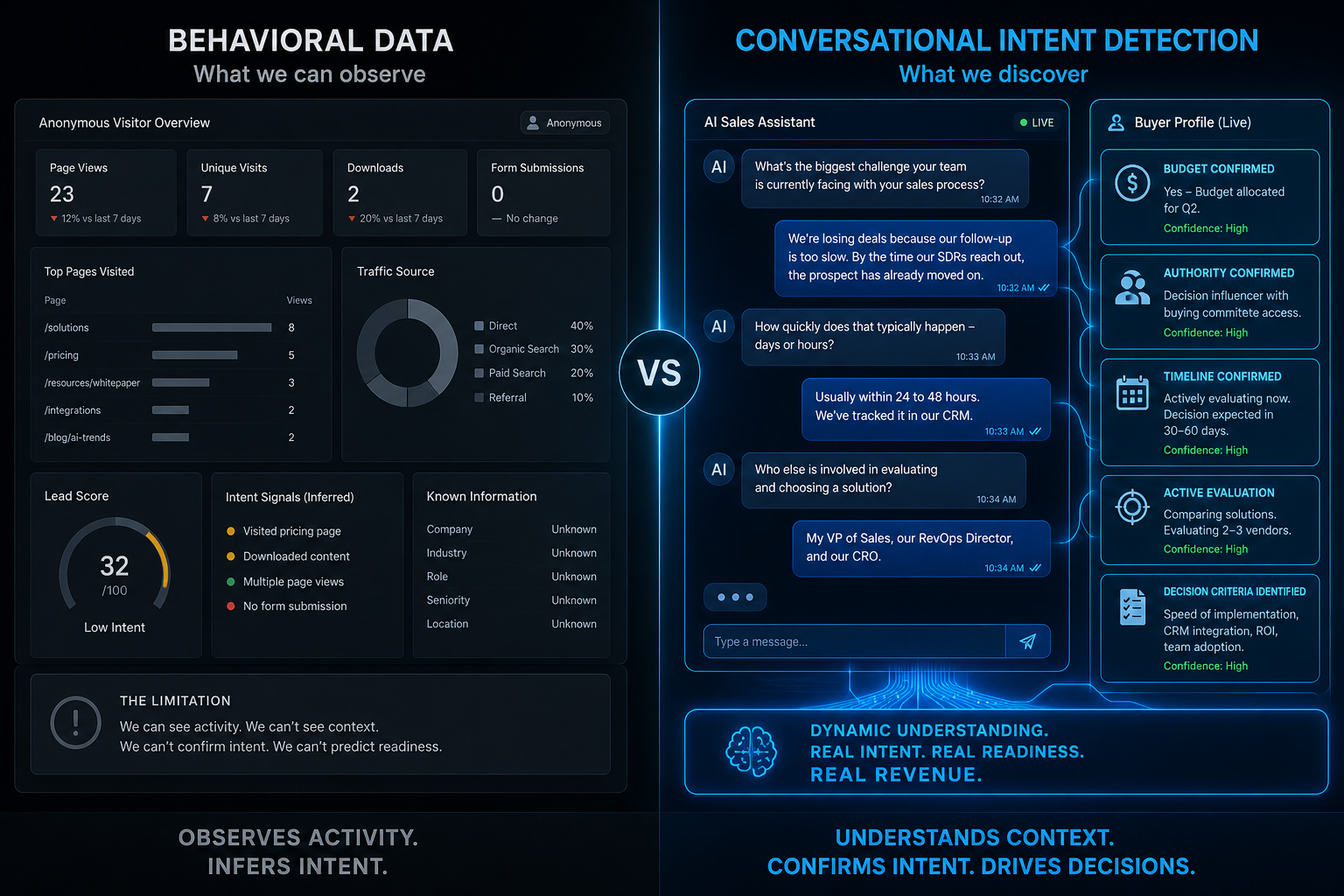
Traditional buyer intent tools often analyze actions such as website visits, content downloads, and product searches.
Conversational intent detection examines what the buyer actually communicates.
For example, visiting a pricing page may suggest interest in a product. Telling a salesperson that the company needs a solution next month provides more specific information about the buyer’s timeline.
However, neither signal guarantees a purchase.
The purpose of conversational intent detection is to identify meaningful buying signals, verify missing information, and help sales teams choose the right next action.
What Is Conversational Intent Detection in B2B Sales?
Conversational intent detection is the process of interpreting customer messages to understand their goals, questions, and possible purchasing readiness.
It can operate during website chats, email exchanges, AI sales conversations, and other supported communication channels.
The system examines both the buyer’s current statement and the available context from earlier interactions.
For example, consider these two messages:
Buyer A: “What is AI lead qualification?”
Buyer B: “We’re comparing AI lead qualification platforms for our 12-person sales team. We need to implement one next month.”
Both buyers are discussing the same product category.
However, the first message is primarily informational.
The second contains explicit evaluation activity, company context, and an implementation timeline.
A conversational intent detection system can classify these differences and recommend different responses.
Buyer A may benefit from educational information.
Buyer B may be ready for a deeper qualification conversation.
Why Does Buyer Intent Matter for Sales Qualification?
B2B qualification aims to determine whether a prospect is a suitable customer and whether further sales engagement is justified.
A person may show strong interest without having a realistic purchasing opportunity.
For example, a student researching CRM software may visit several vendor websites and download technical documentation.
Those activities do not establish buying authority or an organizational purchase plan.
Conversational intent detection provides another source of evidence by allowing buyers to explain their circumstances directly.
Can AI Determine Whether Someone Is Ready to Buy?
AI can identify statements associated with purchasing activity, such as requests for proposals, implementation requirements, and confirmed buying timelines.
However, it cannot establish purchase readiness with certainty.
A prospect may express urgency without having an approved budget.
Another may ask detailed technical questions while researching a project that will not begin for another year.
A reliable system treats purchasing intent as evidence that needs further qualification, not as a guaranteed sale.
Conversational Intent Detection vs. Traditional Lead Scoring
Traditional lead scoring and conversational intent detection examine different types of information.
Lead scoring typically assigns values to customer characteristics and recorded activities.
For example, a company may award points when a prospect visits a pricing page, downloads a guide, or matches its ideal customer profile.
Conversational intent detection analyzes the meaning of buyer statements.
| Area | Traditional lead scoring | Conversational intent detection |
|---|---|---|
| Primary information | Customer attributes and tracked activities | Buyer statements and conversation context |
| Example signal | Prospect visits a pricing page | Prospect asks for pricing for 20 users |
| Qualification approach | Scores based on predefined criteria | Intent classification and conversational discovery |
| Buying urgency | May be inferred from activity | Can be discussed and confirmed directly |
| Decision authority | Usually based on job title or CRM fields | Can be clarified through questions |
| Missing information | May require additional forms or research | Can trigger relevant follow-up questions |
| Sales output | Lead score or priority category | Intent classification, buyer context, and suggested action |
Neither approach is sufficient in every situation.
Lead scoring can help identify accounts showing unusual engagement.
Conversational intent detection can explain the reasons behind that engagement when the buyer chooses to communicate.
Combining reliable behavioral signals, customer fit, and direct buyer statements provides a stronger basis for qualification than treating any single indicator as conclusive.
Which Conversational Signals Reveal B2B Buying Intent?
B2B buyers express different levels of interest through their language.
The most useful signals often concern business needs, purchasing timelines, vendor comparisons, and specific implementation requirements.
1. Business Problems and Pain Points
A buyer may describe a problem affecting revenue, productivity, compliance, or operations.
For example:
“Our SDRs are spending too much time following up with leads who aren’t qualified.”
This statement identifies an operational problem.
However, it does not establish that the buyer is actively purchasing software.
The AI can ask whether the organization is evaluating solutions or exploring possible improvements.
2. Pricing and Budget Discussions
Pricing questions can indicate commercial interest.
Examples include:
-
“How much does your enterprise plan cost?”
-
“Can you prepare a quote for 25 users?”
-
“Do you offer annual contracts?”
-
“We have an approved budget for this project.”
These statements provide different levels of evidence.
Asking about pricing may be general research.
Requesting a formal quote with an approved budget provides stronger evidence of an active evaluation.
The system should interpret the full conversation rather than assigning a fixed purchase probability to the word “pricing.”
3. Implementation Timelines
A buyer may reveal urgency through statements such as:
“We need to replace our existing system before our contract expires in November.”
This provides a specific business event and timeline.
The AI can ask whether the company has already started evaluating vendors and what requirements must be met before implementation.
A confirmed deadline can help sales teams prioritize a relevant opportunity.
4. Competitor Comparisons
Buyers may ask how one platform compares with another.
For example:
“We’re evaluating two other solutions. How does yours handle Salesforce integration?”
This suggests active comparison.
However, mentioning competitors does not automatically mean the buyer is ready to purchase.
The system should identify which differences matter to the prospect and whether they affect the purchasing decision.
5. Technical and Security Requirements
Questions about integrations, data security, compliance, and implementation can reveal serious evaluation needs.
For example:
“Does your platform support SSO, and can our security team review the documentation?”
This may indicate that the organization has started technical due diligence.
The AI should provide verified information and involve the appropriate specialist when necessary.
6. Decision-Making Authority
A buyer’s job title alone does not prove purchasing authority.
A VP of Sales may influence a purchase but still need approval from finance or the chief revenue officer.
Conversational qualification can clarify the decision process by asking:
“Who else would be involved in evaluating and approving this solution?”
The response helps identify relevant stakeholders.
7. Transactional or Procurement Signals
Requests for contracts, formal proposals, purchasing documents, and implementation planning may indicate later-stage evaluation.
For example:
“Can you send a proposal for 30 licenses so our procurement team can review it?”
This is stronger evidence of commercial activity than a general product question.
However, procurement discussions can still end without a purchase.
How Does Conversational Intent Detection Work? A 7-Step Process
AI sales systems may use different technical architectures, but a reliable intent detection workflow generally follows seven connected stages.
The process begins with buyer language and ends with a qualification decision or appropriate sales action.
Step 1: Capture the Buyer’s Message
The system receives a message from a supported conversation channel.
That may be a website chat, an email response, or an interaction with an AI sales agent.
For example:
“We’re comparing sales automation platforms and want to implement something next month.”
The message becomes the input for intent analysis.
The system may also access permitted conversation history and relevant CRM information.
Step 2: Analyze the Language and Identify Intent
Natural language understanding helps the system determine what the buyer is trying to accomplish.
In this example, the buyer is comparing solutions and discussing implementation timing.
The system might classify the message as active vendor evaluation.
This is different from classifying a message such as “What does sales automation mean?” as general research.
Google Cloud’s Dialogflow CX documentation explains how conversational systems match user messages against learned intent categories.
The documentation also describes confidence thresholds that determine whether the system accepts a classification or triggers a no-match response.
Step 3: Extract Important Qualification Information
Once the system understands the message, it can extract relevant details.
These may include:
-
Company size.
-
Buyer role.
-
Product category.
-
Existing software.
-
Budget information.
-
Implementation timeline.
-
Technical requirements.
-
Decision-making responsibilities.
For example:
“We use HubSpot, have 12 sales reps, and need a solution next month.”
The system can identify HubSpot as the existing CRM, 12 as the sales team size, and next month as the stated implementation timeframe.
This process is known as entity extraction.
Microsoft’s Conversational Language Understanding documentation describes how AI systems identify relevant information from customer statements.
Step 4: Interpret the Full Conversation Context
A single statement may not provide enough information to understand purchasing intent.
Consider this exchange:
Buyer: “We’re looking at automation tools.”
AI: “Are you researching options for the future or evaluating a solution now?”
Buyer: “We need to replace our current system before our contract renews.”
The second response changes the interpretation.
The buyer is no longer expressing only general interest.
They have identified a possible purchasing trigger.
A context-aware system evaluates these messages together.
It should also recognize when new information contradicts an earlier assumption.
For example, the buyer may later explain that the implementation project has been postponed.
The system should update the qualification assessment rather than continue using an outdated urgency signal.
Step 5: Compare Buying Intent With Customer Fit
High purchasing intent does not automatically make someone a suitable customer.
A prospect may need a solution urgently but operate in an industry or market the company does not serve.
The system should compare expressed intent with the ideal customer profile (ICP).
Relevant criteria may include company size, industry, location, business requirements, and product compatibility.
Four common situations can emerge:
High fit and high intent: A strong candidate for timely sales qualification.
High fit and low intent: A potentially valuable prospect who may need education or future follow-up.
Low fit and high intent: An interested buyer who may require a different product or referral.
Low fit and low intent: Usually a lower-priority prospect for direct sales engagement.
This helps prevent urgency from being mistaken for suitability.
Step 6: Clarify Missing Information
A good intent detection system should identify what it does not know.
For example, a buyer may confirm a purchasing deadline but provide no information about budget approval.
Instead of assuming funding exists, the AI can ask:
“Has your team approved the budget, or is funding still being reviewed?”
Similarly, if purchasing authority is unclear, the system can ask which stakeholders will participate.
Questions should remain relevant and limited to information needed for the next decision.
The buyer should not feel forced to complete a lengthy interview.
Step 7: Choose the Next Action and Record the Outcome
After interpreting the available evidence, the system can recommend an appropriate response.
Possible actions include providing information, continuing discovery, offering a sales meeting, transferring the conversation to a human representative, or scheduling permitted follow-up.
The system should record the supported qualification findings and relevant evidence.
For example, a suitable buyer with a confirmed project timeline and clear requirements may be routed to an account executive.
A buyer who is still researching may receive relevant educational material.
A prospect with an unresolved technical question may need a specialist.
The objective is to match the next action to the buyer’s actual situation.
Which AI Technologies Power Conversational Intent Detection?
Conversational intent detection can use traditional NLP, machine learning classifiers, large language models, business rules, or a combination of these technologies.
Natural Language Processing and Understanding
Natural language processing helps computers analyze human language.
Natural language understanding (NLU) focuses on interpreting meaning, including what someone wants to do.
For example, an NLU system may recognize that “Can I get a price for 50 seats?” is a pricing request.
Intent Classification
Intent classification assigns a message to a defined category.
A B2B sales system may use categories such as informational research, solution comparison, pricing inquiry, technical evaluation, and proposal request.
The classification helps determine which response or workflow is appropriate.
Entity Extraction
Entity extraction identifies useful details inside a message.
These can include company names, software products, dates, quantities, and purchasing requirements.
For example, the sentence “We need 25 licenses by December” contains a quantity and a stated deadline.
Those details can become structured qualification information.
Large Language Models and Context Tracking
Large language models (LLMs) can interpret more varied customer language and analyze context across several messages.
This can help identify changing requirements and generate relevant follow-up questions.
However, LLMs can also misunderstand context or produce unsupported conclusions.
Important qualification decisions should use defined rules, verifiable evidence, and appropriate review.
Rule-Based vs. AI-Based Intent Detection
| Technology | How it works | Main limitation |
|---|---|---|
| Rule-based detection | Matches defined words, phrases, or conditions | May miss unexpected language |
| Traditional ML classification | Predicts intent from trained examples | Depends on training quality and category coverage |
| LLM-based interpretation | Interprets natural language and conversation context | May produce incorrect or unsupported interpretations |
| Hybrid systems | Combine models, rules, CRM context, and validation | Require careful configuration and testing |
A hybrid approach can help businesses balance flexible language understanding with consistent qualification requirements.
What Does an AI Intent Confidence Score Mean?
Some intent detection systems assign a confidence score to a classification.
For example, an AI model may assign a confidence score of 0.90 to the category “pricing inquiry.”
This means the model has strongly favored that classification according to its scoring method.
It does not mean the buyer has a 90% chance of purchasing.
Google Cloud documents classification confidence scores ranging from 0.0 to 1.0 for Dialogflow CX.
These scores are used to determine whether the system should accept a matching intent or use a fallback response.
They are not automatically calibrated probabilities of revenue conversion.
Businesses should distinguish between:
-
Confidence that a message belongs to an intent category.
-
Evidence that the buyer meets qualification requirements.
-
The independently estimated probability that an opportunity will close.
These are different measurements.
When model confidence is low or information conflicts, the system should ask for clarification or involve a human.
Example: Detecting B2B Buying Intent During a Live Conversation
Consider a fictional interaction between a buyer and an AI sales assistant.
The example demonstrates how conversational intent detection works. It is not a verified XYNEXI customer transcript.
Buyer:
“We’re comparing AI lead qualification platforms for our 12-person sales team. We currently use HubSpot and want to implement a solution next month. Can you explain your pricing?”
AI Sales Assistant:
“I can help with the available pricing information. Since you’re comparing solutions for next month, is HubSpot integration a requirement?”
Buyer:
“Yes. We need everything recorded in HubSpot.”
AI Sales Assistant:
“Understood. Who else will be involved in evaluating and approving the solution?”
Buyer:
“I’m the Head of Sales. Our CFO will approve the final budget.”
The system now has several useful signals.
| Qualification field | Evidence from conversation |
|---|---|
| Current intent | Active vendor evaluation |
| Product category | AI lead qualification |
| Team size | 12 sales representatives |
| Existing CRM | HubSpot |
| Technical requirement | HubSpot integration |
| Timeline | Next month |
| Buyer role | Head of Sales |
| Final approval | CFO |
| Budget approved | Not confirmed |
| Recommended action | Verify integration fit and clarify budget approval |
This conversation provides stronger qualification evidence than a pricing-page visit alone.
However, the system still needs to confirm whether the solution meets the buyer’s requirements and whether the organization has approved funding.
A useful next action might be a technical discussion or a qualified meeting.
The buyer should not automatically be classified as ready to purchase simply because several intent signals are present.
How Does Conversational Intent Detection Support BANT and MEDDICC?
Intent detection can help sales teams apply structured qualification frameworks without relying entirely on static forms.
BANT Qualification
BANT examines budget, authority, need, and timing.
Conversational AI can collect relevant information as these subjects arise naturally.
For example, a buyer describing an implementation deadline provides timing information.
A discussion about finance approval may provide authority and budget context.
Missing information should remain unconfirmed until the buyer or another reliable source verifies it.
MEDDICC Qualification
MEDDICC is commonly used in complex B2B sales.
It covers metrics, economic buyer, decision criteria, decision process, identified pain, champion, and competition.
Conversation analysis can help identify statements related to these categories.
For example, a buyer may describe the business impact of a problem and explain which stakeholders are evaluating vendors.
However, complex qualification still requires careful judgment.
AI should support discovery and documentation rather than assume every requirement has been satisfied.
How Does Detected Buyer Intent Become a Sales Action?
Intent detection becomes useful when it influences a real sales workflow.
A system may identify a high-intent prospect, but the information has limited value if no one takes appropriate action.
Dynamic Lead Prioritization
CRM records can be updated with verified signals from buyer conversations.
For example, a prospect who confirms a business problem, suitable company profile, and active purchasing timeline may receive higher priority.
The system should also account for missing information and previous interactions.
Qualified Sales Handoffs
When a prospect meets the company’s qualification standards, the system can prepare a summary for a human representative.
Useful handoff information includes buyer role, business need, purchasing timeline, relevant stakeholders, technical requirements, unresolved concerns, and suggested next action.
Salesforce Agentforce Qualification provides a documented example.
Salesforce explains that its qualification agent can update a lead record with a rating and create a summary containing the rationale, missing information, conversation context, and recommended action.
The exact behavior depends on the configured workflow.
Salesforce and HubSpot Integration
A suitable CRM integration can connect conversation findings with contact, account, and opportunity records.
This helps prevent repeated questions and duplicate sales activity.
However, businesses should verify supported integration features before deployment.
When Should AI Transfer a Buyer to a Human?
Human escalation is appropriate when the buyer requests a representative or raises a question beyond the system’s authority.
Examples include complex technical requirements, unusual pricing, contractual terms, procurement concerns, and strategic account discussions.
The representative should receive the relevant conversation context.
This supports a smoother transition from automated discovery to human sales engagement.
How Accurate Is Conversational Intent Detection?
There is no single accuracy percentage that applies to every conversational intent detection system.
Performance depends on training data, intent categories, languages, customer segments, conversation complexity, and system configuration.
Companies should measure classification quality using reviewed examples.
Precision, Recall, and F1 Score
Precision measures how often the system is correct when it predicts high buying intent.
Recall measures how many genuinely high-intent cases the system identifies.
F1 score combines precision and recall into one balanced measure.
Consider a hypothetical test containing 200 reviewed conversations.
Suppose 40 conversations truly contain high buying intent.
The AI identifies 40 conversations as high-intent, including 32 correct predictions.
That gives:
-
Precision: 32 ÷ 40 = 80%.
-
Recall: 32 ÷ 40 = 80%.
-
F1 score: 80%.
The system also missed eight genuinely high-intent conversations and incorrectly flagged eight lower-intent conversations.
These are illustrative figures, not verified platform performance.
The example shows why accuracy evaluation must account for both incorrect positive predictions and missed opportunities.
False-Positive Intent Detection
A false positive occurs when the system incorrectly identifies a lower-intent buyer as high-intent.
For example, a student researching enterprise software may ask about pricing and implementation without having any purchasing responsibilities.
If the AI interprets those questions as confirmation of a qualified opportunity, sales representatives may waste time.
False-Negative Intent Detection
A false negative occurs when the system misses a genuine buying signal.
For example, a buyer may describe an urgent project using unusual language that the model does not recognize.
The system may incorrectly classify the message as general research.
Testing should include different buyer roles, industries, languages, and conversation styles.
Microsoft recommends evaluating conversational language understanding models against test data that was not used during training.
Measure Actual Sales Outcomes
Classification accuracy is only one part of performance.
Revenue teams should also measure whether intent-qualified prospects create genuine opportunities and become customers.
Useful metrics include:
| KPI | What it measures |
|---|---|
| Intent precision | Correct high-intent predictions ÷ all predicted high-intent cases |
| Intent recall | Correct high-intent predictions ÷ all actual high-intent cases |
| F1 score | Balanced measure of precision and recall |
| Qualification completeness | Share of records containing required verified information |
| Qualified conversation rate | Conversations meeting agreed qualification criteria |
| Sales handoff acceptance rate | Accepted handoffs ÷ submitted AI-qualified handoffs |
| Intent-to-opportunity rate | Qualified opportunities ÷ relevant intent-qualified prospects |
| Opportunity win rate | Closed-won opportunities ÷ completed won and lost opportunities |
| Time to qualification | Time from initial interaction to a supported qualification decision |
A high classification score does not guarantee more revenue.
The system must help identify suitable buyers and support useful sales actions.
What Research Supports Combining Multiple B2B Buying Signals?
Modern B2B buyers frequently research vendors before speaking to sales teams.
The 2025 6sense Buyer Experience Report found that 94% of surveyed buying groups had ranked their preferred vendors before contacting sellers.
The research also found that buyers initiated approximately 79% of first seller engagements.
These findings explain why companies should not assume that an initial conversation represents the beginning of the buyer’s research.
A prospect may already have specific requirements and a preferred vendor.
Conversation analysis can help sales teams understand what the buyer still needs to confirm.
At the same time, independent research, previous experience, and buying-group discussions may influence the decision.
Conversational intent detection should therefore complement other reliable sources rather than claim to reveal every factor behind purchasing behavior.
Why Is Human Validation Still Important?
In May 2026, Gartner reported that 69% of surveyed B2B buyers preferred to validate AI-generated insights with sales representatives.
The study involved 645 buyers surveyed in August and September 2025.
This highlights the continuing importance of human expertise.
AI can support information gathering and qualification, while experienced representatives can help buyers verify claims and address complex decisions.
How to Implement Conversational Intent Detection in B2B Sales
A reliable implementation requires more than connecting a language model to a chat interface.
Companies need defined intent categories, qualification standards, suitable data, and clear human oversight.
Step 1: Define Buyer Intent Categories
Start with categories that reflect your actual sales process.
Examples include general research, problem awareness, solution evaluation, pricing inquiry, technical review, and procurement readiness.
Document what evidence qualifies a conversation for each category.
Step 2: Establish Customer Fit Criteria
Define the ideal customer profile.
Include relevant company characteristics, business requirements, and product limitations.
Separate customer fit from purchasing urgency.
A high-intent prospect who cannot use the product should not automatically become a qualified opportunity.
Step 3: Prepare Reliable Conversation Data
Review permitted historical sales conversations and identify examples of different intent categories.
Label important buyer statements and qualification details.
Include examples where intent is unclear or where the buyer changes direction.
Protect customer information during collection and preparation.
Step 4: Configure the Intent Detection System
Choose suitable NLP, machine learning, LLM, or hybrid capabilities.
Connect approved product information and configure qualification rules.
Define how the system responds when information is missing or confidence is low.
Step 5: Connect the CRM and Sales Workflow
Determine how conversation findings will be stored.
Configure contact matching, qualification summaries, sales routing, and human escalation.
Check that updates do not create duplicate records or overwrite verified information incorrectly.
Step 6: Test Different Buyer Scenarios
Evaluate the system with realistic conversations.
Include early-stage researchers, qualified buyers, technical evaluators, unsuitable prospects, and buyers who provide conflicting answers.
Measure precision, recall, and qualification completeness.
Review incorrect classifications and adjust the workflow.
Step 7: Monitor Business Results
Track how intent-qualified prospects progress through the pipeline.
Compare qualified opportunities, sales acceptance, conversion, and revenue against the previous process.
Continue reviewing model accuracy as customer behavior and product information change.
What Are the Risks and Limitations of Conversational Intent Detection?
Conversational intent detection can improve qualification, but businesses must account for several limitations.
AI Can Misinterpret Customer Language
Buyers may use sarcasm, incomplete statements, technical terms, or unusual phrasing.
AI can misunderstand these messages or infer details the buyer never confirmed.
Important qualification decisions should be supported by evidence.
Buyer Intent Can Change
A prospect may begin researching with urgency but later postpone the project.
Another may initially appear uninterested but become ready to evaluate a solution after an internal business change.
Qualification systems should update their assessments when new information becomes available.
Conversation Data May Be Incomplete
An AI agent cannot reliably determine private buying-group decisions that were never discussed.
Budget approval, stakeholder concerns, and competitive preferences may remain unknown.
Systems should preserve that uncertainty.
Privacy and Consent Matter
Buyer conversations may contain personal information, financial details, and confidential business requirements.
Organizations need appropriate recording notices, lawful processing, data access controls, and retention policies.
For U.S. commercial email, the Federal Trade Commission’s CAN-SPAM guidance explains requirements that also apply to B2B marketing emails.
The NIST Generative AI Risk Management Profile also provides guidance for evaluating and managing risks associated with generative AI.
Businesses should combine technical safeguards with appropriate human oversight.
How Does XYNEXI Use Conversational Intent Detection?
XYNEXI is an autonomous AI SDR and BDR platform designed to support outbound prospect research, buyer engagement, discovery, qualification, and intent verification.
Its published product information describes the AIRPEC multi-agent reasoning engine, which coordinates specialized AI capabilities across the outbound sales process.
According to XYNEXI’s official platform overview, AIRPEC supports context awareness, adaptive reasoning, and buyer personalization.
Understanding Buyer Intent Through Conversations
XYNEXI describes using direct buyer dialogue to identify customer roles, business challenges, purchasing context, and relevant intent signals.
Rather than relying only on predefined email sequences, its stated approach adapts sales conversations based on what prospects communicate.
This is relevant to conversational intent detection because buyer statements can provide specific qualification evidence.
For example, a prospect may reveal a purchasing deadline, implementation concern, or internal approval requirement during an outbound sales conversation.
Applying Intent to Sales Qualification
XYNEXI’s published workflow includes prospect engagement, intelligent discovery, conversational qualification, personalized solution presentations, and objection handling.
The platform describes verifying buyer interest before handing qualified prospects to human sales teams.
Its Human-In-The-Loop approach leaves important strategy, pricing, relationship, and contract decisions with people.
Connecting Buyer Signals With GTM Decisions
Conversation-derived information can also help revenue teams identify recurring objections, purchasing requirements, and changes in buyer priorities.
However, individual intent signals must be validated before they become strategic conclusions.
XYNEXI’s public materials describe its capabilities at the product level. They do not establish a specific internal intent-classification algorithm, confidence threshold, or independently verified detection accuracy.
Businesses evaluating the platform should confirm the available qualification criteria, CRM integrations, reporting features, and evidence-retention controls.
The main value of conversational intent detection is not simply identifying prospects who ask questions. It is helping sales teams understand which buyers have a relevant need, what information remains missing, and what should happen next.
Explore how XYNEXI works to learn more about its AI-powered sales conversations and qualification approach.
Conclusion
Conversational intent detection helps B2B sales teams identify purchasing signals by analyzing what buyers communicate during real conversations.
It uses NLP, intent classification, entity extraction, conversation context, and qualification rules to understand business needs, evaluation activity, urgency, and purchasing requirements.
Unlike traditional lead scoring, it can examine explicit buyer statements rather than relying only on website behavior.
However, buying intent is not the same as confirmed purchase readiness.
A reliable system must compare intent with customer fit, verify missing information, handle uncertainty, and transfer suitable prospects to the correct sales workflow.
AI can support this process at scale, but accuracy testing, CRM integration, privacy safeguards, and human oversight remain essential.
The business value comes from improving qualification quality and helping sales representatives focus on opportunities supported by genuine buyer evidence.
The goal is not to predict every purchase. It is to understand buyers more accurately and respond with the most appropriate next action.
Frequently Asked Questions
1. What Is Conversational Intent Detection in B2B Sales?
Conversational intent detection is the use of AI and natural language processing to understand what a potential customer wants during a sales conversation. It identifies buying signals, business requirements, purchasing timelines, and other relevant information. Companies use these findings to improve lead qualification, prioritize suitable prospects, and choose appropriate sales actions.
2. How Does AI Recognize Buying Intent During a Conversation?
AI analyzes customer language, identifies relevant intent categories, and extracts details such as budget, urgency, product requirements, and decision-making responsibilities. More advanced systems also use previous messages and CRM context to interpret the conversation. The resulting classification can help determine whether the buyer needs information, further qualification, or human sales assistance.
3. What Is the Difference Between Buyer Intent Detection and Lead Scoring?
Traditional lead scoring often assigns points based on website activity, engagement, and company characteristics. Conversational intent detection analyzes the meaning of direct buyer statements. It can identify information such as purchasing timelines and specific business needs. Both methods can be combined, but neither should be treated as proof that a purchase will occur.
4. Can AI Distinguish High-Intent Buyers From Casual Website Visitors?
AI can help distinguish between research activity and stronger purchasing signals by analyzing buyer statements, customer fit, and available context. For example, a confirmed implementation project and formal proposal request may provide stronger evidence than a general product question. However, AI can misclassify conversations, so important qualification decisions require clear criteria and appropriate validation.
5. How Accurate Is AI-Powered Conversational Intent Detection?
Accuracy depends on the system’s training data, intent categories, customer language, and configuration. Businesses should measure precision, recall, F1 score, and qualification accuracy using reviewed test conversations. There is no universal accuracy percentage that applies to all platforms. A high intent confidence score also does not automatically represent a buyer’s probability of purchasing.
6. How Can Conversational Intent Detection Improve B2B Lead Qualification?
Conversational intent detection can improve qualification by identifying business needs, confirming purchase timelines, clarifying decision-making responsibilities, and capturing relevant buyer requirements. It helps sales teams separate general interest from stronger commercial signals. When connected to suitable CRM workflows, it can support faster routing, better sales handoffs, and more focused engagement with qualified prospects.