
B2B sales teams spend hours researching prospects, updating CRMs, and chasing unqualified leads while important buyers wait for answers. Human-AI sales teammates can handle repeatable work, support faster qualification, and give sales representatives more time for relationships, complex decisions, and revenue growth.
How Are Human-AI Sales Teammates Changing B2B Sales?
Human-AI sales teammates are transforming B2B sales by combining AI-powered prospecting, buyer engagement, qualification, and workflow automation with human judgment, relationship building, and negotiation. AI agents handle suitable repetitive tasks and organize customer information, while human representatives manage complex decisions and important relationships. This collaboration can improve sales capacity, response times, pipeline quality, and revenue productivity when implemented effectively.
Traditional sales teams depend heavily on employees to research accounts, contact prospects, qualify leads, schedule meetings, and manage CRM information.
Human-AI collaboration changes how these responsibilities are distributed.
Instead of requiring a salesperson to perform every task manually, businesses can assign appropriate activities to AI agents while employees retain control over high-value commercial decisions.
The objective is not simply to replace people with software.
It is to create a sales operation where technology and employees contribute to the same customer experience and revenue goals.
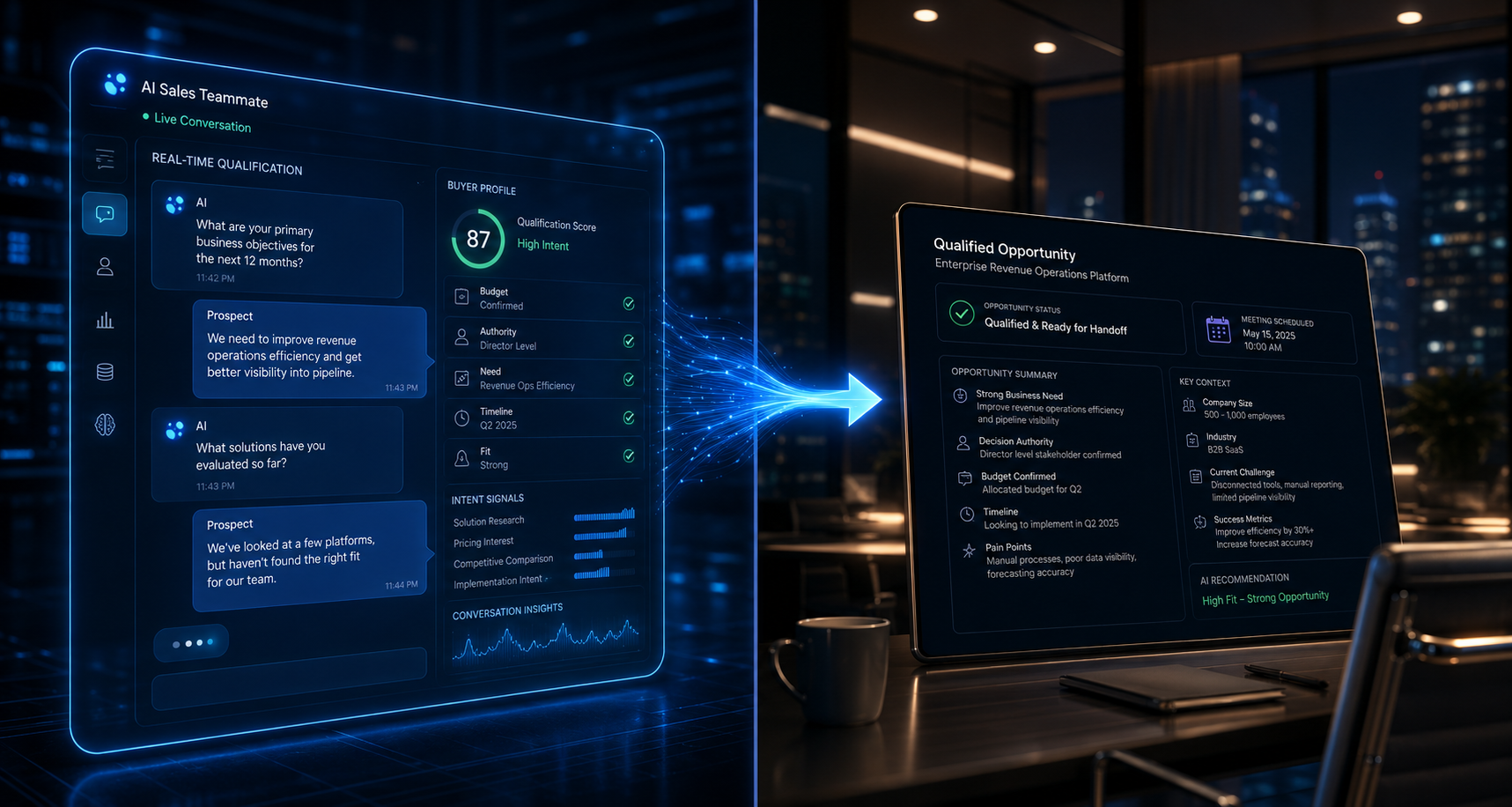
What Are Human-AI Sales Teammates?
Human-AI sales teammates are AI-powered software agents and human sales professionals working together within a shared sales process.
AI agents may research accounts, initiate approved outreach, respond to customer questions, collect qualification information, prepare summaries, and recommend next actions.
Human salespeople use that information to understand customer needs, build relationships, solve complex problems, and manage important purchasing decisions.
This approach is also called human-AI sales collaboration or an AI-augmented sales team.
It differs from traditional automation because some AI agents can interpret buyer responses, use approved business information, and select actions within defined permissions.
What Is the Difference Between an AI Sales Assistant and an Autonomous AI Agent?
An AI sales assistant usually supports a human employee.
For example, it may summarize a meeting, prepare an email draft, or suggest questions for the next discovery call.
The salesperson reviews the output and decides what to do.
An autonomous AI sales agent can perform certain assigned activities without waiting for human approval at every step.
For example, a properly configured outbound AI agent may research suitable prospects, send permitted messages, interpret replies, and collect qualification information.
However, autonomy should have clear limits.
An agent that can respond to pricing questions should not automatically have permission to offer unauthorized discounts or accept contractual terms.
How Are Human-AI Teams Different From Traditional Sales Teams?
Traditional sales organizations often divide work between sales development representatives (SDRs), account executives (AEs), account managers, and revenue operations teams.
Each group performs tasks that require different levels of expertise.
Human-AI teams retain those business responsibilities but use AI to assist with or complete selected activities.
For example, an SDR may no longer need to manually research every company before outreach.
An AI research agent can prepare an account summary, while the SDR or sales manager validates important details and determines the appropriate engagement strategy.
An account executive may receive structured qualification information before speaking with a prospect.
This allows the employee to concentrate on the customer’s business problem instead of repeating basic questions.
Why Are Human-AI Sales Teams Growing in 2026?
B2B companies are adopting AI because sales teams face growing workloads, complex buying processes, and pressure to improve revenue productivity.
However, adoption alone does not guarantee better results.
The strongest business case comes from improving how work is performed.
Salesforce: More Than Half of Sellers Have Used AI Agents
The Salesforce State of Sales Report 2026 surveyed 4,050 sales professionals.
It found that 54% of sellers had used AI agents.
The research also found that top-performing sellers were 1.7 times more likely to use AI agents for prospecting than lower-performing sellers.
Salesforce reported that sellers expected fully implemented agents to reduce prospect research time by 34% and email drafting time by 36%.
These reductions were expectations, not verified savings across every company.
The findings show that AI is becoming part of sales operations, but the relationship between AI adoption and stronger performance does not establish that AI alone caused the difference.
McKinsey: Sales Growth Requires Better Workflows
In July 2026, McKinsey published research on how AI is changing B2B sales.
The research drew on nearly 4,000 buyers and sellers across 13 countries.
Among growth leaders that had integrated AI into core workflows, 59% identified seller efficiency as a primary benefit, while 53% identified improved customer experience.
McKinsey emphasized redesigning commercial workflows rather than simply adding AI tools to existing processes.
This distinction matters.
Automating an inefficient process may increase activity without improving customer outcomes or revenue.
Gartner: AI Saves Time, but Companies Must Use It Effectively
In May 2026, Gartner reported that AI tools saved sellers an average of 4.8 hours per week.
However, 72% of surveyed sales organizations showed low reinvestment of the saved time into high-value selling activities.
The research involved 210 chief sales officers and senior sales leaders.
Organizations achieving meaningful AI time savings and reinvesting those hours were 2.2 times more likely to exceed customer growth goals than organizations reinvesting less.
These findings are associations, not proof of causation.
They highlight an important principle: saving time has limited commercial value if employees do not use that capacity productively.
Which Sales Tasks Should AI and Human Representatives Handle?
Human-AI collaboration works best when companies assign tasks according to complexity, risk, and customer needs.
AI is often suitable for repetitive, information-heavy work.
Human representatives provide judgment, business understanding, and accountability during sensitive or complex decisions.
| Sales activity | AI teammate responsibilities | Human salesperson responsibilities |
|---|---|---|
| Prospect research | Gather and summarize account information | Select strategic target accounts |
| Initial outreach | Prepare or send approved personalized messages | Guide outreach strategy and major relationships |
| Lead qualification | Collect buyer needs, fit, and intent signals | Validate complex or uncertain opportunities |
| Discovery preparation | Summarize customer history and conversations | Investigate deeper business problems |
| Product questions | Provide verified information | Address complex requirements |
| Meeting scheduling | Coordinate availability when integrated | Lead relationship-building discussions |
| Sales presentations | Prepare or deliver approved materials | Adapt complex solutions to business needs |
| Objection handling | Address supported routine concerns | Resolve sensitive or strategic objections |
| Proposal preparation | Draft documents from approved information | Review scope, pricing, and commitments |
| Contract negotiation | Organize commercial context | Negotiate and approve contractual terms |
| CRM management | Prepare or perform permitted updates | Verify important records and own opportunities |
| Sales forecasting | Identify trends and potential risks | Apply judgment and take responsibility for forecasts |
The exact division depends on the organization.
A simple, low-risk transaction may support greater automation.
An enterprise deal involving several departments, legal reviews, and specialized technical requirements usually needs more human involvement.
What Can AI Sales Teammates Do Better Than Manual Workflows?
AI agents can help sales organizations perform repeatable activities consistently when connected to suitable data and systems.
Prospect Research and Lead Enrichment
Sales representatives often spend time reviewing company websites, professional profiles, industry information, and existing CRM records.
AI research tools can organize information from authorized sources and prepare account summaries.
For example, an AI agent may identify a company’s industry, recent business expansion, and possible technology requirements.
A human representative can review those findings before deciding whether the account is worth pursuing.
Personalized Initial Engagement
AI can use approved customer information to prepare relevant outreach messages.
For example, an AI sales agent may adapt its introduction for a chief revenue officer, finance director, or revenue operations manager.
The message should address a relevant business problem instead of inserting a first name into a generic template.
The system must also follow applicable communication rules and respect opt-out requests.
Real-Time Qualification
Conversational AI can ask buyers about their current challenges, purchasing timeline, existing systems, and decision-making process.
It may use frameworks such as BANT or MEDDICC where appropriate.
However, the system should not invent missing budget information or assume that a pricing question confirms purchase readiness.
Meeting and Workflow Coordination
Where supported, AI can help schedule meetings, update CRM records, prepare notes, and recommend follow-up actions.
These functions may reduce administrative work and prevent information from being lost between departments.
Their effectiveness depends on reliable integrations and clear approval rules.
Which Sales Activities Still Require Human Judgment?
AI can support sales decisions, but human expertise remains important when buyers need trust, detailed understanding, or accountability.
Building Executive Relationships
Enterprise relationships often develop through repeated interactions.
Human representatives help customers discuss sensitive priorities, understand organizational concerns, and establish confidence in long-term partnerships.
AI can prepare account information, but it cannot independently guarantee the trust required for every strategic relationship.
Complex Discovery and Solution Design
Some customers have requirements that do not fit standard product configurations.
A buyer may need a combination of technical integrations, custom onboarding, and specialized security controls.
Experienced account executives and solution engineers can assess trade-offs and recommend appropriate solutions.
Commercial Negotiations
Pricing exceptions, contract terms, procurement requirements, and strategic commitments can carry financial or legal consequences.
AI may prepare supporting information, but authorized employees should retain control over important approvals.
Buying Committee Alignment
B2B purchasing decisions may involve finance, IT, operations, procurement, and senior leadership.
These stakeholders can have different priorities.
Human representatives can help identify disagreements, explain business value, and coordinate discussions.
AI can support this work with relevant information, but it should not independently assume that every stakeholder has approved the purchase.
How Do Human-AI Sales Teammates Work Together?
A coordinated sales process allows AI agents and human employees to work on the same opportunity without requiring the buyer to repeat information.
The following seven-step workflow illustrates how this collaboration can operate.
Step 1: AI Supports Initial Buyer Engagement
A prospect responds to an outbound sales message or requests information through a supported channel.
An AI agent can acknowledge the inquiry, provide approved information, and begin discovery.
For example, a prospect may ask whether a sales platform can reduce manual qualification work.
The AI can ask about the organization’s current process and identify what information the buyer needs.
Step 2: AI Collects Qualification Information
The AI asks relevant questions about the business problem, company fit, purchasing timeline, and technical requirements.
It may also collect information about the existing CRM, sales team size, and relevant decision-makers.
The system should identify which details are confirmed and which remain unknown.
Step 3: AI Identifies a Suitable Sales Opportunity
The AI compares the buyer’s statements with the company’s qualification standards.
For example, a prospect may match the ideal customer profile, have a defined business problem, and be evaluating solutions during the current quarter.
Those signals may justify further sales engagement.
However, the agent should not create a high-priority opportunity based on an unverified assumption.
Step 4: A Human Representative Reviews the Handoff
Once the opportunity meets the appropriate criteria, the system passes relevant information to the responsible salesperson.
A useful handoff contains the buyer’s role, business needs, existing systems, purchasing timeframe, outstanding concerns, and agreed next action.
The representative checks whether the information is sufficient and accurate.
This helps avoid repeated discovery questions.
Step 5: The Human Advances the Relationship
The account executive or relationship manager continues the sales process.
The human may conduct deeper discovery, coordinate demonstrations, address implementation concerns, or involve additional stakeholders.
The representative remains responsible for the opportunity’s commercial progression.
Step 6: AI Supports Deal Preparation
During later sales stages, AI can help summarize meetings, prepare approved documents, highlight missing information, and draft follow-ups.
The salesperson reviews important recommendations and ensures they reflect the actual customer situation.
Step 7: Both Contribute to Revenue Intelligence
After the opportunity progresses or closes, the sales organization can review the available conversation data and final outcome.
AI can help identify recurring objections, buyer requirements, or process delays.
Sales leadership and revenue operations should validate those patterns before changing strategy.
This creates a continuous process in which customer conversations inform future qualification, messaging, and sales execution.
What Does a Human-AI Sales Handoff Look Like in Practice?
Consider a fictional B2B SaaS company evaluating an AI sales automation solution.
A prospect responds to an outbound message outside normal working hours.
The following example illustrates an AI-assisted sales workflow. It is not a verified customer conversation or a performance claim about XYNEXI.
Buyer:
“We’re looking for a way to reduce repetitive SDR work. We have seven representatives, and too much time goes into qualifying leads.”
AI Sales Agent:
“Which part of qualification takes the most time for your team?”
Buyer:
“Researching accounts and finding out whether prospects are ready to buy.”
AI Sales Agent:
“Are you exploring options for later, or are you planning to change the process soon?”
Buyer:
“We want something in place this quarter.”
AI Sales Agent:
“Which CRM does your team use, and who would be involved in approving a solution?”
Buyer:
“We use Salesforce. I’m the VP of Sales, and our CRO approves major software purchases.”
AI Sales Agent:
“Thanks. A focused discussion with a sales specialist could help assess your qualification workflow and Salesforce requirements. Would you like to arrange that?”
Buyer:
“Yes. Please include the integration questions.”
At this point, the AI has identified a potential opportunity and an agreed next action.
The system can prepare a summary for the human salesperson.
Example Qualification Handoff
| Field | Buyer information |
|---|---|
| Buyer role | VP of Sales |
| Company type | B2B SaaS |
| Sales team | Seven representatives |
| Primary challenge | Excessive SDR research and qualification work |
| Existing CRM | Salesforce |
| Purchasing timeframe | Current quarter |
| Approval authority | CRO |
| Budget status | Not confirmed |
| Technical requirement | Salesforce compatibility |
| Recommended next step | Specialist-led discovery discussion |
The human representative now has relevant context.
Instead of repeating basic qualification questions, the next conversation can focus on technical fit, operational requirements, financial value, and purchasing approval.
The AI prepares the opportunity. The human continues the relationship and commercial evaluation.
How Do Human-AI Sales Teams Improve Buyer Experience?
The buyer experience is an important part of human-AI sales collaboration.
Customers may want immediate information while also needing human support during complex decisions.
Faster Access to Useful Information
An AI agent can provide supported product information or collect requirements when a human representative is unavailable.
This may be useful for businesses serving customers across several time zones.
However, speed is not enough.
The information must be accurate and relevant.
Fewer Repeated Questions
Connected systems can preserve customer context across interactions.
For example, a buyer who already explained a technical requirement to an AI agent should not need to repeat the same details to an account executive.
This requires reliable CRM integration and appropriate data permissions.
Access to Human Expertise
Buyers should be able to request human assistance when they need it.
In May 2026, Gartner reported that 69% of surveyed B2B buyers preferred validating AI-generated insights with sales representatives.
The research involved 645 buyers surveyed in August and September 2025.
It shows that digital assistance and human sales expertise can serve different needs during the same buying journey.
Trust Through Transparency
Businesses should clearly communicate when customers are interacting with AI.
They should also explain how important customer information will be handled.
The AI should never pretend to have performed an action it has not completed.
For example, it should not claim that a meeting is booked until scheduling is confirmed.
Will AI Sales Agents Replace Human SDRs and Account Executives?
AI can automate some activities traditionally performed by SDRs and account executives.
However, this does not mean every sales role will disappear.
The effect depends on the complexity of the work, the company’s sales model, and the level of autonomy granted to AI agents.
How SDR Roles May Change
AI can support or automate prospect research, outreach preparation, initial engagement, qualification, and certain follow-up tasks.
This may reduce the amount of manual work assigned to SDRs.
Some companies may redesign SDR roles around supervising AI workflows, managing exceptions, and developing qualified opportunities.
Others may use automation to increase sales capacity without hiring additional representatives.
How Account Executive Roles May Change
Account executives may spend less time gathering basic information and more time on deeper customer conversations.
Their responsibilities may increasingly emphasize solution design, stakeholder alignment, financial justification, and negotiation.
AI can support these activities through research and preparation.
However, commercial judgment remains important.
What Does Gartner Predict About AI Agents?
In November 2025, Gartner predicted that AI agents could outnumber human sellers by ten to one by 2028.
The organization also predicted that fewer than 40% of sellers would report productivity improvements from AI agents.
These are forecasts, not observed outcomes.
They highlight the risk of deploying large numbers of agents without clear responsibilities, reliable data, and effective workflow integration.
The important question is not how many AI agents a company uses.
It is whether those agents help people deliver better commercial results.
How to Build an Effective Human-AI Sales Team
A successful human-AI sales model requires clear responsibilities, reliable systems, employee training, and measurable goals.
The following seven steps provide a practical implementation framework.
Step 1: Identify Repetitive Sales Work
Review how SDRs, account executives, and revenue operations employees spend their time.
Look for repetitive tasks such as account research, initial qualification, scheduling, CRM updates, and routine follow-ups.
Identify which activities create delays or reduce selling capacity.
Start with tasks that are repeatable, measurable, and relatively low risk.
Step 2: Assign Responsibilities Between People and AI
Define which activities AI agents can complete independently.
Identify which tasks require human review and which decisions must remain entirely under human control.
For example, AI may prepare a proposal draft, but a human account executive should approve the final commercial terms.
Document ownership and escalation rules.
Step 3: Connect Reliable Data and Approved Knowledge
AI agents need accurate information to support useful sales interactions.
Connect approved product documentation, pricing information, qualification standards, and permitted CRM data.
Systems such as Salesforce and HubSpot can provide relevant customer context when integrations are properly configured.
Keep data current and avoid granting unnecessary access.
Step 4: Configure Human Handoff Rules
Define the conditions that require human involvement.
These may include a qualified buyer requesting a meeting, an unresolved technical question, a commercial exception, or a strategic account.
The system should preserve conversation context during every transfer.
Step 5: Train Sales Representatives to Work With AI
Employees need to understand what the AI can and cannot do.
Training should cover reviewing AI-generated summaries, checking account information, handling incorrect outputs, and managing escalated conversations.
Managers should also explain how automation changes sales responsibilities.
Clear training reduces confusion and helps employees use the technology appropriately.
Step 6: Test One Workflow Before Expanding
Begin with a limited pilot.
For example, a B2B company might test AI-assisted qualification for a defined group of outbound prospects.
Compare the results with the existing process.
Measure qualified opportunities, sales acceptance, buyer experience, response accuracy, and complete operating costs.
Avoid launching several disconnected agents before understanding the results of the first workflow.
Step 7: Improve and Expand Successful Processes
Review the pilot findings.
Identify where AI reduces unnecessary work and where human involvement remains essential.
Adjust qualification rules, knowledge sources, escalation conditions, and CRM integrations.
Expand only when the workflow demonstrates reliable commercial value.
How Should Sales Leaders Redesign Team Responsibilities?
Introducing AI agents affects more than individual tasks.
It changes how sales managers, SDRs, account executives, and revenue operations teams coordinate their work.
Sales Development Representatives
SDRs may spend more time reviewing complex prospects, managing exceptions, and progressing qualified opportunities.
They can also help improve the quality of AI-led discovery by identifying missing qualification questions and common buyer concerns.
Account Executives
Account executives should receive structured buyer context and remain accountable for their opportunities.
They can use AI-generated research and summaries to prepare for discovery, presentations, and negotiations.
Revenue Operations
Revenue operations teams can manage CRM connections, data standards, workflow permissions, reporting, and automation quality.
They should also track whether the new operating model improves commercial outcomes.
Sales Managers
Sales managers remain responsible for coaching, forecasting, employee performance, and accountability.
They should review AI-assisted interactions, identify skill gaps, and ensure that time saved through automation supports productive selling.
Chief Revenue Officers
CROs should determine how AI investments support business goals.
Their responsibilities include setting priorities, evaluating financial returns, protecting buyer experience, and ensuring that employees remain accountable for important decisions.
How Do You Measure Human-AI Sales Productivity and ROI?
Human-AI sales collaboration should be evaluated through both operational efficiency and financial results.
Counting automated tasks or messages does not establish that the system improves revenue.
| KPI | What it measures |
|---|---|
| Revenue per sales rep | Total sales revenue divided by average sales headcount |
| Seller time saved | Hours of repetitive work reduced through AI |
| Time reinvestment rate | Saved hours redirected to valuable selling activities |
| Qualified conversation rate | Conversations meeting defined qualification criteria |
| Human handoff acceptance rate | AI-qualified handoffs accepted by sales representatives |
| Lead-to-opportunity conversion | Qualified opportunities divided by eligible leads |
| Opportunity win rate | Closed-won opportunities divided by completed opportunities |
| AI response accuracy | Correct verified responses divided by reviewed AI responses |
| Buyer satisfaction | Customer feedback on helpfulness and clarity |
| Incremental AI program ROI | Net attributable financial benefits relative to total program costs |
Measuring Revenue per Representative
Revenue per rep indicates how much sales revenue is produced relative to team size.
Revenue per Rep = Total Sales Revenue ÷ Average Number of Sales Representatives
For example, a company generates $2 million in annual sales revenue with 10 representatives.
Revenue per rep is $200,000.
If sales increase to $2.5 million while headcount remains unchanged, revenue per rep rises to $250,000.
That represents a 25% improvement by this measure.
However, the increase should not automatically be attributed to AI.
Pricing changes, customer demand, and other business factors may also affect revenue.
Measuring AI Time Savings
Suppose 10 representatives each save four hours per week through AI assistance.
The total reduction in manual work is 40 hours per week.
However, those hours do not automatically represent a full employee’s salary saved.
If the employees remain on staff, the company should examine how the additional time is used.
For example, representatives may spend more time on qualified discovery calls, customer expansion, or strategic accounts.
Measure whether those activities create additional commercial value.
Calculating Human-AI Sales ROI
A practical formula is:
ROI = [(Incremental Gross Profit + Verified Cost Savings − Total Program Costs) ÷ Total Program Costs] × 100
Suppose a company invests $20,000 in an AI sales pilot.
The company attributes $32,000 in additional gross profit to the tested workflow and identifies no separate verified cost savings.
Its calculated ROI is:
($32,000 − $20,000) ÷ $20,000 × 100 = 60%
This is a hypothetical example, not a verified product result.
Actual calculations should include software, implementation, integrations, usage, supervision, and maintenance.
Businesses should compare similar buyer groups and follow opportunities through completed sales cycles before making major investment decisions.
What Real-World Examples Show Human-AI Collaboration in Sales?
Published company research provides examples of how AI agents can support existing sales organizations.
Salesforce: AI Prospecting With Human Sales Teams
In its February 2026 State of Sales announcement, Salesforce described an internal AI prospecting initiative.
The company reported that its agents contacted 130,000 previously untouched leads and generated 3,200 opportunities over four months.
This illustrates how AI can help sales teams engage contacts that might otherwise remain unworked.
However, the opportunity count is not the same as closed revenue.
The announcement does not establish how much incremental gross profit the initiative generated.
McKinsey: Combining Agentic AI With Relationship Management
McKinsey’s July 2026 B2B sales research described organizations redesigning commercial workflows around AI agents and human sellers.
The report identified examples from financial services where changes to prospecting and relationship-management workflows were associated with revenue per relationship manager increasing by 3% to 15%.
It also reported cost-to-serve reductions of 20% to 40% in those examples.
These figures come from McKinsey’s reported experience with specific implementations.
They should not be treated as guaranteed results for every B2B sales organization.
The important lesson is that AI works best when companies redesign complete workflows instead of automating isolated tasks.
What Are the Main Risks of Human-AI Sales Teammates?
Human-AI collaboration introduces operational, legal, and technical risks that businesses need to manage.
Incorrect Customer Information
AI may use outdated CRM records or inaccurate external information.
This can lead to unsuitable outreach messages, poor qualification, and incorrect recommendations.
Verify important account information before taking significant actions.
Unsupported AI Claims
An AI agent may generate incorrect statements about product features, security, pricing, or implementation.
These errors can damage buyer trust.
Use approved knowledge sources and define topics that require human review.
Poor Sales Handoffs
If the AI fails to preserve buyer context, the human representative may need to repeat discovery.
This can increase friction instead of reducing it.
Test handoff summaries and CRM associations regularly.
Privacy and Data Security
Buyer conversations may contain confidential information.
Organizations should apply appropriate access controls, retention policies, and data processing safeguards.
The NIST Generative AI Risk Management Profile provides guidance for managing generative AI risks.
For U.S. commercial email, the Federal Trade Commission’s CAN-SPAM guidance explains requirements that also apply to B2B marketing messages.
AI Agent Sprawl
Adding too many disconnected AI agents can create overlapping responsibilities and inconsistent information.
In its 2026 research, Gartner warned that poorly integrated AI agents may increase digital activity without producing meaningful productivity gains.
Companies should prioritize clear ownership, reliable data, and coordinated workflows.
How Does XYNEXI Support Human-AI Sales Collaboration?
XYNEXI is an autonomous AI SDR and BDR platform built on its AIRPEC multi-agent reasoning engine.
Its published product information describes AI-powered prospect research, outbound buyer engagement, intelligent discovery, qualification, personalized solution presentations, objection handling, and purchase intent verification.
XYNEXI uses the term Human AI™ for its conversational sales technology.
AI Handles Outbound Sales Development
According to XYNEXI’s official platform overview, its AI sales agent supports the outbound pre-close process.
This includes identifying prospects, engaging buyers through supported channels, conducting discovery conversations, and collecting qualification information.
The AIRPEC engine is described as using context awareness, autonomous reasoning, and persona personalization to adapt interactions.
Human Representatives Retain Commercial Control
XYNEXI describes a Human-In-The-Loop operating model.
The AI handles defined outbound sales execution activities, while people remain responsible for strategy, pricing, customer relationships, and contract execution.
This division reflects a human-AI sales structure in which automation and human oversight serve different purposes.
Buyer Context Supports Better Handoffs
XYNEXI’s published workflow includes delivering qualified, intent-verified prospects to human relationship managers with conversation information.
This can help representatives understand the buyer’s requirements before beginning a commercial discussion.
However, the quality of the handoff depends on accurate qualification and reliable customer information.
Evaluating XYNEXI for Your Sales Team
Businesses considering XYNEXI should assess how its available features match their actual workflows.
Important areas include outbound engagement requirements, qualification criteria, supported integrations, escalation controls, reporting, and total costs.
XYNEXI’s official positioning focuses primarily on autonomous outbound sales development. Companies requiring particular inbound website, scheduling, or CRM features should confirm their availability before deployment.
The main objective is to improve the coordination between AI-led execution and human-led commercial decisions.
AI can extend sales capacity, while human representatives remain responsible for the judgment and relationships that complex B2B sales require.
Explore how XYNEXI works to learn more about its Human AI™ sales model and AIRPEC reasoning engine.
What Is the Future of Human-AI Sales Teams?
Human-AI collaboration is likely to become more integrated into B2B sales workflows as AI agents gain additional capabilities.
However, the extent of adoption and its financial results remain uncertain.
Some organizations may automate more initial sales development work.
Others may use AI primarily for research, meeting preparation, CRM administration, and sales coaching.
The most effective division of responsibilities will depend on the customer, product, sales process, and risks involved.
Revenue leaders should focus on building reliable operating models rather than simply increasing the number of deployed agents.
That means maintaining accurate data, training employees, defining approval rules, and measuring commercial outcomes.
Human sales professionals are likely to spend more time on complex customer problems, strategic relationships, and decisions requiring expertise.
AI agents can support that work by preparing relevant information and handling suitable repetitive activities.
The future of B2B sales is not only about making AI more capable. It is about helping people and AI work together in ways that create measurable value for buyers and businesses.
Conclusion
Human-AI sales teammates are transforming B2B sales by changing how organizations distribute work between people and technology.
AI agents can support prospect research, initial engagement, qualification, customer information management, and repetitive sales activities.
Human representatives continue to provide relationship building, complex discovery, commercial judgment, and accountability.
Research from Salesforce, Gartner, and McKinsey shows growing interest in AI-powered sales workflows and reported improvements in productivity.
However, AI adoption alone does not guarantee higher revenue.
Organizations must connect agents with reliable information, define appropriate responsibilities, preserve buyer trust, and reinvest saved time into valuable sales activities.
The strongest human-AI sales model is one where technology helps employees spend less time on unnecessary work and more time helping customers make informed purchasing decisions.
AI handles appropriate execution. Humans provide judgment and accountability. Together, they can create a more productive B2B sales organization.
Frequently Asked Questions
1. What Are Human-AI Sales Teammates?
Human-AI sales teammates are AI-powered agents and human sales representatives working together within the same sales process. AI handles suitable tasks such as prospect research, initial engagement, qualification, and information management. Human representatives manage complex discovery, customer relationships, negotiations, and important commercial decisions. The objective is to improve sales capacity, efficiency, and buyer experience.
2. Will AI Sales Agents Replace Human Sales Representatives?
AI agents can automate some activities traditionally performed by SDRs and account executives, particularly repetitive prospecting and qualification work. However, complex B2B sales still benefit from human expertise in relationship building, stakeholder alignment, negotiation, and commercial decision-making. The extent of role replacement or redesign depends on the company’s sales model, automation capabilities, and customer requirements.
3. Which Sales Tasks Should AI Handle Instead of Human Reps?
AI is often suitable for account research, lead enrichment, routine outreach, initial qualification, meeting summaries, scheduling support, and approved CRM updates. Human representatives should retain responsibility for strategic accounts, complex technical discovery, sensitive pricing, negotiation, and customer relationships. Companies should assign tasks based on risk, complexity, available AI capabilities, and the level of judgment required.
4. How Do AI Agents Collaborate With SDRs and Account Executives?
AI agents can engage suitable prospects, gather qualification details, identify relevant buying signals, and prepare structured handoff summaries. SDRs or account executives then review important information and continue the relationship. During later stages, AI may assist with meeting preparation, summaries, and approved workflow updates. Reliable CRM integration and clear ownership help prevent repeated questions and lost context.
5. How Can B2B Companies Build an Effective Human-AI Sales Team?
Start by identifying repetitive tasks and sales bottlenecks. Define AI and human responsibilities, connect reliable data, establish qualification and escalation rules, and train representatives to review AI outputs. Test one workflow before expanding. Measure buyer experience, qualification accuracy, accepted opportunities, sales productivity, and program costs to determine whether the implementation creates business value.
6. How Do You Measure the ROI of Human-AI Sales Collaboration?
Measure ROI by comparing incremental gross profit and verified cost savings with the total cost of AI software, implementation, integration, and supervision. Supporting metrics include revenue per rep, qualified conversation rates, sales acceptance, win rates, and time reinvestment. Use comparable customer groups and completed sales outcomes to evaluate whether human-AI collaboration actually improves commercial performance.