
B2B companies often respond to stalled revenue by hiring more sales representatives, yet larger teams also bring training costs and administrative work. Revenue can grow without matching headcount growth when existing sellers qualify better prospects, close more deals, and expand customer accounts.
Can B2B Companies Scale Revenue Without Hiring More Sales Reps?
Yes, B2B companies can scale revenue without hiring more sales reps by improving lead conversion, increasing win rates, shortening sales cycles, growing average deal value, and expanding existing customer accounts. AI sales automation can reduce repetitive work and increase selling capacity, while human representatives focus on qualified opportunities, customer relationships, and complex purchasing decisions.
Scaling revenue without adding headcount means generating more business value from the sales capacity a company already has.
The objective is not to make employees work longer hours or contact more prospects without a clear strategy.
Instead, sales leaders should identify where revenue opportunities are lost, reduce unnecessary work, and help existing representatives close more profitable business.
For B2B SaaS companies, this also includes increasing annual recurring revenue (ARR) through customer retention, upselling, and account expansion.
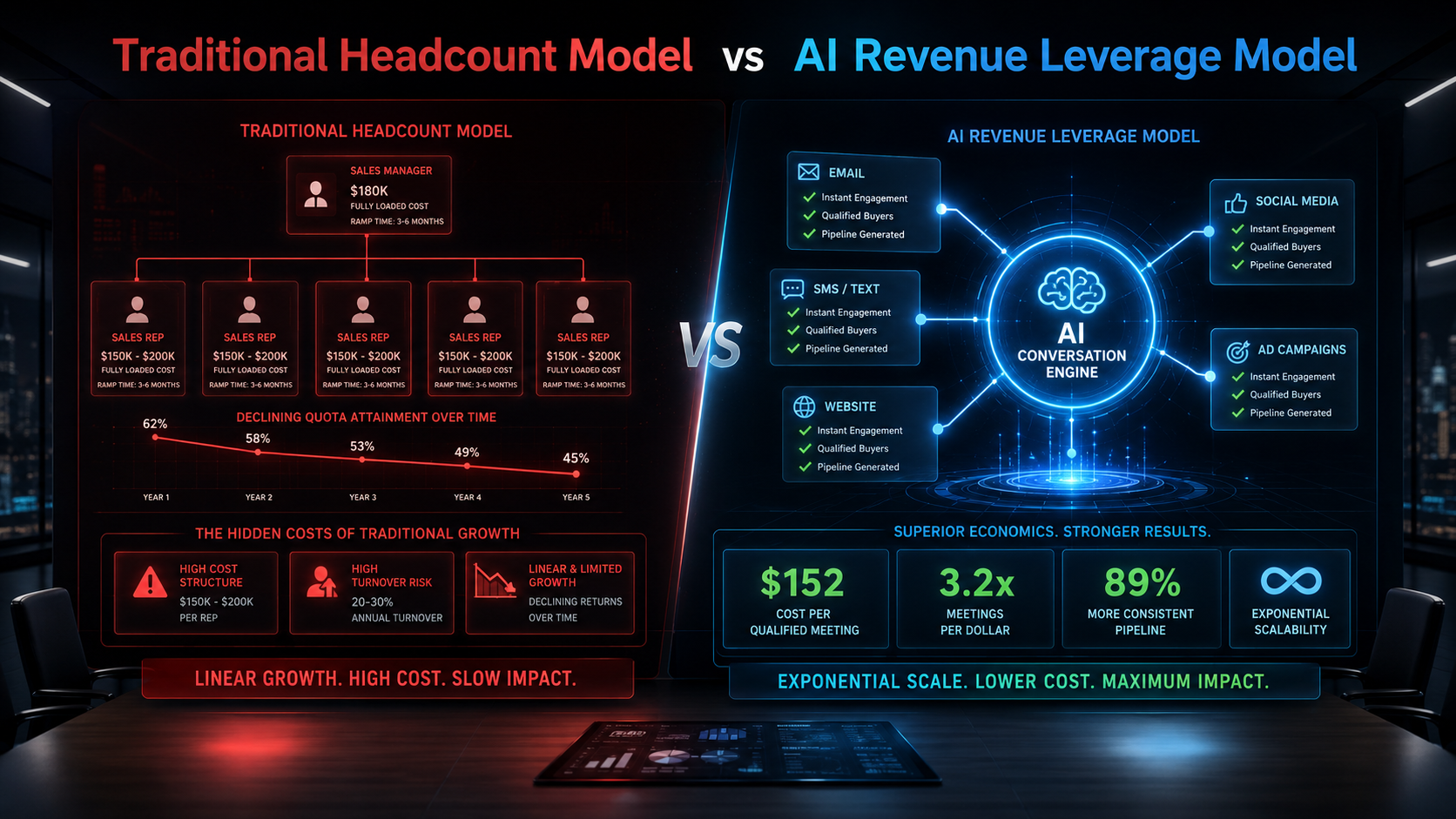
Why Doesn’t Revenue Growth Always Require More Salespeople?
Hiring more representatives can increase sales capacity, but it also increases operating costs.
A growing sales team requires compensation, training, management, software access, and ongoing support.
New employees also need time to understand products, target customers, and internal sales processes.
If the existing sales system contains serious problems, adding employees may increase expenses without delivering proportional revenue growth.
The Limitations of Hiring-Driven Sales Growth
Consider a company generating 500 inbound leads each month.
Its sales team struggles to qualify prospects, resulting in many meetings with organizations that are not ready to purchase.
Hiring two additional SDRs may help the company contact more leads.
However, the new employees will still operate under the same qualification process.
The business may generate more meetings without improving opportunity quality or conversion rates.
A better starting point is identifying why existing leads fail to become customers.
More sales activity does not automatically mean more revenue.
Sales Productivity vs. Sales Activity
Sales activity measures tasks such as calls, emails, meetings, and CRM updates.
Sales productivity measures the valuable outcomes produced from those activities.
For example, two representatives may each make 50 calls.
One creates five qualified opportunities while the other creates one.
Their activity levels are similar, but their results are different.
Revenue leaders should therefore focus on qualified opportunities, sales conversion, and gross profit rather than activity volume alone.
What Does Salesforce’s 2026 Research Reveal?
The Salesforce State of Sales Report 2026 examined responses from 4,050 sales professionals.
The report found that the average seller spends approximately 40% of working time selling.
It also found that 48% of sellers believed they lacked enough time for adequate cold outreach, despite spending nearly a full working day each week on prospecting.
These findings point to a significant sales capacity problem.
Representatives divide their time between customer conversations, prospect research, administrative tasks, meetings, and other responsibilities.
Reducing unnecessary work can give existing teams more time to pursue qualified revenue opportunities.
What Are the 7 Best Ways to Scale B2B Revenue Without Expanding Sales Teams?
Revenue growth without additional sales headcount depends on improving how existing opportunities become customers.
The following seven strategies address different stages of the B2B sales process.
1. Improve Conversion From Existing Leads
Before increasing lead generation spending, review how many existing prospects become customers.
A B2B company may already receive sufficient inquiries but lose opportunities because of delayed engagement, weak qualification, or inconsistent follow-ups.
Start by reviewing lead-to-opportunity conversion rates.
Lead-to-Opportunity Conversion Rate = (Qualified Opportunities ÷ Total Eligible Leads) × 100
For example, if a company generates 400 leads and creates 40 qualified opportunities, its conversion rate is 10%.
If better engagement and qualification increase that number to 60 opportunities, conversion rises to 15%.
The company creates 20 additional qualified opportunities without increasing lead volume.
However, those opportunities must still progress to actual purchases before the improvement can be considered additional revenue.
2. Qualify Buyers Before Sales Representatives Engage
Poor qualification can consume valuable selling time.
Representatives may spend hours pursuing prospects who lack a relevant business need, suitable company profile, or realistic purchasing plan.
A clear ideal customer profile (ICP) helps identify organizations that match the product.
Teams can also use qualification frameworks such as BANT and MEDDICC.
BANT examines budget, authority, need, and timing.
MEDDICC provides a more detailed approach for complex B2B opportunities, covering factors such as decision criteria, economic buyers, business pain, and internal champions.
Qualification should rely on verified buyer information rather than assumptions based only on downloads, email opens, or website visits.
Better qualification can help representatives spend more time with prospects who have genuine purchasing potential.
3. Increase Opportunity Win Rates
A higher win rate allows companies to generate more revenue from the same number of sales opportunities.
Suppose a team works on 100 completed opportunities with an average deal value of $10,000.
At a 20% win rate, the team generates $200,000 in sales.
If the win rate increases to 25% while the opportunity count and average deal value remain unchanged, sales increase to $250,000.
That represents $50,000 in additional revenue without hiring another representative.
This is a mathematical example, not a predicted outcome.
Improving win rates may require better discovery, clearer product positioning, stronger business cases, and earlier involvement from decision-makers.
Sales leaders should examine why deals are lost rather than assuming every unsuccessful opportunity is a pricing problem.
4. Reduce Unnecessary Sales Cycle Delays
Long sales cycles can limit how many opportunities a representative handles during a given period.
Some delays are unavoidable because buyers need time for procurement, technical evaluations, and internal approval.
Others result from unclear handoffs, repeated discovery questions, scheduling problems, or slow proposal preparation.
Revenue teams can reduce avoidable delays through better CRM records, automated scheduling, faster access to product information, and clear next steps.
For example, an account executive should receive relevant discovery notes before meeting a qualified prospect.
The buyer should not need to repeat basic requirements already shared with the SDR.
A shorter sales cycle can increase sales capacity, but it should not come at the cost of pressuring customers into poor decisions.
5. Increase Average Deal Value
Higher average deal value can increase revenue without increasing the number of customers.
Businesses may improve deal value through suitable product packages, additional services, premium features, or enterprise agreements.
However, the larger offering must provide value to the customer.
For example, a B2B SaaS company may offer a standard subscription and an advanced package with additional integrations and security controls.
Enterprise customers with those requirements may prefer the higher-value package.
The sales team should recommend the appropriate solution based on business needs rather than automatically pushing the most expensive option.
Monitor gross margin alongside average contract value to ensure larger deals remain profitable.
6. Automate Repetitive Sales Workflows
AI and workflow automation can reduce time spent on tasks that do not require constant human judgment.
Potential activities include prospect research, lead enrichment, initial qualification, scheduling, follow-up preparation, and CRM administration.
For example, an AI sales agent can conduct an initial conversation with a prospect and collect relevant requirements.
A human account executive can then receive the information before taking over a complex sales discussion.
Automation may increase the number of suitable opportunities a team can manage.
However, the benefit depends on reliable data, accurate answers, and effective handoffs.
7. Grow Revenue From Existing Customers
New customer acquisition is not the only source of B2B revenue growth.
Existing customers may purchase additional seats, expand into new departments, adopt premium features, or add related services.
For subscription businesses, customer expansion can increase ARR without requiring a proportional increase in new customer acquisition.
Customer success teams can identify expansion opportunities through usage patterns, support requests, renewal discussions, and direct customer conversations.
For example, an existing customer may increase employee usage and require additional software licenses.
Offering the appropriate package can increase account revenue.
Customer retention is equally important. Revenue lost through cancellations and downgrades can offset growth from new sales.
How Can AI Increase Sales Productivity Without More Headcount?
AI can help B2B companies improve sales capacity by reducing repetitive work and supporting better decisions.
However, using AI software does not automatically produce additional revenue.
The greatest value comes when saved time is redirected toward meaningful selling activities.
What Does Gartner’s 2026 Research Show?
In May 2026, Gartner reported that AI tools saved sellers an average of 4.8 hours per week.
However, 72% of surveyed sales organizations reported low reinvestment of those savings into high-value sales activities.
The study involved 210 chief sales officers and senior sales leaders.
Organizations that achieved meaningful AI time savings and reinvested those hours were 2.2 times more likely to exceed customer growth goals and 3.1 times more likely to exceed lead-to-opportunity conversion goals than organizations reinvesting less.
These are reported associations, not proof that AI caused the improvements.
The findings highlight an important distinction: saving time only helps revenue growth when the business uses that time effectively.
AI-Powered Prospect Research
Sales representatives often research company websites, industries, decision-makers, and business requirements before contacting prospects.
AI tools can organize information from authorized sources and prepare relevant account summaries.
This may help representatives identify suitable buyers more efficiently.
The information should be checked before use because company data may be outdated or incomplete.
Automated Buyer Qualification
Conversational AI can collect details about business problems, product requirements, purchasing timelines, and decision-making responsibilities.
This can reduce the amount of repetitive discovery performed by human SDRs.
An effective system should distinguish between confirmed buyer information and assumptions.
It should also provide human escalation when questions involve complex technical requirements or commercial decisions.
Faster Follow-Ups and Scheduling
Automation can help maintain consistent follow-up processes.
For example, a buyer who requests additional information can receive relevant approved materials and an appropriate next-step option.
Connected scheduling tools can reduce repeated emails about meeting availability.
CRM integrations can preserve buyer information so representatives receive the necessary context.
Reinvesting Saved Time Into Selling
Sales managers should decide how representatives will use the time created by automation.
High-value activities may include complex discovery, account planning, decision-maker engagement, proposal improvement, and customer expansion.
For example, if automation saves a representative four hours each week, management can allocate part of that time to qualified enterprise opportunities.
Track whether the additional time produces more accepted opportunities, better win rates, or higher gross profit.
Do not assume that every saved hour creates an equivalent financial saving.
What Research Supports AI-Powered B2B Revenue Growth?
AI is increasingly used in sales, but research also shows that implementation quality matters.
Salesforce: Reaching Previously Untouched Leads
In its 2026 sales research, Salesforce reported that its own AI agents contacted 130,000 previously untouched leads and created 3,200 opportunities over four months.
The company also reported that top-performing sellers were 1.7 times more likely to use AI agents for prospecting than underperformers.
These findings demonstrate how automation can extend sales activity to contacts that previously received little attention.
However, opportunity creation is not the same as closed revenue.
The report does not establish that every company will achieve similar results.
McKinsey: AI Across the Full B2B Sales Cycle
In March 2025, McKinsey published research on profitable B2B growth through generative AI.
The report examined seven AI use cases across the sales process, including opportunity prioritization, customer engagement, account research, and sales coaching.
McKinsey emphasized choosing AI projects based on business problems rather than adopting technology without a clear purpose.
This supports a practical approach to revenue scaling.
Companies should identify where employees lose productive time and whether automation can improve measurable commercial outcomes.
Which Sales Activities Should Remain Human?
AI can support many repetitive tasks, but complex B2B sales still require human judgment.
Human representatives remain important for strategic account planning, contract negotiations, sensitive pricing decisions, relationship building, and unusual customer requirements.
They also help buying groups resolve concerns and gain confidence in purchasing decisions.
In May 2026, Gartner reported that surveyed B2B buyers were 39 percentage points more likely to say a human sales representative understood their needs than to say the same about generative AI.
Buyers were also 32 percentage points more likely to say a representative helped them feel confident about a purchase decision.
These findings support using automation for suitable tasks while preserving human expertise where it provides unique value.
The objective is not necessarily to eliminate sales roles.
It is to give the existing team more capacity to handle the work that benefits most from human involvement.
How Can B2B SaaS Companies Grow ARR From Existing Customers?
Annual recurring revenue (ARR) is an important measure for subscription businesses.
Companies can increase ARR through new subscriptions, customer upgrades, additional licenses, and account expansion.
However, growth also depends on retaining existing customers.
Identify Expansion Opportunities
Customer success and account management teams should monitor relevant product usage, customer goals, and changing requirements.
For example, a customer purchasing 20 user licenses may later need 40 as its organization grows.
That expansion can increase recurring revenue without requiring the full process of acquiring a new customer.
Improve Retention and Reduce Churn
Customer churn reduces the recurring revenue available to support growth.
Companies should investigate why customers cancel, reduce subscriptions, or stop using the product.
Common causes may include weak onboarding, limited product adoption, changing requirements, or poor customer support.
Addressing verified retention problems can protect recurring revenue.
Track Net Revenue Retention
Net revenue retention (NRR) measures how recurring revenue from an existing customer group changes after expansion, contraction, and churn.
The formula is:
NRR = [(Starting Recurring Revenue + Expansion − Contraction − Churn) ÷ Starting Recurring Revenue] × 100
Suppose a company begins a period with $100,000 in recurring revenue from an existing customer group.
During the period, those customers add $15,000 through expansion, reduce spending by $3,000, and cancel $7,000.
Ending revenue from that group is $105,000.
Its NRR is 105%.
This is an illustrative calculation.
New customers acquired during the period are excluded from this measure.
NRR helps identify whether the existing customer base is growing independently of new customer acquisition.
How Do You Measure Revenue Growth Without Hiring More Sales Reps?
Revenue growth should be measured against the resources required to produce it.
A company may increase revenue while also increasing acquisition costs, software expenses, or delivery costs.
Sales leaders should therefore monitor productivity and profitability together.
| KPI | Formula or measurement | Purpose |
|---|---|---|
| Revenue per sales rep | Sales revenue ÷ average sales rep count | Measures revenue output per representative |
| Gross profit per rep | Sales gross profit ÷ average sales rep count | Measures profitable sales productivity |
| Qualified pipeline per rep | Qualified pipeline value ÷ average rep count | Measures opportunity coverage |
| Lead-to-opportunity conversion | Qualified opportunities ÷ eligible leads × 100 | Measures qualification efficiency |
| Opportunity win rate | Closed-won ÷ completed won and lost opportunities × 100 | Measures sales conversion |
| Average deal value | Closed-won revenue ÷ won deals | Measures deal economics |
| Sales velocity | Opportunities × win rate × average deal value ÷ sales cycle length | Estimates pipeline revenue movement |
| NRR | Retained and expanded recurring revenue ÷ starting recurring revenue × 100 | Measures existing customer revenue performance |
How Do You Calculate Revenue per Sales Rep?
Use:
Revenue per Rep = Total Sales Revenue ÷ Average Number of Sales Reps
Suppose a company generates $2 million in annual sales revenue with 10 representatives.
Revenue per rep is $200,000.
If annual revenue increases to $2.5 million while the team remains at 10 representatives, revenue per rep rises to $250,000.
That is a 25% productivity increase by this measure.
However, sales leaders should also review gross profit and operating costs.
A higher revenue figure does not automatically mean the business is more profitable.
How Do You Calculate Sales Velocity?
Sales velocity estimates the rate at which a pipeline generates revenue.
Use:
Sales Velocity = (Opportunities × Win Rate × Average Deal Value) ÷ Average Sales Cycle Length
For example, a company has 50 opportunities, a 30% win rate, an average deal value of $12,000, and a 60-day sales cycle.
Its modeled sales velocity is $3,000 per day.
If the sales cycle decreases to 50 days while other inputs remain unchanged, modeled velocity rises to $3,600 per day.
That represents a 20% increase in sales velocity.
The calculation illustrates how reducing delays can improve revenue capacity.
Actual revenue still depends on completed purchases.
AI Sales Automation vs. Hiring More SDRs: Which Is More Cost-Effective?
The financial comparison depends on the company’s lead volume, deal complexity, software requirements, and current employee capacity.
Hiring an SDR adds human selling capacity but also creates compensation, training, management, and tool expenses.
AI automation introduces different costs, including software, implementation, data usage, supervision, and integration maintenance.
Neither approach is automatically more profitable.
Compare Total Cost of Ownership
For a human SDR, include salary, commissions, benefits, recruitment, onboarding, training, management, and equipment.
For AI software, include subscriptions, API usage, data services, CRM integrations, implementation, monitoring, and human oversight.
Use actual vendor proposals and company payroll data rather than treating generalized salary estimates as universal benchmarks.
Compare Qualified Sales Outcomes
The lowest-cost option is not necessarily the best one.
For example, an AI platform may produce many meetings but relatively few genuine sales opportunities.
A human SDR may create fewer meetings but achieve stronger qualification in complex enterprise accounts.
Compare cost per sales-accepted opportunity, opportunity win rate, gross profit, and buyer experience.
How Can You Calculate AI Sales Automation ROI?
A practical formula is:
ROI = [(Incremental Gross Profit + Verified Cost Savings − Total AI Costs) ÷ Total AI Costs] × 100
Suppose an AI pilot generates $33,600 in additional attributable gross profit and costs $12,000.
With no separate verified savings, calculated ROI is 180%.
This is a hypothetical example, not a verified outcome from any platform.
Savings from freed employee time should not be counted as cash savings unless they create real financial value.
When Does Hiring More People Still Make Sense?
Additional hiring may be appropriate when the existing team has already improved its workflows but still lacks capacity.
It may also be necessary when customers need specialized technical expertise, deeper relationship management, or complex commercial support.
For example, an enterprise software company may need another experienced account executive to manage a growing number of strategic customers.
Automation can assist that employee, but it may not replace the need for expert judgment.
How Does XYNEXI Help B2B Companies Scale Sales Capacity?
XYNEXI is an autonomous AI SDR and BDR platform designed to support B2B outbound sales development.
Its AIRPEC multi-agent reasoning engine coordinates prospect research, personalized engagement, buyer qualification, objection handling, and intent verification.
According to XYNEXI’s published platform information, its Human AI system handles early outbound sales conversations and prepares suitable prospects for human sales teams.
Automating Repetitive Outbound Sales Activities
XYNEXI is designed to automate parts of the prospecting and qualification process that would otherwise require manual SDR work.
These include lead intelligence, email and SMS engagement, personalized discovery, and initial objection handling.
The platform describes adapting conversations based on buyer role, industry, and expressed needs.
This may help companies extend outreach capacity without increasing SDR headcount at the same rate.
However, the financial value depends on actual qualified opportunities and closed-won outcomes.
Transferring Qualified Buyers to Human Sales Teams
XYNEXI uses a Human-In-The-Loop model.
Its public product description assigns AI to early sales execution while humans remain responsible for strategy, commercial decisions, relationships, and contract execution.
This division allows existing representatives to concentrate on opportunities that require deeper expertise.
XYNEXI’s verified public positioning primarily focuses on outbound sales workflows. Companies seeking specific inbound engagement, CRM, or scheduling capabilities should confirm their availability before deployment.
Evaluating Revenue Growth With XYNEXI
XYNEXI also offers a Flex ROI Engine for modeling sales automation economics.
Businesses can use their actual lead volumes, conversion rates, deal values, and operating costs to explore potential outcomes.
However, forecast results are estimates until confirmed by real sales performance.
Revenue leaders should run a pilot and measure sales-accepted opportunities, conversion, incremental gross profit, and total program costs.
The goal is to determine whether the platform increases profitable sales capacity within the company’s existing revenue model.
What Does a 90-Day Plan for Scaling Revenue Without Hiring Look Like?
A structured 90-day plan allows B2B companies to identify growth constraints, introduce improvements, and measure early results before expanding investment.
Days 1 to 30: Identify the Largest Revenue Bottleneck
Review existing CRM data in Salesforce, HubSpot, or your current platform.
Measure lead-to-opportunity conversion, win rates, sales cycle length, average deal value, and revenue per representative.
Examine how employees spend time during the working week.
Identify where qualified opportunities are lost or delayed.
Also review expansion and retention opportunities within existing accounts.
Choose one or two high-impact problems rather than changing every sales activity at once.
Days 31 to 60: Improve Qualification and Automate Suitable Workflows
Update qualification standards using evidence from successful customers and completed opportunities.
Introduce faster lead routing and clearer sales handoffs.
Test automation for repetitive prospect research, initial qualification, follow-ups, or CRM administration.
Keep human review for sensitive commercial decisions.
Document the original performance baseline and the costs of each improvement.
Days 61 to 90: Measure Results and Reinvest Capacity
Compare the new workflows with the previous process.
Track qualified opportunities, win rates, gross profit, sales capacity, and customer experience.
Review whether time saved by automation is being used for productive selling activities.
Continue tracking closed revenue beyond the initial pilot if the normal sales cycle lasts longer than 90 days.
Expand changes that demonstrate reliable business value.
If the pilot fails to improve qualified opportunities or revenue efficiency, investigate the process before increasing investment.
What Mistakes Prevent B2B Companies From Scaling Revenue Efficiently?
Several problems can prevent revenue growth even when businesses invest in new technology.
Increasing outreach without improving qualification: More messages can create unnecessary work when the target market or buyer readiness is unclear.
Automating inefficient processes: Automation may increase the speed of a workflow without correcting its underlying problems.
Measuring meetings instead of revenue: A higher meeting count provides limited value when opportunities do not become customers.
Ignoring existing customers: Companies may spend heavily on acquisition while losing revenue through churn or missed expansion opportunities.
Failing to reinvest saved time: Automation creates capacity, but representatives need clear priorities for using it effectively.
Removing human judgment from complex deals: Strategic relationships, unusual requirements, and commercial negotiations may still need experienced employees.
Assuming every AI deployment produces positive ROI: Implementation, usage, supervision, and integration expenses can outweigh the financial benefits.
The most important safeguard is connecting every major process change to a measurable business outcome.
Conclusion
B2B companies can scale revenue without hiring more sales representatives by increasing the productive capacity of their existing teams.
The main growth opportunities include stronger lead qualification, higher win rates, faster deal progression, improved average deal value, efficient sales workflows, and revenue expansion from existing customers.
AI can support these improvements by reducing repetitive work and helping sales teams focus on qualified buyers.
However, automation does not guarantee profitable growth.
Revenue leaders should measure sales productivity, gross profit, customer retention, and the complete cost of implementing new workflows.
Hiring remains appropriate when genuine capacity constraints require additional human expertise.
The objective is not simply to build a smaller sales organization. It is to create a more efficient revenue operation where growth is less dependent on adding employees.
Sustainable scaling happens when each sales representative, customer interaction, and qualified opportunity contributes more value without a proportional increase in operating costs.
Frequently Asked Questions
1. Can B2B Companies Increase Revenue Without Hiring More Salespeople?
Yes. B2B companies can increase revenue without hiring more salespeople by improving lead conversion, qualification, opportunity win rates, average deal value, and customer retention. Automation can reduce repetitive administrative work and increase selling capacity. However, actual growth depends on demand, customer fit, sales execution, and the profitability of the resulting business.
2. How Can Sales Leaders Increase Revenue per Sales Representative?
Sales leaders can increase revenue per representative by reducing time spent on low-value activities and helping employees focus on qualified opportunities. Better discovery, clear sales handoffs, stronger account planning, and customer expansion can improve commercial outcomes. Revenue per rep should be measured alongside gross profit, sales cycle length, and customer retention.
3. What Is the Best Way to Scale B2B Sales With a Small Team?
Start by identifying the largest bottleneck in the existing sales process. Improve buyer qualification, prioritize high-intent opportunities, streamline follow-ups, and remove repetitive administrative tasks. Use automation where it provides measurable value. A small team can handle more revenue opportunities when representatives spend less time on unsuitable prospects and unnecessary work.
4. Can AI Sales Agents Replace Repetitive SDR Workflows?
AI sales agents can automate or assist with prospect research, initial outreach, qualification, follow-ups, and some CRM activities. The exact capabilities depend on the platform and its integrations. Human representatives remain important for complex negotiations, strategic accounts, relationship building, and commercial approvals. Companies should test qualification accuracy and buyer experience before expanding automation.
5. How Can Companies Improve Pipeline Conversion Without Generating More Leads?
Companies can improve pipeline conversion by responding promptly to suitable buyers, strengthening qualification criteria, improving discovery conversations, and removing unnecessary sales delays. Clear opportunity stages and better CRM records can also reduce missed follow-ups. Track lead-to-opportunity conversion, sales acceptance, win rates, and closed revenue to evaluate whether the improvements work.
6. Is AI Sales Automation More Cost-Effective Than Hiring Additional SDRs?
AI sales automation can be more cost-effective for repetitive, high-volume sales activities, but the result depends on complete operating costs and qualified sales outcomes. Compare software, implementation, maintenance, and supervision costs with human compensation, training, and management expenses. Measure actual gross profit, opportunity quality, and customer conversion rather than assuming that automation always costs less.