
B2B companies spend heavily to generate leads, yet slow replies and weak qualification can leave buyers without answers. Real-time sales engagement may recover missed opportunities, but its return depends on closed revenue, gross margin, operating costs, and verified savings, not response speed alone.
What Is the ROI of Real-Time Sales Engagement?
The ROI of real-time sales engagement measures the additional gross profit and verified cost savings generated by faster, more relevant buyer interactions compared with the total investment. Businesses calculate it by subtracting program costs from incremental gross profit and genuine savings, dividing by program costs, and multiplying by 100.
Real-time sales engagement means responding to buyers while their interest is active, providing useful information, qualifying their needs, and helping them take the next appropriate step.
It can involve human sales representatives, automated workflows, conversational AI, or a combination of these methods.
The financial goal is not simply to send more messages or book more meetings. It is to convert existing demand into profitable customers more efficiently.
For chief revenue officers (CROs), chief financial officers (CFOs), and revenue operations teams, real-time engagement becomes a worthwhile investment only when measurable benefits justify its full cost.
Why Does Real-Time Sales Engagement Affect Revenue?
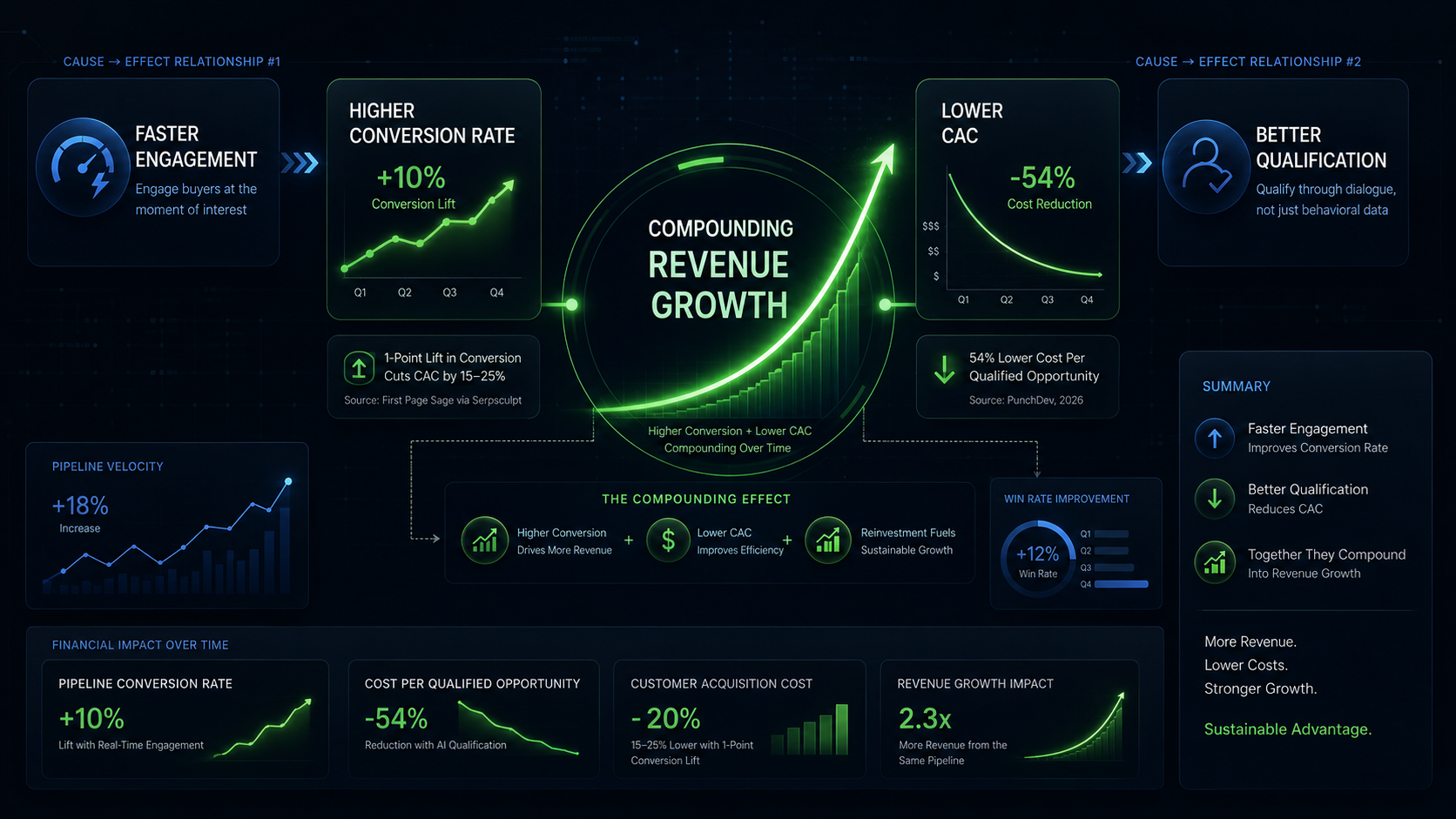
Real-time buyer engagement can influence revenue through three main areas: conversion, qualification, and sales productivity.
Each produces a different financial benefit, and each should be measured separately.
1. Faster Responses Can Improve Lead Conversion
When a buyer requests pricing, a demonstration, or technical information, a delayed response can interrupt the evaluation process.
The prospect may continue researching competitors or postpone the conversation.
Real-time engagement reduces that delay by giving interested buyers access to relevant assistance.
A faster response may increase the likelihood of a meaningful conversation, but that does not automatically mean the buyer will purchase.
For revenue planning, the important measure is whether faster engagement increases closed-won customers from the same lead volume.
2. Better Qualification Can Reduce Acquisition Costs
Not every lead is a suitable sales opportunity.
Some prospects lack a clear business need, fall outside the ideal customer profile (ICP), or are still researching possible solutions.
When representatives spend time pursuing these contacts, the cost of generating qualified opportunities can increase.
Conversational qualification can help identify relevant buyers earlier by collecting information about their requirements, purchasing timeline, and decision-making process.
For example, if a team creates 50 qualified opportunities from the same marketing investment that previously generated 40, its cost per qualified opportunity decreases.
However, the improvement must be measured after including any additional qualification technology or operating costs.
3. Less Repetitive Work Can Increase Sales Capacity
Sales development representatives (SDRs) often handle research, qualification, follow-ups, scheduling, and CRM updates.
Automating suitable repetitive work may allow existing representatives to spend more time on complex customer conversations.
This creates additional sales capacity without necessarily adding headcount.
However, time saved is not automatically money saved.
If an employee continues receiving the same salary, automation has not directly reduced payroll expenses.
The financial benefit must come from measurable additional output, genuine operating cost reductions, or hiring expenses that the company no longer needs to incur.
What Does Research Say About Faster Sales Engagement?
Research supports a relationship between response speed and lead qualification.
However, faster qualification does not establish a universal financial return.
InsideSales: The Five-Minute Response Window
The InsideSales 2021 Lead Response Study reviewed more than 55 million sales activities involving 5.7 million inbound leads across over 400 companies.
The company reported that conversion rates were approximately eight times higher when contact attempts occurred during the first five minutes than when they occurred between five minutes and 24 hours.
This is historical, vendor-reported observational research.
It does not prove that every B2B company can increase revenue eightfold by responding within five minutes.
Nevertheless, the findings support examining how response delays affect lead qualification.
Harvard Business Review: Delayed Contact and Qualification
Research published in Harvard Business Review in 2011 examined approximately 1.25 million leads received by 42 companies.
Researchers found that companies attempting contact within one hour were nearly seven times as likely to qualify a lead as those waiting another hour or longer.
Companies contacting leads within an hour were more than 60 times as likely to qualify them as businesses waiting 24 hours or longer.
The research measured lead qualification through meaningful contact with a decision-maker.
It did not demonstrate equivalent improvements in closed revenue or gross profit.
Gartner: Buyers Want Faster Access Without Unwanted Sales Pressure
Speed does not always mean contacting buyers with a salesperson immediately.
In March 2026, Gartner reported that 67% of surveyed B2B buyers preferred a sales experience without direct representative involvement.
The study surveyed 646 buyers between August and September 2025.
This suggests that real-time engagement should include self-service options, accessible information, and helpful digital assistance.
A buyer who wants a technical answer may prefer receiving it immediately rather than being required to schedule a sales call.
How to Calculate Real-Time Sales Engagement ROI
Calculating ROI requires connecting changes in buyer engagement to actual financial results.
The following process helps B2B companies measure returns without confusing marketing activity with revenue.
Step 1: Establish Your Baseline Sales Performance
Before implementing real-time engagement, record existing sales performance.
Collect data for a period that reflects your normal buying cycle.
Important inputs include:
-
Total inbound inquiries.
-
Percentage of leads becoming qualified opportunities.
-
Average response time.
-
Qualified meeting conversion rate.
-
Closed-won deals.
-
Average revenue per deal.
-
Gross profit margin.
-
Current engagement and sales development costs.
Use the same definitions throughout the measurement period.
For example, an opportunity should meet agreed qualification standards rather than simply represent any contact added to the CRM.
Step 2: Calculate Incremental Closed-Won Revenue
Incremental revenue measures the additional sales that would not reasonably have occurred without the improved engagement process.
The formula is:
Incremental Revenue = Additional Closed-Won Deals × Average Revenue per Deal
Suppose a company previously closed 10 deals each month from 1,000 inquiries.
After introducing faster qualification, the company closes 12 comparable deals from the same inquiry volume.
If each deal generates $5,000 in revenue, the additional two deals produce $10,000.
However, the company must investigate whether the improvement came from faster engagement, better lead quality, changes in pricing, or other factors.
A controlled comparison helps estimate the amount actually attributable to the new process.
Step 3: Convert Additional Revenue Into Gross Profit
Revenue does not equal profit.
Delivering a product or service involves costs that should be considered before calculating ROI.
Use:
Incremental Gross Profit = Incremental Revenue × Gross Margin
If the additional revenue is $10,000 and the company’s gross margin is 80%, incremental gross profit is $8,000.
This represents the contribution after associated cost of goods sold or service delivery costs, before the engagement program’s expenses.
Using gross profit provides a more meaningful view than treating every additional revenue dollar as a financial gain.
Step 4: Calculate Total Engagement Costs
Include both implementation and ongoing operating costs.
Depending on the solution, expenses may include software subscriptions, AI usage, CRM integration, data enrichment, training, employee oversight, and technical maintenance.
If the company uses human representatives, include any additional labor required to operate the new process.
For one-time implementation expenses, use a consistent accounting period when comparing them with financial benefits.
The calculation should reflect the complete cost of delivering the improvement.
Step 5: Include Genuine Cost Savings
A real-time engagement system may reduce manual work or avoid additional staffing expenses.
However, distinguish between financial savings and productivity improvements.
For example, if automation allows the company to avoid a planned $60,000 annual staffing expense without reducing output quality, that avoided cost may be relevant.
If existing employees simply have more time available, report the additional capacity separately unless it produces a measurable financial outcome.
Avoid counting the same benefit twice.
Step 6: Calculate ROI
Use the following formula:

A positive ROI means the measured financial benefits exceed the program costs.
A negative ROI means the measured benefits do not yet recover the investment.
The result is only as reliable as the evidence supporting the incremental gains and costs.
Real-Time Sales Engagement ROI Example
Consider a hypothetical B2B SaaS company evaluating a real-time engagement program.
The business receives 1,000 inbound inquiries each month and wants to improve conversion without increasing lead generation spending.
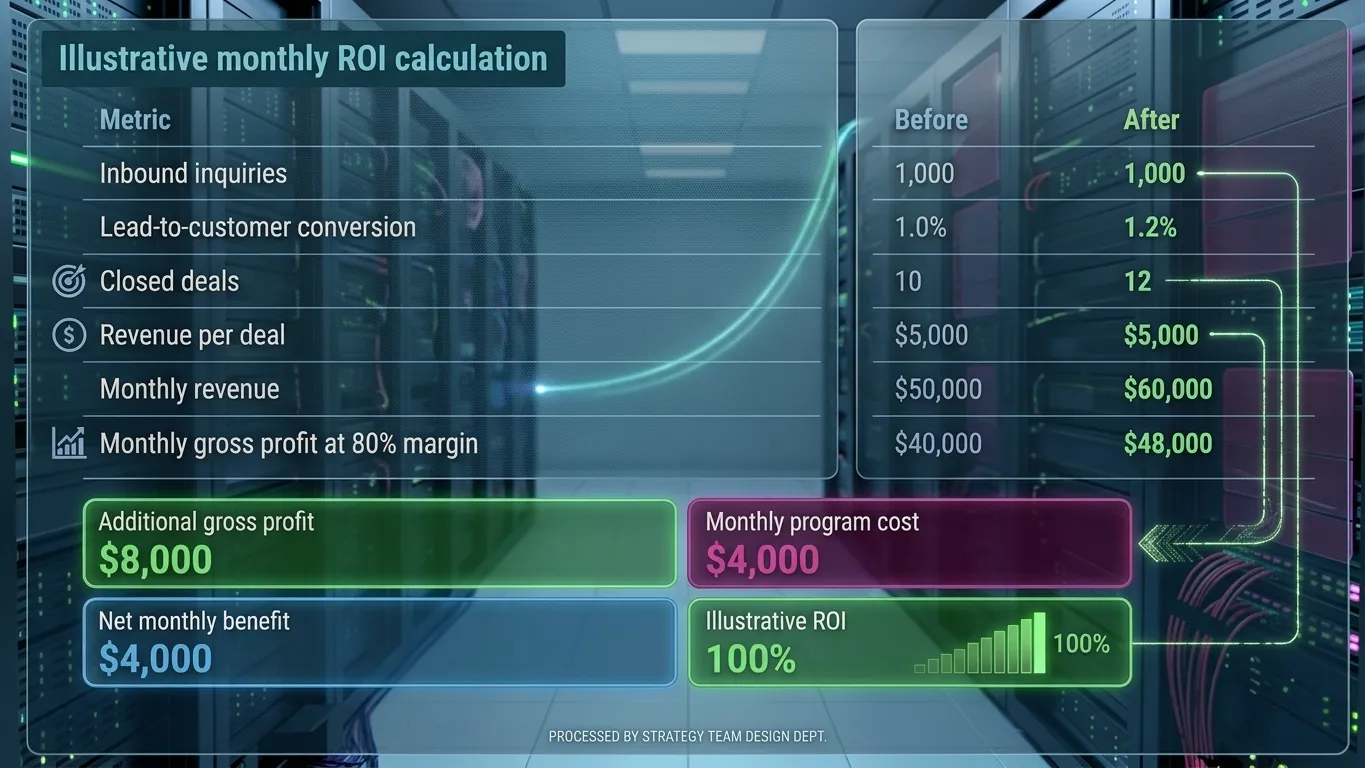
This example shows that increasing lead-to-customer conversion from 1.0% to 1.2% can produce a positive return under the stated assumptions.
It represents a 20% relative increase in conversion, not a 20-percentage-point increase.
The business does not need additional inquiries to achieve the modeled revenue improvement.
However, actual results will depend on buyer quality, conversion performance, sales costs, and the reliability of revenue attribution.
How Do You Calculate Break-Even and Payback Period?
ROI shows the relative financial return on an investment.
Break-even analysis shows the amount of additional business required to recover the cost.
Calculate the Break-Even Number of Deals
Use:
Break-Even Additional Deals = Program Cost ÷ Gross Profit per Deal
In the previous example, each additional deal produces $4,000 in gross profit.
The monthly engagement program costs $4,000.
Therefore, the business must generate one additional attributable deal each month to cover its monthly operating cost.
A second additional deal produces positive financial value, assuming other costs remain unchanged.
Calculate Payback Period
Payback period measures how long it takes to recover an initial investment.
For a project with one-time implementation costs and steady monthly net benefits:
Payback Period = Initial Investment ÷ Monthly Net Cash Benefit
Suppose implementation costs $6,000 and the program generates $2,000 in verified monthly net cash benefits after ongoing expenses.
The payback period is three months.
This is a simplified calculation. If benefits vary or arrive only after long sales cycles, cash-flow timing must be considered.
How Can AI Improve Real-Time Sales Engagement ROI?
Conversational AI can support financial efficiency by reducing repetitive work and helping businesses engage suitable buyers more consistently.
However, AI does not guarantee improved ROI.
Its impact depends on the quality of engagement, system integration, qualification rules, and the actual cost of the solution.
Immediate Buyer Engagement
A properly configured AI system can provide supported responses outside normal business hours.
For example, a prospect asking about product capabilities may receive approved information immediately instead of waiting for a representative.
This can reduce response delays and allow buyers to continue researching.
The system should offer human assistance when it cannot provide a reliable answer.
AI-Powered Qualification
AI agents can collect information about customer needs, organization fit, buying timelines, and relevant requirements.
This may reduce the amount of basic discovery work performed by sales representatives.
However, the AI should not classify every interested prospect as a qualified opportunity.
Accurate qualification requires clear criteria and appropriate review.
Automated Scheduling and Handoffs
CRM and calendar integrations can reduce administrative delays.
For example, a qualified buyer may receive appropriate meeting availability without exchanging several scheduling emails.
Sales representatives can receive a summary of the buyer’s requirements before the meeting.
This helps prevent repeated questions and missing customer context.
Reduced SDR Workload
AI can assist with prospect research, lead enrichment, initial engagement, and follow-up management.
These functions may improve productivity if they allow representatives to concentrate on higher-value work.
The financial benefit should be measured through additional output or genuine cost savings rather than estimated hours alone.
What Does Salesforce’s 2026 Research Show?
Salesforce’s February 2026 State of Sales report surveyed 4,050 sales professionals.
The report found that 54% of sellers had used AI agents, while 87% of sales organizations used some form of AI.
Salesforce also reported that its own AI agents contacted 130,000 previously untouched leads and created 3,200 opportunities over four months.
This is a documented example of increased outreach and opportunity creation.
However, Salesforce did not establish the incremental gross profit or complete program costs associated with those opportunities in that announcement.
Therefore, the figures should not be treated as a verified ROI percentage.
AI Sales Engagement vs. Human SDR Costs
When evaluating AI engagement software against traditional sales development, businesses should compare complete operating costs and qualified commercial outcomes.
|
Cost or performance factor |
Human SDR workflow |
AI-supported workflow |
|---|---|---|
|
Staffing |
Salary, benefits, management |
Software, supervision, implementation |
|
Initial setup |
Recruitment and training |
Configuration, integration, testing |
|
Availability |
Depends on staffing and schedules |
Automated functions may run continuously |
|
Qualification |
Human discovery and judgment |
Automated initial qualification with escalation |
|
Scale |
Additional capacity may require hiring |
Usage and infrastructure costs may rise with volume |
|
Buyer experience |
Human relationships and judgment |
Fast routine responses, with quality depending on design |
|
Cost measurement |
Cost per qualified opportunity and closed customer |
Total cost per qualified opportunity and closed customer |
The financial comparison should use actual costs for the specific business.
For example, an AI platform costing $2,000 per month is not necessarily cheaper if it produces fewer qualified opportunities or requires extensive manual correction.
Likewise, reducing SDR administrative work can be valuable even when the organization keeps its existing representatives.
The objective is to increase profitable revenue relative to the resources required.
Which KPIs Prove Real-Time Sales Engagement Is Working?
A reliable dashboard should connect engagement speed with qualification quality, pipeline progression, and financial outcomes.
|
KPI |
Calculation or measurement |
|---|---|
|
Median first-response time |
Typical time from inquiry to meaningful response |
|
Five-minute response rate |
Inquiries answered within five minutes ÷ eligible inquiries × 100 |
|
Lead-to-conversation rate |
Meaningful buyer conversations ÷ total eligible leads × 100 |
|
Qualified meeting rate |
Qualified meetings ÷ eligible leads × 100 |
|
Lead-to-opportunity rate |
Qualified opportunities ÷ total eligible leads × 100 |
|
Opportunity win rate |
Closed-won ÷ all closed opportunities × 100 |
|
Cost per qualified opportunity |
Relevant engagement costs ÷ qualified opportunities |
|
Customer acquisition cost |
Applicable acquisition costs ÷ customers acquired |
|
Incremental gross profit |
Additional attributable revenue after associated delivery costs |
|
Program ROI |
Net attributable financial benefit ÷ total program costs × 100 |
Why Is Cost per Qualified Opportunity Important?
Cost per lead measures the expense of generating contact information.
Cost per qualified opportunity measures the expense of producing genuine sales potential.
For example, two campaigns may generate equal numbers of leads while producing very different numbers of qualified opportunities.
A real-time engagement system that improves qualification may reduce the cost per qualified opportunity even if total lead volume does not change.
However, sales leaders should also track whether those opportunities become customers.
A low cost per opportunity offers limited financial value if the opportunities rarely close.
How Can Companies Prove That Faster Engagement Increases Revenue?
Revenue leaders should avoid assuming that conversion improvements are caused entirely by faster responses.
The strongest approach compares similar leads under different engagement processes.
Establish a Reliable Baseline
Record response times, qualification rates, opportunity conversion, sales cycle length, and customer outcomes before implementation.
Include lead source, company size, buyer intent, and acquisition period.
This helps determine whether the new workflow performs better than the existing system.
Run a Controlled Pilot
Where practical, randomly assign comparable eligible inquiries to the existing workflow or the improved engagement process.
Both groups should use the same qualification criteria and receive appropriate service.
If random assignment is not practical, compare carefully matched groups while acknowledging the limitations.
Measure meaningful responses, qualified opportunities, and completed purchases.
Do not deliberately withhold necessary assistance from buyers simply to create a test.
Compare Results Through the Full Sales Cycle
A pilot may show faster responses and more meetings during the first month.
However, many B2B sales cycles last longer.
Continue tracking opportunities until enough reach a completed outcome.
Otherwise, projected revenue may be mistaken for actual financial gains.
Account for Other Influences
Conversion can also change because of marketing campaigns, pricing adjustments, seasonal demand, or product improvements.
Use comparable customer groups and document major changes during the test.
This helps revenue operations distinguish genuine engagement improvements from unrelated growth.
When Does Real-Time Sales Engagement Produce the Highest Value?
The potential return differs across B2B businesses and sales models.
High-Intent Inbound Inquiries
Demo requests, specific pricing questions, and active procurement discussions may benefit from quick assistance.
These contacts have already expressed interest in a relevant product or business problem.
A delayed response may leave questions unanswered during an active evaluation.
B2B Companies With High Lead Volumes
Organizations managing many inquiries may benefit from automated routing and qualification.
Even modest improvements in conversion or operating efficiency can matter when applied across a large volume of suitable leads.
However, the total cost of processing those interactions must be considered.
Businesses Receiving Inquiries Outside Office Hours
Companies serving multiple regions may receive requests when their sales teams are unavailable.
Real-time digital assistance can provide answers, capture requirements, and offer a suitable next action.
This may be useful when the business cannot justify staffing every time zone.
Enterprise Sales With Complex Buying Processes
Enterprise buyers often need detailed information involving security, procurement, integrations, and financial value.
Real-time access to accurate information can reduce avoidable delays.
However, the financial outcome depends on how effectively the process supports stakeholder decisions.
Immediate automated engagement alone may not shorten a complex enterprise purchase.
When Might Real-Time Sales Engagement Produce Negative ROI?
Not every sales organization benefits financially from an additional engagement platform.
Returns may be low or negative when the solution costs more than the improvements it creates.
Common problems include:
-
Too few qualified inquiries to justify the investment.
-
Poor customer fit or weak demand.
-
AI responses containing incorrect product information.
-
Increased meeting volume without better sales opportunities.
-
Expensive integrations or ongoing supervision.
-
Existing representatives already responding quickly.
-
Long sales cycles that delay financial benefits.
-
Buyers preferring self-service without additional sales contact.
For example, a company receiving only a few qualified inquiries each month may not recover the cost of a complex AI system.
The better investment may be improving website information or simplifying a manual workflow.
Evaluate the actual bottleneck before selecting technology.
How to Test Real-Time Sales Engagement ROI in 30 Days
A 30-day pilot can establish early evidence of improved responsiveness and qualification.
It may not be long enough to prove final revenue returns, especially for enterprise sales.
Days 1 to 7: Measure Existing Performance
Collect CRM data on inbound inquiries, response times, qualified meetings, and opportunity creation.
Identify where interested buyers wait for assistance.
Record current costs and establish the financial baseline.
Days 8 to 14: Configure the Engagement Process
Choose one high-value inquiry type or sales workflow.
Set qualification standards, routing rules, response targets, and human escalation requirements.
Configure the selected automation or AI system using approved product information.
Days 15 to 21: Launch a Controlled Test
Apply the new workflow to a defined group of eligible inquiries.
Track response times, engagement quality, meeting bookings, and sales acceptance.
Review incorrect responses, technical problems, and buyer feedback.
Days 22 to 30: Evaluate Early Results
Compare the pilot against the baseline or control group.
Calculate cost per qualified opportunity and any verified operating savings.
Review whether the process improves buyer experience.
Continue measuring closed revenue as deals complete.
Use the evidence to decide whether to expand, adjust, or stop the program.
How Does XYNEXI Support Sales Engagement ROI?
XYNEXI is an autonomous AI SDR and BDR platform designed to support outbound sales development through prospect research, engagement, qualification, and buyer conversations.
The platform uses its AIRPEC multi-agent reasoning engine to conduct personalized outreach, identify customer needs, handle initial objections, and prepare qualified buyers for sales teams.
Its published capabilities include email and SMS outreach, lead enrichment, conversational qualification, and purchase intent verification.
Connecting Engagement With Qualified Opportunities
XYNEXI focuses on moving prospects through early sales development rather than simply sending automated messages.
The platform describes using real-time buyer conversations to understand business requirements and prepare sales handoffs.
Its Human-In-The-Loop model retains human responsibility for strategy, pricing decisions, relationships, and contract execution.
For companies evaluating financial returns, these capabilities should be measured using sales-accepted opportunities, completed purchases, and actual operating costs.
Using XYNEXI’s ROI Calculator
XYNEXI also provides a Revenue Acceleration Planner and ROI Calculator.
The calculator allows users to enter estimated financial gains and investment costs to explore potential returns.
Its standard ROI calculation subtracts investment from expected financial gain and divides the result by investment cost.
For a more rigorous financial assessment, companies should enter incremental gross profit and genuine cost savings, not total revenue or unverified pipeline projections.
This makes the calculation more useful when evaluating whether AI engagement can create a positive return.
XYNEXI’s current public product information emphasizes outbound SDR workflows. Organizations seeking fully automated inbound website engagement should confirm the specific features and integrations required before including them in an ROI forecast.
The most reliable investment decision comes from testing actual performance against the company’s existing process.
Explore how XYNEXI works and evaluate its conversational AI approach against your sales goals.
Conclusion
The ROI of real-time sales engagement in B2B sales depends on the additional profitable revenue and genuine operating savings produced by faster, more relevant buyer interactions.
Faster lead responses can support better qualification. Improved qualification may help sales teams spend less time on unsuitable opportunities. Automation can reduce repetitive work and expand available engagement capacity.
However, none of these improvements guarantees a positive financial return.
Revenue leaders should compare closed-won results, gross profit, total program costs, and verified savings before calculating ROI.
Historical research supports the importance of timely responses, while newer studies show that AI can extend sales capacity and support buyer engagement.
The strongest strategy combines responsive service, accurate qualification, useful conversations, and measurable financial performance.
Real-time sales engagement becomes a worthwhile investment when its proven financial benefits exceed the full cost of delivering them.
Frequently Asked Questions
1. What Is the ROI of Real-Time Sales Engagement?
The ROI of real-time sales engagement measures the financial return generated by faster and more effective buyer interactions. It compares incremental gross profit and verified operating savings against total engagement costs. A positive ROI means the program produces more measurable financial value than it costs. There is no universal ROI percentage for all B2B companies.
2. How Does Faster Lead Response Affect B2B Sales Revenue?
Faster lead response can improve the likelihood of qualifying interested buyers and progressing them toward sales opportunities. Historical research from Harvard Business Review and InsideSales found higher qualification or conversion rates among quickly contacted leads. However, faster engagement does not guarantee additional sales revenue. Businesses should measure completed deals and gross profit to establish the actual financial effect.
3. How Do You Calculate the ROI of AI-Powered Sales Engagement?
Calculate AI sales engagement ROI by adding attributable incremental gross profit and verified cost savings, subtracting all relevant AI program costs, dividing the result by those costs, and multiplying by 100. Include software, setup, integration, usage, maintenance, and supervision expenses. Avoid treating projected pipeline or employee time saved as realized financial gains without supporting evidence.
4. Can Real-Time Sales Engagement Reduce SDR Costs?
Real-time engagement can reduce repetitive SDR work through automated qualification, routing, scheduling, and CRM updates. It may also help businesses avoid certain hiring or outsourcing expenses. However, automation does not automatically reduce payroll costs when employees remain on staff. Financial savings should be based on actual reduced expenses or verified avoided costs rather than estimated productivity improvements alone.
5. Which Metrics Prove That Real-Time Engagement Increases Revenue?
The most important metrics include lead-to-opportunity conversion, sales acceptance, opportunity win rate, attributable closed revenue, gross profit, customer acquisition cost, and program ROI. Response time and qualified meeting rates are useful supporting indicators. Comparing similar lead groups and tracking opportunities through completion provides stronger evidence than measuring the number of automated messages or booked meetings.
6. How Long Does It Take to See ROI From AI Sales Engagement?
The time required to see ROI depends on the sales cycle, inquiry volume, implementation costs, and conversion improvements. Businesses may observe faster responses and better qualification within weeks, but closed-revenue results often take longer. A 30-day pilot can establish early performance indicators, while a reliable financial evaluation should continue until enough opportunities have completed the sales process.