
B2B sales calls capture pricing objections, unmet needs, competitor comparisons, and buying signals, but most of that knowledge never reaches marketing or product teams. Turning buyer conversations into strategic GTM insights helps revenue leaders find recurring problems, make better decisions, and improve pipeline quality.
How Do You Turn Buyer Conversations Into Strategic GTM Insights?
To turn B2B buyer conversations into actionable GTM insights, capture customer interactions, identify recurring pain points and objections, validate patterns against sales outcomes, and share findings across marketing, sales, and product teams. Use conversation intelligence to improve positioning, qualification, product priorities, and revenue strategy while measuring the results of each change.
The real value of buyer conversations extends beyond helping sales representatives close individual deals.
Every qualified interaction can reveal why customers choose a product, what prevents them from purchasing, and which competing solutions they consider.
When organizations collect and analyze this information consistently, they can make better go-to-market (GTM) decisions using direct customer evidence instead of relying only on assumptions or individual sales opinions.
What Is Strategic GTM Conversation Intelligence?
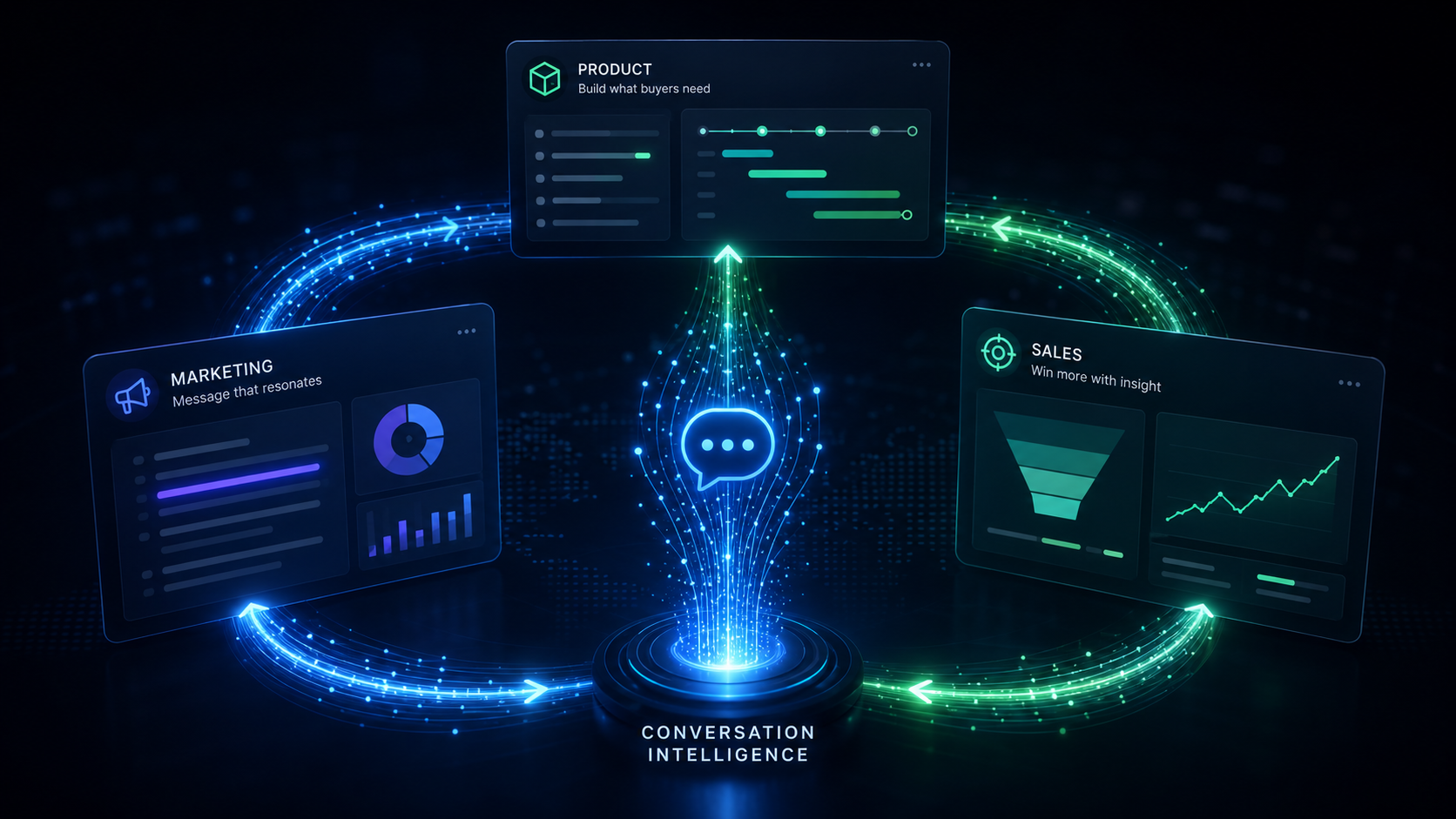
Strategic GTM conversation intelligence is the process of collecting, analyzing, and using buyer interactions to improve business decisions across sales, marketing, product development, and revenue operations.
Traditional sales reporting often focuses on activities such as calls completed, meetings booked, and opportunities created.
Conversation intelligence examines what buyers actually say during those interactions.
It can reveal the business problems customers want to solve, features they need, competitors they consider, and objections that prevent purchases.
These insights become strategic when teams use them to make measurable changes.
For example, if several potential customers mention difficulty integrating a product with Salesforce, that information may help multiple departments:
-
Marketing: Explain existing integration capabilities more clearly.
-
Sales: Prepare answers to common integration concerns.
-
Product: Investigate missing integrations or technical limitations.
-
Revenue Operations: Track whether integration concerns affect deal progression.
One recurring issue can influence several business decisions when the evidence is reliable.
How Is Sales Call Analytics Different From Strategic GTM Intelligence?
Sales call analytics and strategic conversation intelligence use similar information but answer different questions.
|
Area |
Sales call analytics |
Strategic GTM intelligence |
|---|---|---|
|
Main purpose |
Improve individual sales conversations |
Improve business-wide GTM decisions |
|
Data focus |
Call duration, topics, objections, next steps |
Recurring needs, buying patterns, market changes |
|
Main users |
SDRs, account executives, sales managers |
CROs, CMOs, product teams, RevOps |
|
Typical outcome |
Better coaching and follow-up |
Better positioning, qualification, and product decisions |
|
Measurement |
Call quality and sales activity |
Pipeline quality, conversion, and revenue |
Sales call analytics may reveal that one representative struggled to explain pricing.
Strategic intelligence can reveal that pricing uncertainty appears across multiple industries and affects qualified opportunities.
The second finding offers evidence for a broader business improvement.
Why Are Buyer Conversations Valuable for GTM Strategy?
Buyer conversations contain first-party customer information that businesses cannot fully understand from website analytics or CRM activity fields alone.
A page visit may show interest in pricing. A conversation can explain whether the buyer considers the price too high, cannot justify the investment, or needs a different payment structure.
That distinction matters because each issue requires a different response.
Understanding Real Customer Pain Points
Buyers often describe business problems using language that differs from a company’s marketing materials.
A software vendor might promote its ability to automate workflows.
However, a customer may explain that the real problem is losing inquiries because employees cannot respond after working hours.
The second description identifies a more specific problem.
By reviewing similar conversations, marketing teams can identify the language customers naturally use when describing their needs.
This information can help improve website content, landing pages, advertising messages, and product demonstrations.
Identifying Buying Intent and Purchase Triggers
Customer conversations can reveal why organizations begin evaluating new products.
Common purchasing triggers include:
-
Expiring software contracts.
-
Increased operating costs.
-
A new compliance requirement.
-
Business expansion into another market.
-
Changes in management or internal systems.
-
A planned technology replacement.
These signals can help sales teams understand urgency and prioritize suitable opportunities.
However, a buyer mentioning a deadline does not automatically mean a purchase will happen.
Representatives should verify the business need, decision process, and next action.
Discovering Pricing, Competitor, and Implementation Objections
Sales conversations frequently reveal concerns that do not appear in standard lead generation reports.
For example, buyers may consider a product too expensive because the expected business value is unclear.
Others may prefer a competitor because of an integration, contractual requirement, or existing relationship.
These are different problems.
Conversation analysis should classify objections by their underlying causes rather than grouping every pricing concern under one generic label.
Understanding the Influence of Other Buyers
B2B purchasing decisions involve information and opinions beyond a company’s direct sales conversations.
In March 2025, Forrester reported that 82% of surveyed B2B buyers trusted coworkers and internal management as information sources. Existing vendors were trusted by 79%.
This matters because a buyer may enter a sales conversation with concerns shaped by colleagues, previous experiences, or internal recommendations.
A seller cannot see those private conversations directly.
However, buyer questions and objections can reveal issues that the wider buying group wants addressed.
The 2025 6sense Buyer Experience Report also found that 94% of surveyed buying groups ranked preferred vendors before contacting sellers.
Understanding those existing preferences can help GTM teams improve their positioning and support buying-group decisions.
How to Turn Buyer Conversations Into Actionable GTM Insights
Turning raw conversations into business decisions requires a repeatable process.
The following seven steps help revenue teams move from individual customer comments to verified patterns, assigned actions, and measurable results.
Step 1: Capture Relevant Buyer Conversations
Start by collecting interactions that contain useful information about customer needs and purchasing decisions.
Potential sources include sales calls, discovery meetings, approved email conversations, website chats, AI qualification interactions, customer interviews, and support discussions.
Each source provides different information.
Sales conversations often reveal purchasing requirements. Support conversations may reveal product problems. Customer interviews can provide deeper explanations of why certain features matter.
Capture conversations only where recording, storage, and analysis are legally permitted.
The objective is to preserve useful buyer evidence, not simply collect as many recordings as possible.
Step 2: Organize Conversations by Buyer and Deal Context
Conversation data becomes easier to analyze when it is connected to the correct customer and sales opportunity.
Useful information includes:
-
Company name and industry.
-
Buyer role and department.
-
Company size or customer segment.
-
Account and opportunity identifiers.
-
Sales pipeline stage.
-
Products or services discussed.
-
Conversation date and channel.
-
Deal outcome, when available.
This context helps distinguish patterns that affect different groups.
For example, technical buyers may frequently discuss integrations, while finance leaders focus on cost, risk, and expected returns.
Analyze these groups separately before making broad conclusions.
Step 3: Extract Recurring Customer Themes
Review conversations to identify repeated subjects.
AI tools can support this process by classifying transcripts and highlighting relevant statements.
Common categories include customer pain points, feature requests, competitor mentions, pricing concerns, buying triggers, and purchase barriers.
A useful classification system also separates statements made by the buyer from claims introduced by a salesperson.
This prevents sales messaging from being incorrectly counted as direct customer demand.
For example, if a representative repeatedly mentions a competitor, that does not establish that buyers consider the competitor important.
The analysis should identify who introduced the subject and why it was discussed.
Step 4: Validate Insights Against Real Outcomes
A repeated comment is not automatically a verified market trend.
Before changing GTM strategy, examine how frequently the issue appears across unique customers and whether it is associated with meaningful business outcomes.
For example, suppose 36 of 120 distinct customer accounts mention implementation concerns.
That represents 30% of the sampled accounts.
These are illustrative figures. They do not establish the prevalence of implementation concerns across the wider market.
Teams should also check whether those concerns appear more frequently in stalled or lost deals.
Compare similar industries, deal sizes, and sales stages to reduce misleading conclusions.
Independent customer interviews and CRM outcomes can provide additional evidence.
Step 5: Prioritize Insights by Business Impact
Not every recurring theme requires immediate action.
A feature request mentioned several times may affect a small customer segment. Another issue may appear less frequently but prevent high-value opportunities from closing.
Evaluate findings using four factors:
-
Frequency: How many distinct accounts report the issue?
-
Revenue relevance: Which opportunities or customer segments are affected?
-
Evidence quality: How reliable and representative is the finding?
-
Actionability: Can the business address the issue through a practical change?
For example, a missing integration repeatedly mentioned during enterprise evaluations may deserve more attention than a minor interface preference.
Record the reason for each priority so teams can review decisions later.
Step 6: Apply Findings Across Marketing, Sales, and Product
Once a theme is validated, assign it to the department responsible for improving the customer experience.
Marketing can revise messaging and campaign targeting.
Sales leadership can improve discovery questions, objection handling, and qualification standards.
Product teams can investigate feature gaps or recurring implementation concerns.
Revenue operations can update CRM fields and reporting to track whether the problem continues.
Each improvement should have a clear owner, expected outcome, and review date.
Step 7: Measure Results and Refine GTM Strategy
After implementing a change, measure whether customer behavior or commercial performance improves.
For example, if marketing updates its messaging to address a common implementation concern, compare relevant landing-page conversion rates and qualified-opportunity outcomes.
If sales introduces stronger objection-handling materials, examine whether opportunities affected by that objection progress more consistently.
Avoid treating one improved metric as proof of a larger revenue benefit.
Continue reviewing conversation themes as products, competitors, and buyer expectations change.
How Does AI Analyze Buyer Conversations at Scale?
Artificial intelligence can help revenue teams analyze large collections of approved customer conversations.
Manual review works for small volumes, but reviewing hundreds of transcripts may require substantial employee time.
AI systems can help organize conversations, identify recurring terms, classify buyer statements, and summarize relevant information.
Extracting Buyer Intent and Pain Points
Large language models can classify statements according to defined categories.
For example, an AI system may identify a buyer’s discussion of delayed lead follow-up as a sales operations problem.
It may also recognize an upcoming contract renewal as a possible purchasing trigger.
The analysis becomes more useful when each classification links to the supporting transcript passage.
Human reviewers should be able to check what the buyer actually said.
Analyzing Objections and Competitor Mentions
AI conversation intelligence platforms can identify discussions involving pricing, technical limitations, competitors, and purchasing requirements.
Salesforce Einstein Conversation Insights supports analysis of recorded conversations, including competitor mentions, pricing discussions, next steps, and relevant sales topics.
These capabilities can help managers find issues across conversations without reviewing every recording manually.
However, mentions require interpretation.
A customer praising a competitor and a customer explaining why they rejected that competitor are not expressing the same view.
Identifying Emerging Market Trends
Conversation intelligence can reveal changes in what buyers discuss over time.
For example, the June 2026 Gong Labs Trends research analyzed topics across a dataset covering 33.5 million deals worked since February 2024.
Gong reported an 85% increase in the occurrence of AI discussions across deals over that period. Its analysis also found substantial growth in discussions mentioning AI agents.
This demonstrates how conversation data can help researchers identify changing subjects of interest.
However, topic frequency alone does not prove purchasing demand or revenue growth. Gong’s dataset also reflects the customers and deals represented in its platform, not every B2B market.
How Can Teams Verify AI-Generated Insights?
AI summaries and classifications can contain mistakes.
A system may misunderstand a buyer’s meaning, confuse speakers, omit important context, or assign an incorrect reason for a lost opportunity.
Companies should test outputs against transcripts reviewed by employees.
Useful quality checks include classification accuracy, missing evidence, incorrect buyer attribution, and consistency across industries.
The NIST AI Risk Management Framework recommends managing AI risks through processes that address reliability, transparency, privacy, and accountability.
Apply these principles before using automated conclusions to influence important commercial decisions.
How Can Conversation Insights Improve GTM Strategy?
Buyer intelligence becomes valuable when teams use it to change how their business attracts, qualifies, and serves customers.
Refine Your Ideal Customer Profile
An ideal customer profile (ICP) describes organizations most likely to benefit from and purchase a company’s solution.
Conversation insights can reveal which customer groups have urgent needs, suitable budgets, and realistic purchase plans.
Combine these observations with closed-won and closed-lost records.
For example, a B2B software provider may discover that midmarket companies discuss a particular problem more frequently than larger enterprises.
If those midmarket accounts also show stronger conversion and retention, the evidence may support refining the ICP.
Conversation frequency alone should not determine the target market.
Improve Marketing Messaging and Product Positioning
Marketing teams can use recurring buyer language to explain products more clearly.
Suppose customer conversations frequently focus on reducing missed inquiries rather than increasing employee productivity.
Marketing can test messaging that addresses missed inquiries directly.
This does not mean every customer phrase should become advertising copy.
Teams should verify that the language accurately represents the problem and that the product can deliver the promised solution.
For more on why interest does not always produce customers, see Why Are Your B2B Leads Not Converting?.
Strengthen Sales Qualification
Conversation analysis may reveal questions that help distinguish serious buyers from early-stage researchers.
For example, successful opportunities may frequently include a confirmed implementation deadline and participation from the person responsible for approving the project.
Sales teams can use that information to improve qualification.
However, patterns identified in past deals should be tested before becoming strict requirements.
Better qualification can help sales representatives focus on realistic opportunities.
Improve Sales Enablement
Sales enablement teams can turn recurring objections into training materials, product explanations, and discovery guides.
If buyers frequently ask about data security, teams can prepare verified information about certifications, access controls, and security practices.
If implementation concerns regularly delay deals, account executives may need better technical support or clearer onboarding information.
Review whether the materials improve sales conversations and help opportunities progress.
Inform Product Development
Product teams can use buyer conversations to identify unmet needs and feature limitations.
Suppose several prospective customers say that a missing integration prevents them from adopting the product.
That information may indicate a product development opportunity.
However, product managers should verify the demand, technical feasibility, expected customer value, and commercial impact before changing the roadmap.
Conversation intelligence helps identify problems worth investigating. It does not replace product research or strategic planning.
How Can Sales, Marketing, and Product Teams Share GTM Insights?
Conversation intelligence works best when departments use shared evidence.
Without an organized process, sales managers may review calls, marketing may run separate surveys, and product teams may receive isolated feature requests.
These disconnected systems make it difficult to identify patterns across the complete customer journey.
Connect Conversation Intelligence to Your CRM
A CRM can connect buyer conversations with accounts, contacts, opportunities, and outcomes.
For example, HubSpot supports conversation transcription, recorded-call review, searchable terms, and associations with CRM records, depending on subscription and configuration.
Its September 2026 documentation also describes syncing transcripts into customer records to support summaries, follow-ups, and CRM workflows.
Salesforce offers related capabilities through Einstein Conversation Insights.
The key requirement is connecting conversation evidence with the correct customer and deal.
Build a Shared Buyer Insight Repository
A searchable repository helps teams reuse findings without repeatedly reviewing raw recordings.
Each insight should contain enough information to support a business decision.
Useful fields include the theme, customer segment, number of affected accounts, supporting transcript references, relevant opportunities, business impact, and recommended action.
Record the date of the observation and the department responsible for reviewing it.
This helps teams distinguish recent findings from older concerns that may no longer apply.
Assign Ownership and Reporting Responsibilities
Revenue operations (RevOps) can coordinate the data structure, reporting standards, and cross-functional review process.
However, RevOps should not make every strategic decision.
Marketing should own messaging changes. Sales should own qualification and coaching improvements. Product teams should own product evaluations and roadmap decisions.
A monthly voice-of-customer review can bring these teams together.
The purpose should be to approve measurable actions, not simply present dashboards.
For each major finding, record the owner, decision, expected result, and follow-up date.
Which Conversation Intelligence Platforms Should B2B Teams Consider?
Different platforms support different parts of the conversation intelligence process.
Common examples include:
-
Gong: Offers conversation analysis, deal intelligence, coaching, and revenue insights.
-
Salesforce Einstein Conversation Insights: Connects call analysis with Salesforce sales records and reporting.
-
HubSpot Conversation Intelligence: Supports call review, transcription, tracked terms, and CRM context.
-
Fireflies.ai: Provides meeting transcription, summaries, and integrations, including a HubSpot Marketplace integration.
These platforms should not be treated as identical.
Some focus heavily on sales coaching and revenue forecasting. Others specialize in meeting summaries, CRM synchronization, or conversational engagement.
When selecting a platform, evaluate transcription accuracy, theme classification, CRM integration, permissions, security, reporting, and pricing.
Also check whether the platform can analyze trends across multiple conversations rather than only summarize individual meetings.
Total implementation costs may include subscriptions, processing usage, integrations, training, data preparation, and administration.
What Evidence Supports Conversation Intelligence in B2B Sales?
Industry research and customer case studies provide examples of how conversation and revenue intelligence are used in sales organizations.
Experian: Improving Sales Visibility and Win Rates
Experian Employer Services adopted Gong’s Revenue AI platform to improve sales visibility, opportunity prioritization, and forecasting.
According to Gong’s Experian customer case study, the company reported a 25% increase in win rates and 10% growth in sales volume.
The case also describes how the organization used connected customer interactions and deal information to identify risks and improve decisions.
These are vendor-reported results from a broader technology and workflow implementation.
They do not establish that analyzing conversations alone caused the reported increases.
The case does illustrate how conversation information becomes more useful when connected to pipeline management and commercial decisions.
How Do You Measure GTM Conversation Intelligence ROI?
Conversation intelligence should be evaluated through its effect on business decisions and outcomes, not simply the number of recordings analyzed.
Revenue leaders can monitor both the quality of insights and the results of changes informed by those insights.
|
KPI |
What it measures |
|---|---|
|
Theme detection accuracy |
Whether identified themes match verified conversation evidence |
|
Insight coverage |
Percentage of eligible conversations included in analysis |
|
Insight-to-action rate |
Percentage of validated findings leading to assigned actions |
|
Opportunity conversion rate |
Whether relevant sales opportunities progress more successfully |
|
Win rate |
Percentage of closed opportunities resulting in sales |
|
Sales cycle length |
Time required to complete opportunities |
|
Revenue impact |
Incremental gross profit linked to tested GTM changes |
How Can Companies Calculate Conversation Intelligence ROI?
A useful formula is:
ROI = [(Incremental Gross Profit + Verified Cost Savings − Total Program Costs) ÷ Total Program Costs] × 100
Suppose a company invests $15,000 in a conversation intelligence program.
The company attributes $35,000 in additional gross profit to tested GTM improvements, with no additional verified savings.
The calculated ROI is:
($35,000 − $15,000) ÷ $15,000 × 100 = 133.3%
These are illustrative figures, not a reported platform result.
In practice, attribution is difficult because revenue may also be affected by marketing changes, product improvements, pricing, and sales execution.
Use comparable customer groups, historical baselines, and sufficient sales cycle data to evaluate the results.
Avoid counting projected pipeline value as realized profit.
What Are the Main Risks of Analyzing Buyer Conversations?
Conversation analysis introduces privacy, security, and accuracy responsibilities.
Recording Consent and Privacy
In the United States, laws governing the recording of telephone and other conversations vary by jurisdiction.
Some situations require consent from every party, while others operate under different consent rules.
The Reporters Committee’s recording law guide provides state-by-state information about recording requirements.
Companies should establish recording notices, consent processes, and appropriate policies before collecting conversations.
International customers may also be protected by laws such as the European Union’s General Data Protection Regulation (GDPR).
Data Security
Buyer conversations may contain confidential product plans, budgets, internal problems, and personal information.
Limit access to employees who need the information.
Apply appropriate encryption, retention policies, and contractual safeguards with vendors that process recordings or transcripts.
Avoid storing unnecessary sensitive information.
Incorrect AI Interpretation
AI-generated insights should be treated as findings requiring validation, particularly when they influence major strategic decisions.
For example, one inaccurate classification could create a false impression that several buyers rejected a product because of price.
Review supporting evidence and compare AI outputs with human-reviewed examples.
Biased Conversation Samples
Not every customer speaks with sales.
Some buyers evaluate products independently, while others never respond to outreach.
Therefore, recorded conversations represent only part of the market.
Combine conversation findings with customer research, product usage data, sales outcomes, and other relevant evidence before making major strategic changes.
How Can XYNEXI Fit Into Strategic GTM Conversation Intelligence?
XYNEXI’ proposed Human AI approach focuses on turning buyer engagement into useful commercial conversations.
For this approach to deliver strategic GTM intelligence, live interactions should capture relevant information such as customer problems, buying motivations, objections, decision criteria, and agreed next steps.
That information can potentially support several business functions:
Marketing can identify recurring customer concerns and test clearer messages.
Product teams can investigate unmet needs and feature requests.
Sales leaders can improve qualification, discovery, and opportunity management.
Revenue operations can connect conversation patterns with pipeline and revenue results.
The important distinction is between capturing a conversation and delivering a verified insight that changes a business decision.
Teams evaluating XYNEXI should confirm its actual transcript access, analytics capabilities, CRM integrations, privacy controls, and cross-functional reporting before adopting it for this purpose.
A useful demonstration would show how several buyer conversations become a validated finding, how that finding reaches the appropriate department, and how the resulting action is measured.
The goal is a continuous learning process where buyer feedback informs marketing, product development, and sales strategy.
Conclusion
Turning buyer conversations into strategic GTM insights helps B2B companies understand customer needs, purchase barriers, competitor concerns, and changing market priorities.
However, simply recording more conversations does not improve business performance.
Organizations need a structured process to capture information, identify recurring patterns, verify findings, and assign improvements across sales, marketing, and product teams.
AI can help analyze large volumes of conversation data, but human review remains important for accuracy, context, and strategic decisions.
The most useful conversation intelligence programs connect buyer evidence with measurable business outcomes.
When each validated insight leads to an action and that action is measured, customer conversations become a practical source of continuous GTM improvement.
Frequently Asked Questions
1. What Is Strategic GTM Conversation Intelligence?
Strategic GTM conversation intelligence is the process of analyzing buyer conversations to improve sales, marketing, product positioning, and revenue decisions. It identifies recurring customer needs, purchasing objections, competitor concerns, and market trends. Companies validate these findings against CRM records and customer outcomes before using them to guide business strategy.
2. How Can B2B Companies Turn Sales Conversations Into Actionable Insights?
B2B companies can turn conversations into insights by collecting permitted customer interactions, organizing them by account and buyer segment, identifying recurring themes, and checking findings against sales outcomes. Teams should then prioritize meaningful issues, assign responsible departments, and measure whether the resulting improvements increase conversion, customer satisfaction, or revenue.
3. Can AI Automatically Identify Customer Pain Points and Buying Intent?
Yes. AI systems can analyze transcripts and classify statements related to customer problems, purchasing requirements, objections, and possible buying triggers. However, automated classifications may contain mistakes or miss context. Organizations should verify important findings against the original conversation and avoid treating AI-generated predictions as confirmed purchasing decisions.
4. How Can Conversation Intelligence Improve B2B Marketing Messaging?
Conversation intelligence helps marketing teams understand how customers describe their problems and evaluate solutions. By identifying recurring questions, objections, and business priorities, marketers can refine website content, campaigns, landing pages, and product positioning. Changes should be tested against conversion rates and qualified pipeline results rather than assumed to improve performance.
5. What Is the Difference Between Gong and Salesforce Conversation Intelligence?
Gong provides revenue intelligence capabilities focused on customer conversations, deal activity, sales coaching, and revenue workflows. Salesforce Einstein Conversation Insights analyzes supported recorded calls within the Salesforce environment, including key topics, competitor mentions, and follow-up information. The appropriate platform depends on CRM compatibility, required analytics, subscription features, data governance, and budget.
6. How Do You Measure the ROI of GTM Conversation Intelligence?
Measure ROI by comparing the incremental gross profit and verified operating savings from conversation-informed improvements with the total cost of the program. Track insight accuracy, actions completed, opportunity conversion, win rates, and sales cycle performance. Use comparable customer groups or historical baselines, and avoid attributing every revenue increase to conversation intelligence without supporting evidence.