
B2B teams can generate hundreds of marketing leads while qualified pipeline barely grows. Buyers research vendors independently, sales development representatives chase unready contacts, and buying committees remain hidden. A conversation-based go-to-market strategy connects buyer questions, qualification, and sales engagement before interest disappears.
How Can B2B Companies Transition to Conversation-Based GTM?
To transition from lead-based to conversation-based GTM, shift the focus from collecting contacts to understanding buyer intent through meaningful conversations. Define qualification standards, engage interested buyers promptly, connect conversations to CRM opportunities, align marketing and sales, and measure qualified pipeline instead of relying on MQL volume alone.
Conversation-based go-to-market (GTM) connects marketing, sales development, and account executives around buyer needs and purchasing decisions.
It does not mean abandoning demand generation, removing human sales teams, or replacing every lead form with an AI chatbot.
Instead, businesses change what happens after someone expresses interest. Rather than automatically entering a lengthy nurture sequence or waiting in an SDR queue, suitable buyers can ask questions, receive relevant information, and move toward a qualified sales conversation.
The transition involves three connected changes: how teams measure demand, how they engage buyers, and how they manage sales opportunities.
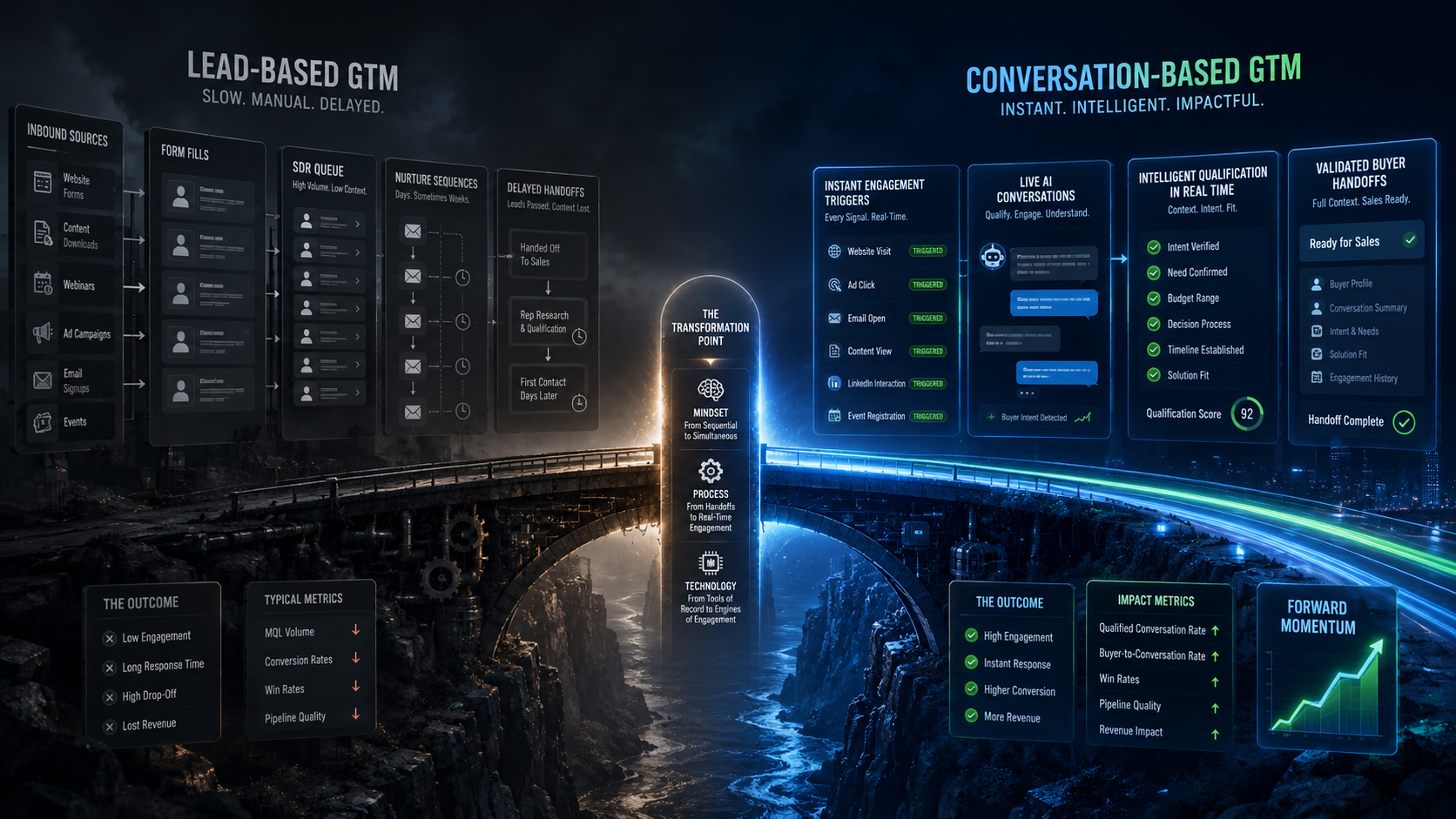
What Is Conversation-Based GTM?
Conversation-based GTM is a B2B sales and marketing approach that uses direct buyer interactions to identify needs, understand purchase intent, and create qualified revenue opportunities.
Traditional lead-based GTM often starts with collecting contact information. Marketing generates leads, assigns scores, and passes qualified contacts to sales development representatives (SDRs).
Sales then determines whether those contacts are actually interested in buying.
Conversation-based GTM changes this sequence. Buyer engagement and qualification can happen during the initial interaction, allowing sales representatives to receive better information about the prospect’s needs.
The model focuses on three questions: Who is interested, what problem are they solving, and what should happen next?
Lead-Based vs. Conversation-Based GTM: What’s the Difference?
Both models aim to create revenue, but they measure and manage buyer engagement differently.
|
Key area |
Lead-based GTM |
Conversation-based GTM |
|---|---|---|
|
Primary focus |
Lead generation and MQL volume |
Buyer conversations and qualified opportunities |
|
Buyer engagement |
Forms, campaigns, and follow-up sequences |
Two-way conversations when buyers engage |
|
Qualification |
Lead scoring and SDR follow-up |
Conversational discovery and verified intent |
|
Sales handoff |
Contact details and lead scores |
Buyer needs, context, and next steps |
|
Buyer tracking |
Individual contacts |
Contacts connected to accounts and buying groups |
|
Success metrics |
Leads, MQLs, and cost per lead |
Qualified conversations, pipeline, and revenue |
|
Technology |
CRM and marketing automation |
CRM, automation, and conversational engagement |
Why Is MQL Volume No Longer Enough?
A marketing-qualified lead (MQL) is a contact that meets a company’s marketing qualification criteria.
A person may become an MQL after downloading a guide, attending a webinar, or reaching a lead score.
However, these activities do not always establish purchasing intent.
For example, a cybersecurity company may generate 500 webinar registrations. Some attendees could be students, consultants, or researchers with no purchasing plans.
Counting them as sales-ready prospects can inflate pipeline expectations and increase unnecessary SDR work.
Conversation-based qualification helps separate educational interest from active buying needs.
MQLs can remain useful for reporting and nurturing. They should not be the only measure of GTM performance.
Does Conversation-Based GTM Replace Demand Generation?
No. Demand generation remains necessary.
Businesses still need search visibility, educational content, paid advertising, email marketing, events, and brand awareness to attract potential customers.
The difference lies in what happens after buyers engage.
Instead of measuring a campaign only by the number of contacts collected, marketing also measures whether those contacts participate in meaningful conversations and create qualified opportunities.
Conversational marketing is one part of this process. Conversation-based GTM is broader, connecting buyer engagement with qualification, account management, sales handoffs, and revenue reporting.
Why Does Modern B2B Buying Require a Different GTM Model?
B2B buyers increasingly research products, compare vendors, and consult colleagues before contacting sales representatives.
A lead-based process that waits until someone submits a form may miss valuable information about how an organization reached that decision.
Buyers Research Vendors Before Speaking to Sales
The 2025 6sense Buyer Experience Report examined how B2B buying groups research and select vendors.
The study found that:
-
94% of buying groups ranked their preferred vendors before engaging with sellers.
-
95% of purchases went to a vendor already on the buyer’s initial shortlist.
-
Buyers contacted sellers approximately 61% of the way through their purchasing journey, compared with 69% in 2024.
These results come from 6sense’s buyer research and describe observed purchasing patterns, not guaranteed outcomes for every industry.
For B2B marketers, this means valuable buyer engagement often begins before a formal demo request.
Companies should provide clear product information, comparisons, implementation details, and opportunities to ask questions during the research process.
Buying Committees Matter More Than Individual Contacts
An enterprise purchase rarely depends on one employee.
The person researching software may not control the budget. A finance director, department leader, procurement specialist, or IT manager may also influence the decision.
In January 2026, Forrester reported that a typical B2B purchasing decision involved 13 internal stakeholders and nine external influencers.
These findings highlight a weakness in managing demand through isolated contacts.
A conversation-based approach can record each stakeholder’s needs and connect their interactions to the same account and opportunity.
For example, an IT manager may prioritize security, while a finance director focuses on return on investment.
Both conversations provide valuable information about the same potential purchase.
Why Is Buyer Intent More Useful Than Content Engagement Alone?
Content engagement shows interest in information. Buyer intent provides evidence that an organization may be evaluating a purchase.
Useful buying signals include discussing implementation deadlines, requesting pricing, reviewing technical requirements, and asking about contracts.
However, no single action proves that a buyer is ready to purchase.
A useful GTM process combines company fit, behavioral signals, and direct conversations to understand purchase readiness.
How Can B2B Teams Turn Engagement Into Qualified Conversations?
Moving toward conversational GTM starts by making it easier for buyers to ask questions and share their requirements.
Replace High-Friction Lead Capture With Useful Interactions
Traditional forms can collect valuable information, but long forms may create unnecessary barriers.
A buyer seeking basic product details should not need to provide every qualification field before receiving an answer.
Businesses can introduce conversational engagement through website chat, product pages, email replies, and other supported channels.
For example, a buyer researching CRM integrations could begin by asking whether the product connects with HubSpot.
The conversation can then explore the buyer’s business needs and identify whether a sales meeting would be helpful.
Forms should remain available when they suit the buyer’s needs. The objective is flexibility, not eliminating every traditional contact method.
What Makes a Buyer Conversation Sales-Qualified?
A sales-qualified conversation is a buyer interaction that provides sufficient verified information to justify an appropriate sales action.
A useful qualification standard may include:
-
Customer fit: The organization matches the ideal customer profile.
-
Business need: The buyer describes a problem the solution can address.
-
Purchase intent: The buyer shows meaningful interest in evaluating a solution.
-
Decision process: The team understands who participates in the purchase.
-
Timing: The buyer has a relevant timeline or business event.
-
Next action: Both sides agree on a useful follow-up.
Not every conversation must answer all six questions.
Early-stage buyers may have a genuine need but no approved budget.
The system should record missing information rather than automatically treating uncertainty as disqualification.
How Should Teams Ask Qualification Questions?
Strong discovery conversations begin with the buyer’s business problem.
Instead of immediately asking for a budget, a sales representative or AI agent might ask:
“What is the biggest problem with your current sales process?”
The next question can build on the answer.
For example, if the buyer says their team loses inbound leads after working hours, the discussion can focus on response delays, current processes, and business impact.
This method supports frameworks such as BANT while creating a more relevant buyer experience.
How to Transition From Lead-Based to Conversation-Based GTM
A successful transition does not require rebuilding the entire revenue operation at once.
Businesses can begin with one buyer interaction, improve qualification, and expand after measuring results.
The following seven steps provide a practical implementation roadmap.
Step 1: Audit Your Existing Lead-Based Funnel
Start with your current sales and marketing data.
Review how many contacts enter the funnel, how many become MQLs, how many sales accepts, and how many turn into opportunities.
Identify where qualified buyers become inactive.
Look for delayed responses, rejected MQLs, repeated discovery questions, and missing CRM information.
Use historical closed-won opportunities to understand which characteristics are associated with successful purchases.
The first priority is identifying the biggest gap between buyer interest and qualified sales engagement.
Step 2: Define a Qualified Buyer Conversation
Marketing and sales must agree on what qualifies as a meaningful buyer conversation.
For example, a B2B software company might require a confirmed business problem, suitable company profile, and an agreed sales action.
Document these criteria in a shared qualification policy.
Define separate outcomes for qualified, not ready, unsuitable, and requires human review.
This prevents every chatbot exchange or email reply from being counted as a qualified conversation.
Step 3: Improve High-Friction Engagement Points
Choose one important buyer touchpoint for the initial transition.
A product pricing page, high-intent landing page, or demo request process may be suitable.
Make it easy for visitors to obtain relevant information and reach the correct sales resource.
Offer an option to ask questions without requiring an immediate demo booking.
Keep existing channels available during testing so buyers can choose their preferred contact method.
Step 4: Introduce AI-Powered Qualification
Conversational AI can support initial engagement by responding to questions and gathering buyer requirements.
Configure the system using approved business information and the qualification rules developed earlier.
For example, an AI agent may ask about company size, current systems, implementation needs, and purchase timing.
It can then record relevant information and identify the appropriate next action.
However, AI responses require safeguards against incorrect information, unsupported promises, and unnecessary data collection.
Step 5: Connect Conversations to Your CRM
Conversation-based GTM requires reliable access to buyer context.
Integrate engagement tools with your CRM so that useful conversation details can be recorded against contacts, accounts, and opportunities.
In Salesforce, the Agentforce Qualification feature can assess leads using configured criteria and generate a qualification summary with supporting reasons and suggested actions.
HubSpot also provides AI customer agent features for buyer conversations, qualification, and handoffs, subject to available subscriptions and settings.
The exact integration requirements depend on the platform.
Avoid duplicate records and repeated outreach by maintaining clear account ownership and matching contacts to existing organizations.
Step 6: Align Marketing and Sales Handoffs
Traditional GTM processes often create a gap between marketing qualification and sales engagement.
Conversation-based GTM should reduce that gap.
Define when a qualified conversation becomes the responsibility of an SDR or account executive.
A useful handoff includes the buyer’s requirements, identified stakeholders, purchase timeline, outstanding questions, and agreed next action.
Marketing should remain involved when additional buying-group members need education or relevant content.
Sales should provide feedback about whether the conversation produced a genuine opportunity.
Both teams should share responsibility for opportunity quality.
Step 7: Test, Measure, and Expand
Launch the new process with a limited group of buyers or one acquisition channel.
Compare results with a similar group continuing through the existing lead-based workflow.
Measure qualification accuracy, accepted conversations, opportunities created, and buyer experience.
Allow enough time for opportunities to progress through their normal sales cycles.
If the pilot demonstrates reliable improvement, expand into other channels and customer segments.
If conversion does not improve, review qualification standards, conversation quality, and CRM handoffs before increasing automation.
How Does Conversational AI Support the New GTM Model?
AI can help conversation-based GTM operate across more buyer interactions without requiring a representative for every initial exchange.
However, not all AI sales tools provide the same capabilities.
AI Conversations vs. Scripted Chatbots
A traditional scripted chatbot often follows predefined questions and answers.
A conversational AI agent can use available context to ask follow-up questions and handle a wider range of buyer requests.
For example, a buyer might explain that their organization uses Salesforce and needs to reduce manual qualification work.
An AI agent with approved product information can discuss relevant features and ask about the company’s current process.
A scripted bot may instead direct the buyer through fixed menu options.
Both approaches can be useful. The appropriate choice depends on the complexity of the conversation and the accuracy requirements.
How Can AI Maintain Buyer Context Across Channels?
Conversation continuity requires more than remembering messages within one chat session.
Businesses need a consistent record of relevant interactions across supported channels.
The CRM can act as the central source for contact details, conversation summaries, account information, and sales ownership.
If a buyer starts through website chat and later contacts a representative by email, the team should have access to appropriate earlier context.
This requires reliable identity matching, permission controls, and supported integrations.
When Should AI Transfer a Conversation to a Human?
AI should escalate a conversation when a buyer requests human assistance or when the issue exceeds its approved authority.
Examples include complex pricing negotiations, security requirements, legal questions, custom implementation requests, and strategic account discussions.
The agent should transfer relevant context rather than force the buyer to repeat the entire conversation.
This allows AI to support routine engagement while people handle decisions requiring deeper expertise.
What Metrics Should Replace MQL Volume in Conversation-Based GTM?
MQL volume can remain a supporting metric, but it should not be the main measure of GTM success.
Revenue teams should track whether buyer interactions create qualified opportunities and progress toward closed revenue.
|
Metric |
Calculation |
Business purpose |
|---|---|---|
|
Qualified conversation rate |
Qualified conversations ÷ eligible buyer conversations × 100 |
Measures conversation quality |
|
Conversation-to-opportunity rate |
Opportunities created ÷ qualified conversations × 100 |
Measures pipeline creation |
|
Sales acceptance rate |
Accepted handoffs ÷ submitted qualified handoffs × 100 |
Measures sales readiness |
|
Lead response time |
Time from inquiry to meaningful response |
Measures engagement speed |
|
Buying-group coverage |
Opportunities with identified required stakeholders ÷ eligible opportunities × 100 |
Measures stakeholder visibility |
|
Opportunity win rate |
Closed-won opportunities ÷ all closed opportunities × 100 |
Measures sales outcomes |
|
Cost per qualified conversation |
Applicable GTM costs ÷ qualified conversations |
Measures engagement efficiency |
|
Revenue from conversational GTM |
Attributable closed-won revenue |
Measures business contribution |
Use consistent definitions and deduplicate conversations associated with the same buyer or opportunity.
How Do You Calculate Conversation-to-Opportunity Conversion?
Suppose a B2B company receives 200 buyer inquiries.
Of those inquiries, 80 result in qualified conversations.
The qualified conversation rate is:
80 ÷ 200 × 100 = 40%
If 32 qualified conversations create opportunities, the conversation-to-opportunity rate is:
32 ÷ 80 × 100 = 40%
These are illustrative figures, not established industry benchmarks.
The company should compare these results with its historical funnel and similarly qualified leads.
For account-based GTM, opportunities should also be connected to buying groups so that separate conversations do not create duplicate opportunities.
Are There Reliable Benchmarks for AI-Qualified Conversations?
There is no single reliable conversion benchmark that applies to every conversational GTM deployment.
Results vary by industry, lead source, product price, account fit, qualification rules, and buyer readiness.
For example, a buyer actively requesting enterprise software pricing is different from a visitor asking a general product question.
Use your own historical baseline, compare similar segments, and measure opportunity outcomes rather than adopting a vendor’s reported conversion rate as a universal target.
How Can Revenue Leaders Calculate Conversation-Based GTM ROI?
Conversation-based GTM should be evaluated through incremental business value and total implementation costs.
Relevant costs include AI software, integration work, data services, employee training, monitoring, and ongoing operations.
A useful formula is:
ROI = [(Incremental Gross Profit + Verified Cost Savings − Total Program Costs) ÷ Total Program Costs] × 100
For example, suppose a company invests $12,000 in a conversational GTM pilot.
The pilot generates $30,000 in additional attributable gross profit, with no separately verified cost savings.
The calculated ROI is:
($30,000 − $12,000) ÷ $12,000 × 100 = 150%
This is an illustrative example, not a documented result from a GTM platform.
Revenue operations should measure actual results through connected CRM records and comparable lead cohorts.
Because B2B sales cycles may last months, early engagement improvements should be measured separately from eventual closed revenue.
What Real Companies Have Improved by Moving Beyond MQLs?
Real-world examples show how B2B organizations have improved sales processes by focusing on buying groups and opportunities rather than isolated leads.
These cases concern buying-group GTM changes, not necessarily conversational AI.
Palo Alto Networks: Better Buying-Group Engagement
Palo Alto Networks worked with Forrester to shift its marketing approach from individual MQLs toward buying groups.
According to Forrester’s published customer story, early testing showed that opportunities with multiple buying-group members attached were eight times as likely to progress as opportunities linked to one person.
Forrester also reported a 17% higher closed-won rate after the organization increased its focus on buying groups.
These are reported outcomes from one organization, not proof that the same improvements will occur elsewhere.
The case supports the value of understanding the people involved in a purchasing decision.
Siemens: Moving to an Opportunity-Based Revenue Model
Siemens Digital Industries Software also worked with Forrester to change its lead-focused revenue process.
The company adopted an opportunity-based approach that connected buying-group engagement with revenue activity.
Forrester’s 2023 case study reported a 130% year-over-year increase in the number of new closed deals influenced by marketing.
The result demonstrates the potential value of organizing marketing and sales around opportunities.
However, it does not establish that conversational AI alone caused the improvement.
What Are the Common Mistakes When Transitioning to Conversational GTM?
Changing GTM strategy requires more than introducing a new communication tool.
Adding AI Without Improving Qualification
An AI chatbot cannot compensate for unclear buyer qualification criteria.
If the system labels every interested visitor as sales-ready, representatives may receive more conversations without better opportunities.
Define qualification standards before expanding automated engagement.
Removing Lead Forms Without Considering Buyer Preferences
Some buyers prefer forms, email, scheduled meetings, or self-service research.
Forcing everyone into a chatbot may create new barriers.
Keep multiple appropriate contact options and measure which experiences help different buyer segments progress.
Treating Every Conversation as a Revenue Opportunity
A website visitor asking a basic support question should not automatically become a sales opportunity.
Separate service inquiries, educational discussions, and commercial buying signals.
Measure qualified conversations using verified criteria rather than total message count.
Ignoring Data Privacy and Consent
Buyer conversations may contain names, contact information, company requirements, and other personal or commercially sensitive data.
Organizations should restrict data access, establish retention policies, and inform users appropriately.
For U.S. commercial email, the Federal Trade Commission explains that the CAN-SPAM Act applies to B2B messages and requires compliant sender information and opt-out handling.
International engagement may require additional privacy and communications compliance.
Measuring Activity Instead of Commercial Outcomes
A conversational GTM platform may increase interactions without improving revenue.
Track accepted opportunities, opportunity conversion, and closed-won results.
If activity rises while commercial outcomes remain unchanged, investigate the buyer journey before expanding the system.
How Can Xynexi Support Conversation-Based GTM?
Xynexi offers an autonomous AI sales development platform built around buyer engagement and conversational qualification.
Its AIRPEC reasoning system is designed to coordinate prospect research, personalized outbound engagement, qualification conversations, objection handling, and buyer intent verification.
According to Xynexi’s published platform overview, its Human AI technology adapts sales conversations using buyer context and prepares suitable prospects for a human sales handoff.
This makes it relevant to businesses moving away from outreach volume toward qualified conversations.
Xynexi’s public product information currently emphasizes outbound AI SDR workflows. Companies planning inbound website engagement or broader channel automation should verify those specific capabilities and integrations before deployment.
For revenue leaders, the important evaluation is whether Xynexi can improve qualification, preserve buyer context, and produce sales-accepted opportunities within the existing GTM process.
Explore Xynexi’s live AI sales experience to assess its conversational approach.
Conclusion
Transitioning from lead-based to conversation-based GTM in 2026 means focusing on buyer needs, meaningful engagement, and qualified revenue opportunities rather than counting contacts alone.
The transition should begin with clear qualification standards, faster engagement, and better coordination between marketing and sales.
Conversational AI can support the new approach by answering buyer questions, collecting relevant information, and preparing sales handoffs.
However, demand generation, human relationships, CRM management, and reliable sales processes remain essential.
Businesses do not need to replace their entire go-to-market operation immediately.
Start with one high-value buyer interaction, measure the outcome, and expand only when the new process produces better qualification and pipeline results.
The objective is simple: turn more existing buyer interest into meaningful conversations, qualified opportunities, and measurable revenue.
Frequently Asked Questions
1. What Is Conversation-Based GTM in B2B Sales and Marketing?
Conversation-based GTM is a sales and marketing approach that prioritizes meaningful buyer interactions over contact collection alone. Companies use conversations to understand business needs, qualify purchase intent, and connect suitable prospects with sales representatives. Performance is measured through qualified conversations, opportunities, and revenue rather than relying only on MQL volume.
2. How Is Conversation-Based GTM Different From Lead-Based GTM?
Lead-based GTM commonly focuses on collecting contacts, scoring them, and passing qualified leads to sales. Conversation-based GTM emphasizes understanding buyer needs through direct interactions and sharing that context across revenue teams. Both models can use demand generation, CRM software, and marketing automation, but they prioritize different engagement and measurement methods.
3. Does Conversation-Based GTM Eliminate the Need for SDRs?
No. Conversation-based GTM can reduce repetitive SDR tasks through automation and conversational AI. However, human representatives remain important for complex discovery, strategic accounts, stakeholder relationships, and commercial negotiations. The appropriate balance between AI and human engagement depends on the company’s products and buying process.
4. How Can AI Qualify B2B Buyers Through Conversations?
AI can ask buyers about business problems, requirements, decision-making responsibilities, and purchase timelines. It can compare responses with configured qualification rules and record relevant information in a CRM. Suitable buyers can then be transferred to sales. Organizations should verify AI accuracy, protect customer information, and provide human assistance when required.
5. Which Metrics Matter Most in Conversation-Based GTM?
Important metrics include qualified conversation rate, sales acceptance rate, conversation-to-opportunity conversion, buying-group coverage, opportunity win rate, and attributable revenue. These measures help revenue teams understand whether buyer interactions create genuine business opportunities. MQL volume may remain useful as a supporting indicator, but it should not be the only measure of success.
6. How Long Does It Take to Transition From Lead-Based to Conversation-Based GTM?
The timeline depends on CRM data quality, qualification standards, team alignment, integrations, and sales cycle length. Businesses can begin with a limited pilot rather than changing every channel at once. Early improvements in response time and qualification may become visible before revenue outcomes. A complete evaluation should continue until enough opportunities have progressed through the sales process.