
Sales development representatives (SDRs) spend valuable hours researching prospects, sending follow-ups, and updating CRM records. When qualified buyers wait for answers, opportunities can go cold. AI conversations can handle repetitive sales development work while human representatives focus on complex decisions, relationships, and closing deals.
Can AI Conversations Replace Traditional SDR Workflows?
AI conversations can replace many repetitive SDR tasks, including initial outreach, lead qualification, follow-ups, meeting scheduling, and CRM updates. Conversational AI agents can engage prospects, ask questions, identify buying intent, and prepare qualified leads for sales. Human SDRs remain important for complex negotiations, strategic accounts, relationship building, and decisions requiring judgment.
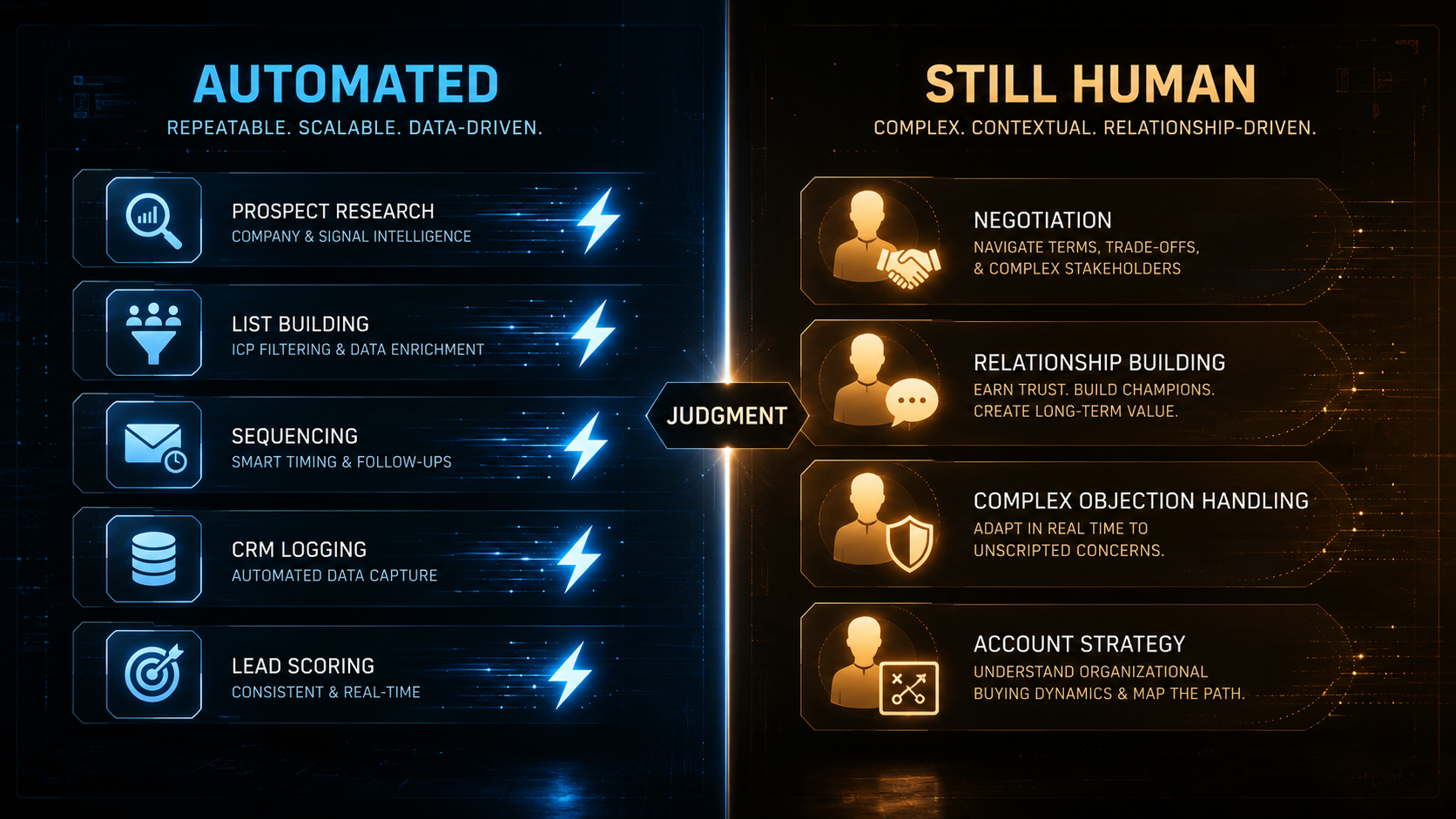
Replacing SDR workflows with AI does not require removing every human representative from the sales process.
Instead, businesses can assign repeatable activities to AI systems while allowing sales development representatives and account executives to handle situations that need deeper business knowledge.
The goal is to generate more qualified conversations, reduce manual work, and improve sales pipeline efficiency without sacrificing buyer experience.
What Are AI SDR Conversations?
AI SDR conversations are two-way sales interactions handled by artificial intelligence rather than manually conducted by a sales development representative.
An AI SDR, or artificial intelligence sales development representative, uses conversational AI, customer information, and qualification rules to engage potential buyers.
Instead of sending the same prepared response to every prospect, a conversational AI agent can adjust its questions based on previous answers.
For example, a B2B software buyer might ask whether a product integrates with Salesforce.
An AI agent with access to verified product information can answer the question, identify the buyer’s existing systems, and ask about implementation requirements.
The conversation may continue until the buyer is qualified or requires help from a human representative.
How Are AI SDRs Different From Traditional Sales Automation?
Traditional sales automation usually follows predefined instructions.
For example, an email sequence may send a follow-up three days after the first message unless the prospect replies.
Agentic AI can handle more flexible tasks. It can interpret a buyer’s response, identify relevant information, and select an appropriate next action within configured limits.
However, an AI agent’s ability to respond naturally does not guarantee that its answers are correct.
Reliable performance requires approved business information, CRM access, clear qualification standards, and human escalation rules.
Which Traditional SDR Tasks Can AI Replace?
AI can automate significant portions of sales development, particularly tasks that follow repeatable processes.
The most suitable activities include prospect research, inbound engagement, basic qualification, follow-ups, scheduling, and CRM administration.
Inbound Lead Engagement
When someone submits a demo request or starts a website conversation, an AI SDR can respond without waiting for a representative to become available.
It can acknowledge the request, ask relevant questions, and direct suitable prospects toward a sales meeting.
AI systems can also provide initial engagement outside normal business hours, provided the platform remains available and is configured correctly.
This helps businesses serve buyers in different time zones.
Prospect Research and Lead Enrichment
SDRs often spend time researching company websites, industries, employee counts, and existing technology.
AI-assisted research tools can collect and organize information from authorized data sources.
They may identify companies matching an ideal customer profile (ICP) and highlight relevant business characteristics.
Human review remains important because third-party company data can be incomplete or outdated.
Lead Qualification
AI SDR agents can qualify buyers through structured conversations.
For example, they can ask about business problems, purchasing timelines, required features, and decision-making responsibilities.
The system can then classify prospects according to the company’s qualification standards.
A lead who has a confirmed project, suitable requirements, and clear next steps may deserve immediate sales attention.
A prospect conducting early research may be better suited to nurturing.
Follow-Up and Lead Nurturing
Traditional SDR workflows often depend on manually scheduled reminders and prepared email sequences.
AI conversations can respond to prospects based on what they actually say.
A buyer requesting technical information can receive relevant product details, while someone needing more time can receive an appropriate follow-up.
These workflows must respect communication preferences, opt-outs, and applicable marketing laws.
Meeting Scheduling and CRM Updates
AI SDR systems can connect with scheduling and CRM software to reduce manual administration.
Depending on their integrations, they can check calendar availability, suggest meeting times, record responses, and update contact information.
They can also prepare conversation summaries for account executives.
This removes repetitive data-entry work while giving sales teams more complete buyer information.
Which SDR Activities Still Require Human Judgment?
AI can support many sales conversations, but some activities remain better suited to experienced representatives.
These include complex negotiations, sensitive pricing discussions, strategic account planning, and situations involving several decision-makers.
Human representatives are also important when buyers need reassurance about unusual implementation requirements or contractual obligations.
Research supports retaining human involvement.
In May 2026, Gartner reported that 69% of surveyed B2B buyers preferred validating AI-generated insights with sales representatives.
The research surveyed 645 buyers in August and September 2025.
This finding suggests that buyers may value both automated information and human confirmation during purchasing decisions.
The appropriate model is therefore not always fully autonomous selling. Companies should decide where AI can operate independently and where a person must approve or continue the conversation.
How Do AI Conversations Qualify B2B Buyers?
AI qualification works by asking relevant questions, interpreting responses, and checking whether a prospect meets defined sales criteria.
A well-configured AI SDR should gather information naturally rather than forcing buyers through a long questionnaire.
Can AI Use BANT and MEDDICC Qualification Frameworks?
AI systems can be configured to support established B2B qualification frameworks.
BANT examines four areas:
-
Budget: Does the buyer have funding or a realistic path to approval?
-
Authority: Who influences or approves the purchase?
-
Need: What business problem requires a solution?
-
Timing: When does the organization expect to make a decision?
MEDDICC provides a more detailed approach for complex sales. It covers metrics, economic buyer, decision criteria, decision process, identified pain, champion, and competition.
An AI system can collect answers related to these areas during discovery.
However, it should distinguish confirmed information from assumptions.
For example, a prospect saying they will recommend a product does not establish that they control the final budget.
How Can AI Identify Genuine Buying Intent?
A serious B2B buyer often shares specific business requirements.
Signals may include asking about implementation, integration, security reviews, pricing, procurement, or a planned purchase date.
An AI SDR can record these details and compare them with qualification criteria.
It should not automatically classify every pricing inquiry as a qualified opportunity.
Buyer intent becomes more meaningful when customer fit, business need, and purchasing activity support one another.
Can AI Handle Buyer Objections?
Conversational AI can address common objections when it has access to approved information.
For example, a prospect may ask whether implementation requires replacing their existing CRM.
The AI can explain supported integration options if those details are available in its knowledge base.
If the question involves a custom deployment, unusual security requirement, or unapproved commercial commitment, the agent should transfer the discussion to a qualified employee.
This approach helps prevent incorrect promises while keeping the conversation moving.
How Can AI Improve Inbound SDR Workflows?
Inbound sales development begins when a buyer expresses interest through a website, advertisement, email, or another approved channel.
The main challenge is turning that interest into a useful conversation before the buyer disengages.
Why Does Immediate Lead Response Matter?
A study published in Harvard Business Review in 2011 examined approximately 1.25 million sales leads from 42 companies.
Researchers found that businesses contacting prospects within one hour were nearly seven times as likely to qualify them as businesses waiting at least another hour.
Companies responding within an hour were more than 60 times as likely to qualify leads as those waiting 24 hours or longer.
These findings concern lead qualification rather than completed sales, and the study predates modern conversational AI.
Nevertheless, it provides evidence that delays in contacting interested prospects can matter.
Can AI Qualify Leads Around the Clock?
A properly deployed AI system can offer continuous initial engagement without following human working hours.
For example, a software company in California may receive an inquiry from a European buyer outside its normal office schedule.
The AI can answer approved product questions, gather business requirements, and offer available meeting times.
A human account executive can then review the information when available.
How Can AI Turn Inquiries Into Booked Meetings?
An AI SDR should establish why the buyer wants a meeting before scheduling one.
It can collect the buyer’s business need, check account fit, and identify the appropriate representative.
If the prospect meets the qualification criteria, the system can offer calendar availability.
A confirmed booking should create or update the relevant CRM activity and notify the assigned salesperson.
When the agent cannot answer a question, it should provide a clear human handoff rather than invent an answer.
How Can AI Replace Manual SDR Outreach and Follow-Ups?
Outbound sales development involves identifying suitable organizations and contacting potential buyers.
AI can support prospect research, outreach preparation, response handling, and follow-up management.
However, successful outbound sales requires more than sending large numbers of messages.
Personalized Buyer Conversations
AI personalization should use relevant, accurate information about the prospect.
For example, an AI agent may reference a company’s published product launch and ask whether the new offering creates a need for additional sales capacity.
That is more relevant than using a generic message that only inserts the buyer’s name.
Personalization must rely on reliable sources and should not invent business problems or imply a relationship that does not exist.
Two-Way Conversations Instead of Fixed Sequences
Traditional sequences generally follow predetermined timing and message rules.
Conversational AI can adapt when a prospect responds.
A buyer requesting more information about data security should receive an appropriate answer or human referral, not another generic sales email.
Similarly, a prospect declining contact should be removed from further marketing outreach in accordance with applicable rules.
Re-Engaging Existing Leads
AI can help review inactive CRM contacts and identify accounts worth revisiting.
For example, a buyer who previously postponed a software purchase may have a new business requirement.
Before contacting the account, the system should verify contact permissions, review earlier conversations, and check whether a human representative already owns the relationship.
This helps prevent duplicate outreach and unwanted communication.
How to Replace SDR Workflows With AI Conversations
Replacing manual SDR activities requires a planned transition. Businesses should begin with suitable tasks, connect the necessary systems, and test buyer experiences before expanding automation.
Step 1: Audit Existing SDR Activities
Review how representatives spend their working hours.
Separate repetitive administrative tasks from activities requiring judgment.
Measure prospect research time, lead response delays, follow-up workload, meeting scheduling, and CRM administration.
Identify which activities have clear rules and measurable outcomes.
These are usually the strongest candidates for initial automation.
Step 2: Define Buyer Qualification Criteria
Set the conditions a prospect must meet before becoming a sales-qualified lead.
Criteria may include industry, company size, business problem, purchase timeline, and decision-making responsibilities.
Use a consistent framework such as BANT or MEDDICC when appropriate.
Also define when a prospect should be nurtured, disqualified, or transferred to a human representative.
Step 3: Configure AI Conversation Workflows
Provide the AI system with approved product information, qualification questions, and conversation rules.
The agent should know what it can explain and which subjects require human approval.
Test how it responds to pricing inquiries, technical questions, objections, and unclear answers.
Avoid relying solely on prepared demonstrations. Use realistic buyer scenarios.
Step 4: Connect CRM and Scheduling Tools
Integrate the AI platform with the company’s existing systems.
For example, businesses using Salesforce or HubSpot should check whether their selected AI agent supports the required CRM operations.
The integration should support lead ownership, duplicate detection, qualification updates, conversation summaries, and authorized meeting scheduling.
Use limited permissions and verify that records remain accurate.
Salesforce’s Agentforce Qualification, for example, can update a lead’s qualification rating and create a summary with supporting reasons and suggested actions.
Step 5: Establish Human Escalation Rules
Define when AI must stop acting independently.
Examples include contract negotiations, unusual pricing requests, legal questions, complex technical concerns, and requests to speak with a person.
High-value strategic accounts may also require earlier human involvement.
The system should preserve conversation history during handoffs so representatives can continue without restarting discovery.
Step 6: Launch a Controlled Pilot
Begin with a limited group of suitable leads rather than changing the entire sales process immediately.
For example, test AI qualification on selected inbound inquiries while a comparable group continues through the existing SDR workflow.
Use the same qualification definitions and measure results across a suitable period.
Check meeting quality, buyer feedback, CRM accuracy, and escalation performance before expanding deployment.
Implementation time depends on integration complexity, data quality, security reviews, and required customization. There is no reliable universal deployment timeline.
Step 7: Measure Performance and Improve
Review the pilot against the original workflow.
Identify conversations where the AI qualified buyers correctly and situations where it made mistakes.
Update its approved knowledge, qualification rules, and escalation conditions.
Expand only when the system demonstrates reliable performance and provides measurable business value.
What Does an AI-Powered SDR Workflow Look Like?
Consider a hypothetical B2B software company receiving an inbound inquiry.
A purchasing manager visits the website and asks whether the company’s software can integrate with their existing platform.
An AI SDR responds using approved product information and asks about the company’s requirements.
The buyer explains that the organization plans to replace its current system within three months.
The AI collects relevant qualification details, records the discussion, and identifies the appropriate next step.
If the buyer meets the company’s criteria, the system offers an available meeting with an account executive.
The representative receives the buyer’s requirements and conversation summary before the meeting.
This process may reduce repeated discovery questions and manual administration.
However, if the buyer requests a complex security commitment or custom contract terms, the system should involve an authorized employee.
The main advantage is continuity between initial buyer interest, qualification, and human sales engagement.
AI Conversations vs. Traditional SDR Workflows
The differences between manual SDR work and AI-supported sales development are clearest when comparing how specific tasks are handled.
|
Sales activity |
Traditional SDR workflow |
AI-supported workflow |
|---|---|---|
|
Prospect research |
Manual research and data collection |
Automated research using connected sources |
|
Inbound response |
Depends on representative availability |
Automated initial engagement |
|
Lead qualification |
SDR-led discovery questions |
AI-led initial qualification with human review |
|
Follow-up |
Manual or scheduled sequences |
Context-aware responses within defined rules |
|
CRM updates |
Manual data entry |
Automated record updates through integrations |
|
Meeting booking |
Representative coordinates calendars |
Connected scheduling tools |
|
Complex objections |
Human judgment and discussion |
Human escalation when needed |
|
Strategic relationships |
Human-led relationship building |
Human-led, supported by AI context |
AI offers speed and consistency for certain activities. Human representatives provide judgment, accountability, and relationship management.
The most effective division of work depends on the product, buyers, and complexity of the sales process.
What Does Research Say About AI SDR Productivity in 2026?
Current industry research shows growing AI adoption in sales, but it also highlights the importance of implementation quality.
Salesforce: Sales Teams Spend Significant Time Outside Selling
The 2026 Salesforce State of Sales findings reports that the average seller spends approximately 40% of their working time selling.
The study surveyed 4,050 sales professionals between August and September 2025.
It also found that 87% of surveyed sales organizations used some form of AI.
Sellers expected AI agents, once fully implemented, to reduce prospect research time by 34% and email drafting time by 36%. These were expectations, not verified time savings.
The findings suggest that reducing administrative work remains an important opportunity for sales teams.
Gartner: More AI Does Not Automatically Mean More Productivity
In July 2026, Gartner predicted that AI agents would outnumber human sellers by 10 to one by 2028.
However, Gartner also predicted that fewer than 40% of sellers would report improved productivity from AI agents.
These are future projections, not measured 2028 outcomes.
Gartner emphasized that disconnected systems, weak data, and poor workflow design can limit AI’s benefits.
The implication for sales leaders is clear: purchasing AI tools is not enough.
Companies need reliable data, clear processes, and appropriate human supervision.
How Much Does AI SDR Software Cost Compared With Human SDRs?
AI SDR pricing varies by provider, features, usage, integration requirements, and contract terms.
A direct comparison with human SDRs should use total operating costs rather than software subscription prices alone.
Human SDR expenses may include salary, commissions, employer taxes, benefits, recruitment, training, sales tools, and management.
AI SDR expenses may include licensing, implementation, API usage, data enrichment, messaging, integration maintenance, monitoring, and human oversight.
AI can reduce the workload associated with repetitive activities, but it does not automatically remove employment costs.
For example, if representatives continue receiving their normal salaries, time saved represents additional selling capacity rather than an immediate payroll saving.
How Can Sales Leaders Calculate AI SDR ROI?
A practical formula is:
AI SDR ROI = [(Incremental Gross Profit + Verified Cost Savings − Total AI Costs) ÷ Total AI Costs] × 100
Suppose a company spends $12,000 on an AI SDR pilot.
During a comparable measurement period, it generates $24,000 in additional gross profit attributable to the pilot, with no other verified cost savings.
Its calculated ROI is:
($24,000 − $12,000) ÷ $12,000 × 100 = 100%
This is an illustrative example, not a documented AI SDR performance result.
Actual ROI calculations should include complete costs and distinguish genuine incremental revenue from sales that would have happened anyway.
Which Metrics Measure AI SDR Success?
AI SDR performance should be measured through qualified sales outcomes, not simply conversations started or messages sent.
Important metrics include:
-
Lead response time: Time between inquiry and meaningful engagement.
-
Qualification accuracy: Percentage of AI-qualified leads that meet verified sales criteria.
-
Sales acceptance rate: Percentage of AI-qualified leads accepted by sales.
-
Qualified meeting rate: Percentage of engaged prospects who book suitable meetings.
-
Meeting attendance rate: Percentage of booked meetings that take place.
-
Opportunity conversion rate: Percentage of qualified meetings that become genuine opportunities.
-
Pipeline value: Qualified opportunity value linked to the AI workflow.
-
Cost per qualified opportunity: Total applicable AI costs divided by qualified opportunities created.
Sales leaders should also review buyer satisfaction, failed conversations, incorrect information, and human escalation rates.
For example, an AI SDR may book more meetings than a human workflow while producing fewer genuine opportunities.
In that situation, meeting volume has improved, but qualification quality may have declined.
Opportunity conversion and revenue are stronger indicators of commercial performance than activity alone.
What Are the Main Risks of Replacing SDR Tasks With AI?
AI sales systems can introduce business and compliance risks when organizations deploy them without proper controls.
Incorrect Product Information
An AI agent may provide an inaccurate answer about features, integrations, pricing, or implementation.
Reduce this risk by using approved knowledge sources, limiting unsupported claims, and requiring human approval for sensitive commitments.
The system should clearly communicate uncertainty when it cannot verify an answer.
Poor Buyer Experience
Buyers may become frustrated if AI repeatedly asks irrelevant questions or refuses to connect them with a person.
Allow users to request human assistance. Keep qualification conversations relevant and avoid collecting unnecessary information.
CRM Errors and Duplicate Outreach
Disconnected systems can lead to incorrect records, repeated messages, or conflicting account ownership.
Use duplicate detection, clear lead ownership rules, and permission-controlled CRM updates.
Marketing Compliance and Data Privacy
AI outreach must follow the same marketing and privacy requirements as human-led campaigns.
In the United States, the Federal Trade Commission’s CAN-SPAM compliance guide explains requirements for commercial email, including accurate sender information, nondeceptive subject lines, and working opt-out methods.
Commercial email opt-out requests generally must be honored within 10 business days.
For contacts in the United Kingdom, the UK GDPR and Privacy and Electronic Communications Regulations may apply. The Information Commissioner’s Office B2B marketing guidance explains that business contact information can still qualify as personal data and that email marketing rules differ by recipient type.
Automated calls and text messages can carry additional consent requirements. Companies should check the laws applying to their audiences and communication channels before enabling automated outreach.
How Does Xynexi Support AI SDR Conversations?
Xynexi provides an autonomous AI SDR and business development platform designed around conversational buyer engagement.
According to its published platform information, Xynexi uses its AIRPEC reasoning system and Human AI technology to support prospect research, lead enrichment, outreach, buyer qualification, and objection handling.
Unlike tools limited to drafting messages or scheduling meetings, Xynexi describes capabilities for conducting live discovery conversations and personalized sales presentations.
Its platform materials also describe using slides, video, buyer context, and qualification information during conversations.
This approach aims to move suitable prospects further through qualification before transferring them to sales representatives.
For complex opportunities, human teams remain responsible for decisions requiring commercial authority or detailed judgment.
Sales leaders evaluating Xynexi should test its actual conversation quality, CRM integrations, escalation controls, and opportunity outcomes against their existing SDR process.
Explore how Xynexi’s AI sales agent works or experience its live AI sales conversation to assess its capabilities.
Conclusion
Replacing SDR workflows with AI conversations means changing how sales development work is performed, not necessarily removing the people responsible for sales relationships.
AI agents can handle repetitive activities such as prospect research, initial engagement, qualification, follow-ups, and CRM administration.
Human SDRs and account executives remain valuable for complex buying decisions, strategic opportunities, negotiations, and relationship building.
Successful implementation depends on clear qualification standards, reliable business information, connected systems, and well-defined escalation rules.
Businesses should begin with controlled pilots and measure qualified opportunities, conversion rates, buyer experience, and actual financial outcomes.
The objective is to give sales teams more time for the conversations that move genuine buyers toward a purchase.
Frequently Asked Questions
1. Can AI Completely Replace Human SDRs?
AI can automate many SDR activities, including prospect research, lead qualification, initial outreach, follow-ups, and scheduling. However, complex negotiations, strategic account management, and sensitive buyer discussions still benefit from human judgment. Whether a company can reduce human SDR responsibilities depends on its sales process, customers, and the reliability of its AI systems.
2. How Do AI SDR Agents Qualify B2B Leads?
AI SDR agents qualify prospects through conversations about business needs, purchase timing, customer fit, and decision-making authority. They can use frameworks such as BANT or MEDDICC to organize qualification details. Suitable prospects may be routed to sales, while early-stage contacts can enter nurturing workflows. Human review remains important for uncertain or complex cases.
3. Can AI SDRs Handle Inbound Leads 24/7?
Yes. Properly deployed AI SDR systems can engage inbound prospects at any time, provided the service is available. They can answer approved questions, gather buyer information, and offer meeting times through connected scheduling tools. Human representatives may still be required for complex inquiries, unavailable information, or issues outside the AI’s authority.
4. How Do AI SDR Agents Integrate With Salesforce and HubSpot?
AI SDR agents can integrate with Salesforce, HubSpot, or other CRMs through supported native integrations or APIs. Depending on the platform, they may create leads, update qualification fields, store conversation summaries, assign owners, and schedule activities. Businesses should verify integration capabilities, permissions, duplicate prevention, and data synchronization before deployment.
5. Is AI SDR Software Cheaper Than Hiring Human SDRs?
AI SDR software can reduce the cost of certain repetitive sales development activities, but savings are not guaranteed. Total costs include subscriptions, implementation, usage, maintenance, and supervision. Human SDR costs include compensation, benefits, training, and tools. A reliable comparison measures actual operating expenses alongside qualified opportunities and revenue generated.
6. What Is the Best Way to Implement AI SDR Workflows?
Start by identifying repetitive SDR tasks and defining clear buyer qualification criteria. Configure an AI system using approved product information, connect the CRM, and establish human escalation rules. Launch a controlled pilot before expanding. Evaluate lead quality, response times, opportunity conversion, buyer satisfaction, and ROI to determine whether the workflow produces measurable improvements.