
B2B sales teams often know which deals closed but not why buyers chose one vendor over another. That gap hides unmet needs, competitive threats, and new market opportunities. Buyer decision intelligence connects purchasing evidence with clearer marketing, product, and sales decisions.
What Can Buyer Decision Intelligence Reveal About Your B2B Market?
Buyer decision intelligence reveals why B2B customers purchase, delay, reject, or prefer specific solutions. It combines buyer conversations, purchasing outcomes, competitive comparisons, and customer feedback to identify unmet needs, buying barriers, market demand, pricing expectations, and growth opportunities. Companies can use these findings to improve go-to-market strategy, product positioning, and sales performance.
Traditional sales reports show which deals were won or lost. Buyer decision intelligence helps explain the factors behind those outcomes.
It also goes beyond individual opportunities. When revenue teams analyze patterns across many buyers, they can identify customer segments that need different solutions, competitors gaining preference, and purchasing requirements changing across their market.
The objective is to turn reliable buyer evidence into better business decisions.
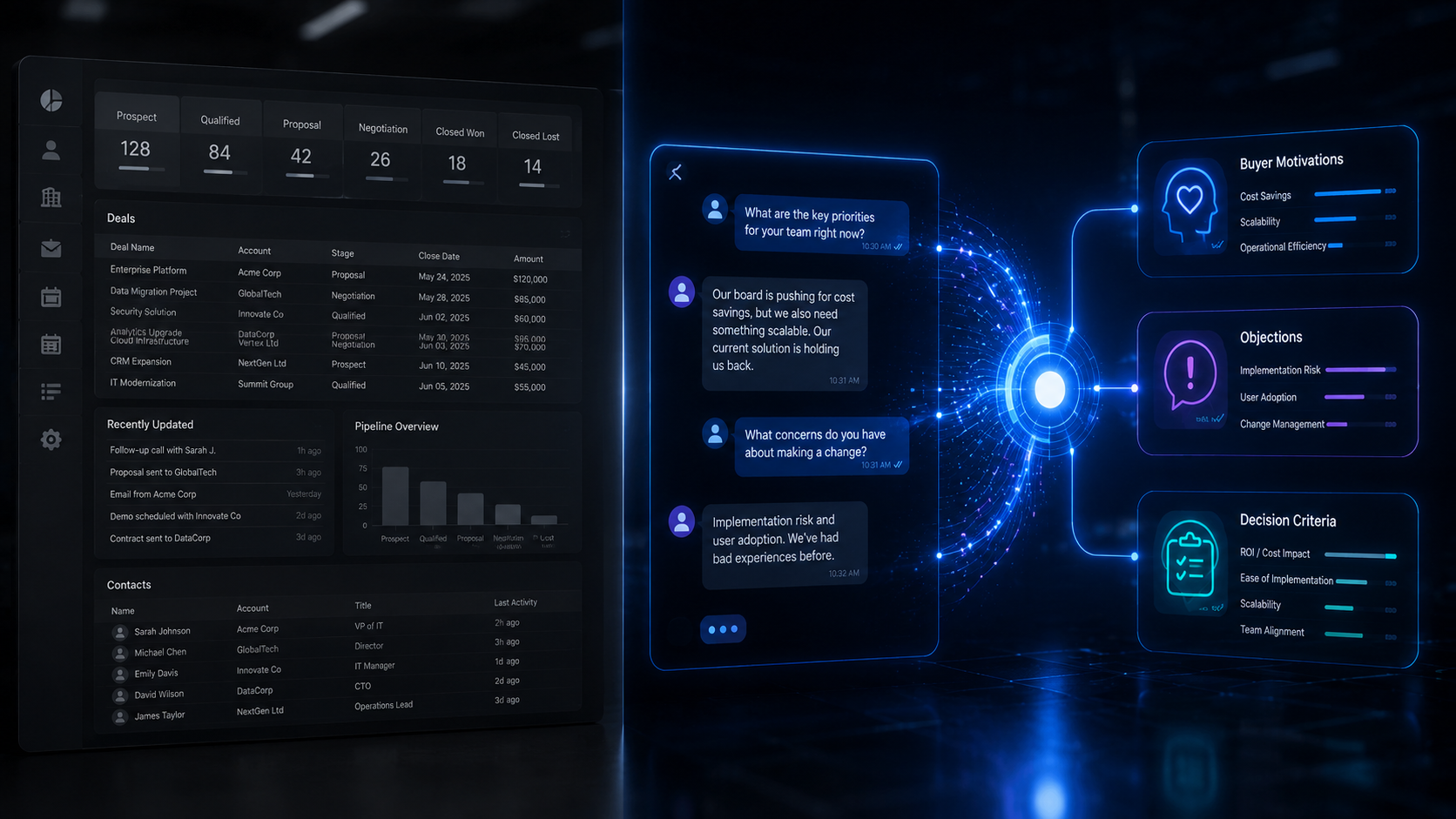
What Is Buyer Decision Intelligence in B2B Markets?
Buyer decision intelligence is the process of understanding the factors that influence business purchasing decisions.
It combines direct buyer feedback, sales conversations, purchasing outcomes, competitor comparisons, and buying-group behavior to explain how customers evaluate products and services.
Unlike basic lead scoring, buyer decision intelligence focuses on the reasons behind a decision.
For example, a company might know that 40 enterprise opportunities were lost during the previous quarter. Its CRM may classify 15 of those losses as pricing problems.
Buyer research could reveal that customers were more concerned about implementation costs, unclear ROI, or missing integrations than subscription prices.
Those findings would suggest different solutions.
How Is Buyer Decision Intelligence Different From Buyer Intent Data?
Buyer intent data identifies behavior suggesting that a company may be researching or evaluating a solution.
Examples include visits to pricing pages, product comparison searches, demo requests, and engagement with relevant content.
Buyer decision intelligence examines the reasons behind purchasing behavior.
It investigates what customers value, which alternatives they consider, what risks influence their decisions, and why they ultimately purchase or decline.
|
Data type |
What it reveals |
Example |
|---|---|---|
|
CRM data |
Sales activity, opportunity stages, deal outcomes |
An opportunity closed without a purchase |
|
Buyer intent data |
Potential interest in a solution |
A prospect reviews pricing and product comparisons |
|
Buyer decision intelligence |
Reasons influencing purchase decisions |
The buying group rejected the solution because deployment risk was too high |
|
Market research |
Broader market needs and preferences |
A survey identifies demand across a target industry |
These sources work best together.
A CRM can store detailed buying context when teams capture it correctly. However, standard opportunity fields alone rarely provide a complete explanation of purchasing decisions.
What Does Buyer Decision Intelligence Reveal About Market Needs?
Purchasing decisions contain information about customer priorities, unmet needs, market gaps, and business risks.
Analyzing these patterns across independent buyers helps companies identify where their offerings match demand and where improvements may be necessary.
1. Unmet Customer Needs and Product Gaps
Buyers often explain what they need during product evaluations.
For example, a B2B SaaS company may repeatedly hear that customers need an integration with their existing accounting platform.
If that requirement appears across several qualified opportunities, it may indicate unmet demand.
However, a repeated feature request does not automatically justify development.
Product teams should investigate how many buyers need the capability, whether it affects purchasing decisions, and whether the expected revenue supports the investment.
2. Emerging Market Demand
Buyer conversations can reveal changes in customer priorities before those changes become obvious in sales reports.
Suppose manufacturing companies increasingly ask vendors about automated compliance reporting.
That pattern may indicate growing attention to reporting efficiency or regulatory requirements.
The company should compare these conversations with industry research, purchasing activity, and relevant regulatory developments.
Buyer interest becomes stronger evidence of market demand when organizations commit resources, begin formal evaluations, or complete purchases.
A high volume of general inquiries alone does not prove that a new market opportunity exists.
3. Pricing Expectations and Perceived Value
Customer feedback can reveal how buyers judge product value.
A buyer choosing a more expensive vendor may value stronger security, easier implementation, better support, or lower operating risk.
Another customer may reject a lower-priced product because its capabilities do not meet essential requirements.
This shows why pricing analysis should consider more than the amount customers pay.
Companies should investigate the total cost of ownership, expected benefits, purchasing budgets, and perceived implementation risk.
Buyer conversations can reveal pricing concerns, but estimating willingness to pay requires additional pricing research and testing.
4. Purchasing Barriers and Decision Delays
Some buyers recognize a genuine business problem but do not complete a purchase.
Common barriers include uncertain ROI, limited funding, internal disagreements, implementation concerns, and competing business priorities.
These situations should not automatically be classified as poor demand.
For example, an organization may need a new customer support platform but postpone the purchase because its IT department is handling another major implementation.
Understanding the reason helps sales teams choose the correct follow-up strategy.
It also helps marketing develop materials that address purchasing concerns.
5. Underserved Customer Segments
Purchasing patterns can reveal groups of customers whose needs are not fully addressed by existing products.
For example, a software company serving large enterprises may discover repeated interest from smaller organizations.
Those businesses may need similar capabilities but prefer simpler implementation and different pricing.
This could support exploring a new product package.
Before entering that segment, the company should test demand, acquisition costs, product requirements, and expected profitability.
What Can Buyer Decisions Reveal About Your Competitors?
Competitive buyer intelligence helps companies understand why customers favor particular vendors and which differences matter during purchasing decisions.
Traditional competitor research often compares product features, pricing, and marketing claims.
Buyer decision research adds evidence from actual evaluations.
Why Do Buyers Choose One B2B Vendor Over Another?
Customers may select vendors based on product fit, prior experience, reputation, service quality, integration capabilities, price, or perceived risk.
A 2025 6sense B2B Buyer Experience Report surveyed nearly 4,000 buyers.
The report found that:
-
94% of buying groups had ranked their preferred vendors before engaging with sellers.
-
The winning vendor appeared on the buying group’s initial shortlist in 95% of purchases.
-
The preferred vendor before seller contact ultimately won approximately 77% of the time.
These findings show the importance of vendor awareness and preference before formal sales engagement.
They do not mean buyers never reconsider their preferred vendor.
Instead, companies should investigate what influences early shortlists and why some vendors maintain their advantage throughout the evaluation.
How Can Win-Loss Research Identify Competitive Gaps?
Win-loss analysis compares customer feedback from successful and unsuccessful opportunities.
It can reveal why buyers preferred another solution and whether the decision involved product features, sales execution, pricing, or business relationships.
For example, a buyer might explain that a competitor offered stronger implementation support.
The sales team may initially interpret the result as a pricing loss.
The actual competitive gap could involve service delivery rather than price.
For a deeper explanation, read Why Don’t B2B Sales Teams Know Why They Win or Lose Deals?.
How Can Companies Identify Competitive Market Opportunities?
Competitive gaps may reveal areas where buyers lack suitable solutions.
Suppose several midmarket companies report that enterprise products are too complex while smaller tools lack necessary security controls.
That pattern may suggest demand for a product that combines simpler implementation with stronger security capabilities.
However, companies should validate the opportunity through independent research, product testing, and purchasing evidence before investing.
How Do B2B Buying Committees Influence Purchasing Decisions?
B2B purchasing often involves more than the person who speaks with a sales representative.
The buyer’s organization may require approval from finance, procurement, IT, operations, and executive leadership.
According to Forrester’s State of Business Buying 2026, the typical B2B buying decision involves 13 internal stakeholders and nine external participants.
Forrester’s research draws on a survey of nearly 18,000 global business buyers.
These findings help explain why individual contact activity cannot fully represent an organization’s purchase readiness.
What Roles Do Buying-Group Members Play?
Different stakeholders evaluate different aspects of a potential purchase.
An economic buyer may control funding.
A technical evaluator may examine security, system compatibility, and implementation requirements.
An internal champion may recommend the product and help other stakeholders understand its benefits.
Procurement may review commercial terms and vendor requirements.
Revenue teams should identify the roles relevant to each opportunity instead of assuming that one interested contact can complete the purchase.
Why Do Buying Groups Disagree?
Buying-group members may have conflicting objectives.
For example, finance may prioritize reducing costs, while operations values functionality and IT emphasizes security.
In May 2025, Gartner reported that 74% of surveyed B2B buying teams experienced unhealthy conflict during purchasing decisions.
The same study found that groups achieving consensus were 2.5 times as likely to report a high-quality deal.
The research shows why sales teams should address shared business goals and stakeholder concerns.
A product may satisfy one department while failing to gain the wider organization’s approval.
How Is AI Changing B2B Buyer Research?
AI-assisted research is becoming part of the B2B purchasing process.
Forrester’s 2026 research found that 94% of surveyed business buyers used AI during their buying journey.
However, buyers also sought confirmation from colleagues, experts, and other trusted sources because AI-generated information can be incomplete or inaccurate.
B2B companies should therefore make product information accurate, accessible, and easy to verify.
Buyer decision intelligence can help identify the questions customers ask during these early research stages.
How to Collect and Analyze Buyer Decision Intelligence
A reliable intelligence program combines information from several sources.
The following seven steps help B2B organizations collect evidence, identify market patterns, and apply findings without relying on isolated customer comments.
Step 1: Capture Buyer Conversations
Collect relevant information from permitted sales calls, discovery meetings, customer interviews, email exchanges, and conversational AI interactions.
Focus on purchasing needs, objections, alternative solutions, decision criteria, and timelines.
Store important statements with enough context to understand their meaning.
Recording and analyzing conversations must follow applicable consent, privacy, and data protection requirements.
Step 2: Collect Feedback From Won and Lost Deals
Interview customers after purchasing decisions.
Ask what prompted their search, which vendors they considered, and what influenced their final choice.
Include successful deals, competitive losses, and opportunities where no purchase occurred.
A December 2025 Forrester win-loss research guide recommends combining buyer interviews, short surveys, and sales call transcripts.
This approach provides more context than CRM loss categories alone.
Step 3: Connect Buyer Evidence With CRM Outcomes
Associate customer feedback with the correct account and opportunity in Salesforce, HubSpot, or another CRM.
Record the deal outcome, company size, industry, product, and buying-group information.
Distinguish confirmed buyer statements from salesperson interpretations.
Also separate competitive losses from no-decision outcomes.
This helps analysts compare similar purchasing decisions and identify recurring patterns.
Step 4: Analyze Purchasing Patterns Using AI
AI conversation intelligence can help classify approved transcripts and identify repeated topics.
For example, a language model can group discussions involving implementation concerns, competitive comparisons, security requirements, and pricing objections.
It may also identify changes in topic frequency over time.
However, AI should not decide that a particular issue caused a lost deal without supporting evidence.
Review important findings against transcripts and buyer feedback.
Step 5: Segment Insights by Industry and Buyer Role
Analyze buyer decisions by industry, company size, geographic market, product category, and purchasing role.
Different customer segments may evaluate the same product using different criteria.
For example, smaller businesses may prioritize implementation simplicity, while enterprise customers may focus on governance and integrations.
These are possible patterns, not universal rules.
Use your actual customer data to identify which differences exist.
Step 6: Validate Findings Against Broader Market Evidence
A company’s sales conversations usually represent organizations that already know about or engage with the company.
They do not represent the entire addressable market.
Combine conversation intelligence with independent buyer surveys, industry research, customer usage data, and competitor information.
Pay attention to sampling bias and missing customer groups.
A few strong opinions should generate questions for further research, not automatic strategic conclusions.
Step 7: Turn Findings Into Measurable GTM Decisions
Assign validated findings to the appropriate department.
Marketing can test positioning changes. Sales can improve qualification. Product teams can investigate unmet needs. Revenue operations can track whether the changes improve outcomes.
Record the evidence, responsible person, proposed change, and expected result.
Continue measuring after implementation.
How Can AI Reveal Patterns Across Hundreds of Buyer Decisions?
AI helps organize larger amounts of buyer information.
Instead of manually reading hundreds of transcripts, analysts can use approved AI systems to classify recurring topics and identify conversations requiring review.
A useful AI analysis workflow should preserve the supporting evidence behind each finding.
For example, if the system reports that buyers frequently raise data security concerns, analysts should be able to examine the relevant transcript passages.
What AI Can Identify
AI-supported analysis may help identify common objections, buying triggers, competitor mentions, product requirements, and differences across customer segments.
It can also produce summaries that help analysts compare won, lost, and delayed opportunities.
What AI Cannot Reliably Determine Alone
AI cannot automatically uncover private discussions that never appear in available records.
It also cannot establish that one factor caused a purchasing decision simply because that factor appeared in a transcript.
Automated summaries may omit context, misunderstand statements, or assign comments to the wrong speaker.
Use human review and direct buyer research for important commercial conclusions.
For more on analyzing live interactions, read How to Turn B2B Buyer Conversations Into Actionable GTM Insights.
How Can Buyer Decision Intelligence Improve Your GTM Strategy?
Buyer intelligence creates value when organizations use verified findings to change business decisions.
The following examples show how purchasing patterns can influence marketing, sales, and product strategy.
|
Buyer decision signal |
Potential market insight |
GTM action |
|---|---|---|
|
Repeated requests for a missing feature |
Possible unmet customer need |
Investigate product demand |
|
Higher conversion in one industry |
Potentially stronger customer fit |
Refine the ideal customer profile |
|
Buyers regularly favor one competitor |
Possible differentiation gap |
Review competitive positioning |
|
Purchases stall during implementation reviews |
Deployment risk may be important |
Improve onboarding and technical guidance |
|
Several stakeholders raise conflicting concerns |
Buying-group alignment may be weak |
Create stakeholder-specific decision support |
|
Buyers choose more expensive alternatives |
Value or risk may outweigh price |
Test value-based messaging |
|
Smaller companies request enterprise features |
Potential underserved segment |
Research new packaging options |
These are hypothetical interpretations. Each finding requires validation before making major investments.
Refine Your Ideal Customer Profile
An ideal customer profile (ICP) describes organizations that are likely to benefit from and purchase a product.
Buyer decision intelligence helps companies identify characteristics shared by successful customers.
For example, a software provider may find that organizations with a particular operational problem close faster and renew more often.
That evidence may support refining marketing targeting and sales qualification.
Compare results with customer acquisition costs, retention, and profitability before making significant changes.
Improve Product Positioning and Marketing Messages
Buyer feedback can reveal which benefits customers value most.
For example, marketing may emphasize automation while buyers repeatedly discuss reducing missed revenue opportunities.
The company can test messaging that connects the product to the outcome customers describe.
This can make marketing more relevant without changing the product itself.
However, every claim must accurately reflect what the solution can deliver.
Optimize Pricing and Packaging
Purchasing feedback can help explain whether product packages match customer needs.
Some buyers may need fewer features at a lower entry price.
Others may value additional support, integrations, or advanced security.
These observations can guide pricing research and package testing.
Do not assume that repeated pricing objections automatically justify discounts.
The company should first investigate whether customers are concerned about affordability, value, or purchasing risk.
Improve Sales Qualification and Pipeline Quality
Buyer decision patterns can identify characteristics associated with realistic purchasing opportunities.
For example, closed-won deals may frequently include a confirmed business problem, access to decision-makers, and an agreed evaluation timeline.
Sales teams can use that information to improve qualification standards.
Better qualification may help representatives spend more time on buyers with genuine purchasing potential.
Explore How to Improve B2B Sales Pipeline Quality Without More Leads or Headcount.
Identify New Market Opportunities
Customer decisions may reveal demand outside the company’s current target segments.
For example, a business selling to large enterprises may discover repeated interest from midmarket companies with similar needs.
Revenue leaders can investigate whether that segment supports a profitable offering.
Before expanding, evaluate market size, buying behavior, competition, delivery costs, and customer acquisition requirements.
What Real-World Research Supports Buyer-Led GTM Decisions?
Buyer research and documented business cases provide evidence for using purchasing behavior to improve go-to-market decisions.
Palo Alto Networks: Better Results From Buying-Group Visibility
Palo Alto Networks worked with Forrester to improve how marketing and sales identified buying groups.
Previously, marketing often passed individual leads to sales without enough context about the wider purchasing organization.
According to Forrester’s Palo Alto Networks case study, the initiative reported that opportunities involving multiple identified buying-group members were eight times as likely to advance as opportunities involving only one contact.
The company also reported a 17% higher closed-won rate after adopting its buying-group approach.
These are reported outcomes from a broader change in marketing and sales practices.
They do not establish that conversation intelligence alone caused the improvement.
The case demonstrates the value of understanding purchasing decisions at the account level rather than focusing only on individual leads.
Siemens: Connecting Buying Groups With Revenue
Siemens Digital Industries Software also worked with Forrester to move from a lead-focused revenue model toward an opportunity-based approach.
The company sought better visibility into buying-group engagement and stronger coordination between marketing and sales.
Forrester’s 2023 case study reported a 130% year-over-year increase in the number of new closed deals influenced by marketing after the broader transformation.
This example shows how aligning revenue processes with buying behavior can support business improvements.
However, the reported outcome cannot be attributed solely to collecting buyer decision data.
How Do You Measure Buyer Decision Intelligence ROI?
Revenue leaders should evaluate an intelligence program based on the quality of its findings and the measurable business changes that follow.
The most useful indicators connect customer evidence with purchasing outcomes and strategic decisions.
|
KPI |
What it measures |
|---|---|
|
Buyer decision coverage |
Percentage of eligible decisions with usable buyer evidence |
|
Verified decision driver rate |
Percentage of researched decisions with evidence-supported explanations |
|
Competitive win rate |
Percentage of completed competitive opportunities won |
|
Customer segment conversion |
Conversion rates by industry, company size, or market |
|
Unmet-need frequency |
Share of researched buyers reporting a particular need |
|
Insight-to-action rate |
Percentage of approved findings that result in implemented actions |
|
Revenue impact |
Changes in attributable gross profit after tested GTM improvements |
How Can Companies Calculate Buyer Intelligence ROI?
A practical formula is:
ROI = [(Incremental Gross Profit + Verified Cost Savings − Total Intelligence Costs) ÷ Total Intelligence Costs] × 100
For example, suppose a company invests $20,000 in buyer research, conversation analysis, and implementation.
After making tested improvements, it attributes $50,000 in additional gross profit to those changes.
With no other verified cost savings, calculated ROI is:
($50,000 − $20,000) ÷ $20,000 × 100 = 150%
This is an illustrative example, not a documented performance result.
Actual ROI calculations should account for research costs, software, employee time, implementation, and ongoing operations.
Use comparable customer groups or reliable historical baselines where possible.
Avoid treating pipeline value or projected opportunities as realized profit.
What Are the Limitations of Buyer Decision Intelligence?
Buyer decision intelligence is useful, but companies should understand its limitations.
Incomplete market representation: Sales conversations mostly reflect organizations that engage with the company. Other potential buyers may have different requirements.
Buyer memory and interpretation: Post-decision interviews can contain incomplete recollections or explanations influenced by hindsight.
Small samples: A few interviews may reveal useful issues but cannot establish a market-wide trend.
AI classification errors: Automated analysis can misunderstand comments or omit important context.
Privacy and security: Customer conversations may contain personal information, confidential business details, and sensitive purchasing plans.
Changing market conditions: Buyer priorities can change as products, competitors, budgets, and industry requirements evolve.
Companies should combine several evidence sources and review findings regularly.
Recording and processing customer conversations also requires suitable legal notices, consent practices where required, access controls, and retention policies.
How Does XYNEXI Support Buyer Decision Intelligence?
XYNEXI is an autonomous AI sales development platform that uses its AIRPEC reasoning engine to support outbound engagement, discovery, qualification, and buyer conversations.
Its official website describes the Curated Buyer Decision Tool (CBDT), which is designed to analyze completed buyer conversations and identify objections, hesitations, purchasing triggers, and other decision signals.
XYNEXI describes using these findings to inform future qualification, outreach, and revenue execution.
This approach can help organizations preserve buyer information collected during early sales engagement.
For example, a conversation may reveal that a prospect needs a particular integration, has concerns about implementation, or plans to purchase within a defined period.
When that information is captured accurately, it can support future sales interactions and campaign improvements.
From Individual Conversations to Strategic Market Intelligence
A company can use conversation-derived information to investigate wider purchasing patterns.
For example, recurring objections may suggest a need to improve product explanations.
Repeated interest from a particular industry may suggest a potential customer segment worth researching.
However, these findings should be validated against actual purchasing outcomes and broader market evidence.
XYNEXI’s published capabilities focus on outbound sales execution and conversation-derived buyer intelligence. Businesses should verify the specific reporting, export, integration, and analysis capabilities required for their own intelligence programs.
The strategic objective is not merely to collect more customer data.
It is to understand what buyers need, identify why they make purchasing decisions, and use validated evidence to improve future sales and GTM performance.
Explore XYNEXI’s AI sales platform to learn how its conversational sales technology works.
Conclusion
Buyer decision intelligence reveals what drives customer purchasing decisions and what those decisions may indicate about the wider B2B market.
It helps companies identify unmet needs, competitive preferences, purchasing barriers, stakeholder concerns, and possible growth opportunities.
However, useful intelligence requires more than collecting conversations or analyzing CRM records.
Organizations should combine direct buyer feedback, verified deal outcomes, independent research, and carefully reviewed AI analysis.
Marketing can use these findings to improve positioning. Sales can strengthen qualification and discovery. Product teams can investigate market gaps. Revenue leaders can make better investment decisions.
The companies that benefit most are those that turn buyer evidence into tested business improvements.
Understanding why customers buy today can help businesses decide where and how to compete tomorrow.
Frequently Asked Questions
1. What Is Buyer Decision Intelligence in B2B Marketing?
Buyer decision intelligence is the process of collecting and analyzing evidence about how business customers make purchasing decisions. It combines buyer conversations, customer feedback, competitive comparisons, and deal outcomes. Marketing teams use these insights to understand customer needs, improve product positioning, identify market opportunities, and develop more relevant campaigns.
2. What Can Buyer Decision Intelligence Reveal About Market Demand?
Buyer decision intelligence can reveal unmet customer needs, recurring purchasing requirements, emerging priorities, and potential gaps in available solutions. It can also show why organizations delay purchases or favor particular vendors. However, companies should confirm market demand using broader research and actual purchasing evidence rather than relying only on customer inquiries.
3. How Is Buyer Decision Intelligence Different From Buyer Intent Data?
Buyer intent data identifies behavior that may suggest interest in a product, such as pricing-page visits, product research, or demo requests. Buyer decision intelligence examines why customers consider, select, reject, or delay purchasing solutions. Intent data helps identify potential buyers, while decision intelligence provides deeper evidence about their requirements and purchasing choices.
4. How Can AI Analyze Purchasing Decisions to Identify Market Opportunities?
AI can analyze permitted sales transcripts, customer feedback, and CRM information to identify recurring needs, objections, competitor mentions, and purchasing patterns. Businesses can compare these findings across industries and customer segments. Human validation and independent market research remain important because AI may misunderstand statements or identify patterns that do not represent the wider market.
5. How Can Buyer Intelligence Improve Competitive Positioning?
Buyer intelligence helps businesses understand why customers prefer competing vendors. It may reveal differences involving features, implementation, pricing, support, trust, or perceived business value. Companies can use verified findings to improve marketing messages, sales enablement, product capabilities, and competitive comparisons. Important decisions should be based on repeated evidence rather than isolated customer opinions.
6. How Can Companies Measure the ROI of Buyer Decision Intelligence?
Companies can measure ROI by comparing incremental gross profit and verified cost savings from buyer-informed improvements with the total cost of research, software, and implementation. Supporting metrics include competitive win rates, opportunity conversion, decision coverage, and insight-to-action rates. Comparable customer groups and historical performance data help determine whether the intelligence program contributed to measurable business improvements.