B2B buyers can request a demo, compare vendors, and shortlist solutions before your sales team responds. Slow follow-ups, delayed qualification, and poor handoffs can waste that interest. Faster, useful sales engagement helps companies reach qualified buyers while purchasing decisions are still active.
Why Is Speed a Competitive Advantage in B2B Sales?
Speed is a competitive advantage in B2B sales because timely responses help companies engage interested buyers, answer urgent questions, and qualify opportunities before interest fades. Improving lead response time, qualification, scheduling, and deal progression can reduce delays and support higher conversion rates. Speed works best when every interaction delivers genuine buyer value.
Sales speed is not simply about calling prospects before competitors.
It includes how quickly a company understands customer needs, answers questions, resolves buying concerns, and helps qualified opportunities progress.
For a chief revenue officer (CRO), sales director, or revenue operations leader, the goal is to reduce unnecessary delays without pressuring buyers or weakening qualification standards.
A company that responds quickly with accurate information can provide a more useful experience than one that sends an immediate generic acknowledgment but takes days to answer the buyer’s actual question.
How Does Sales Speed Influence B2B Buying Decisions?
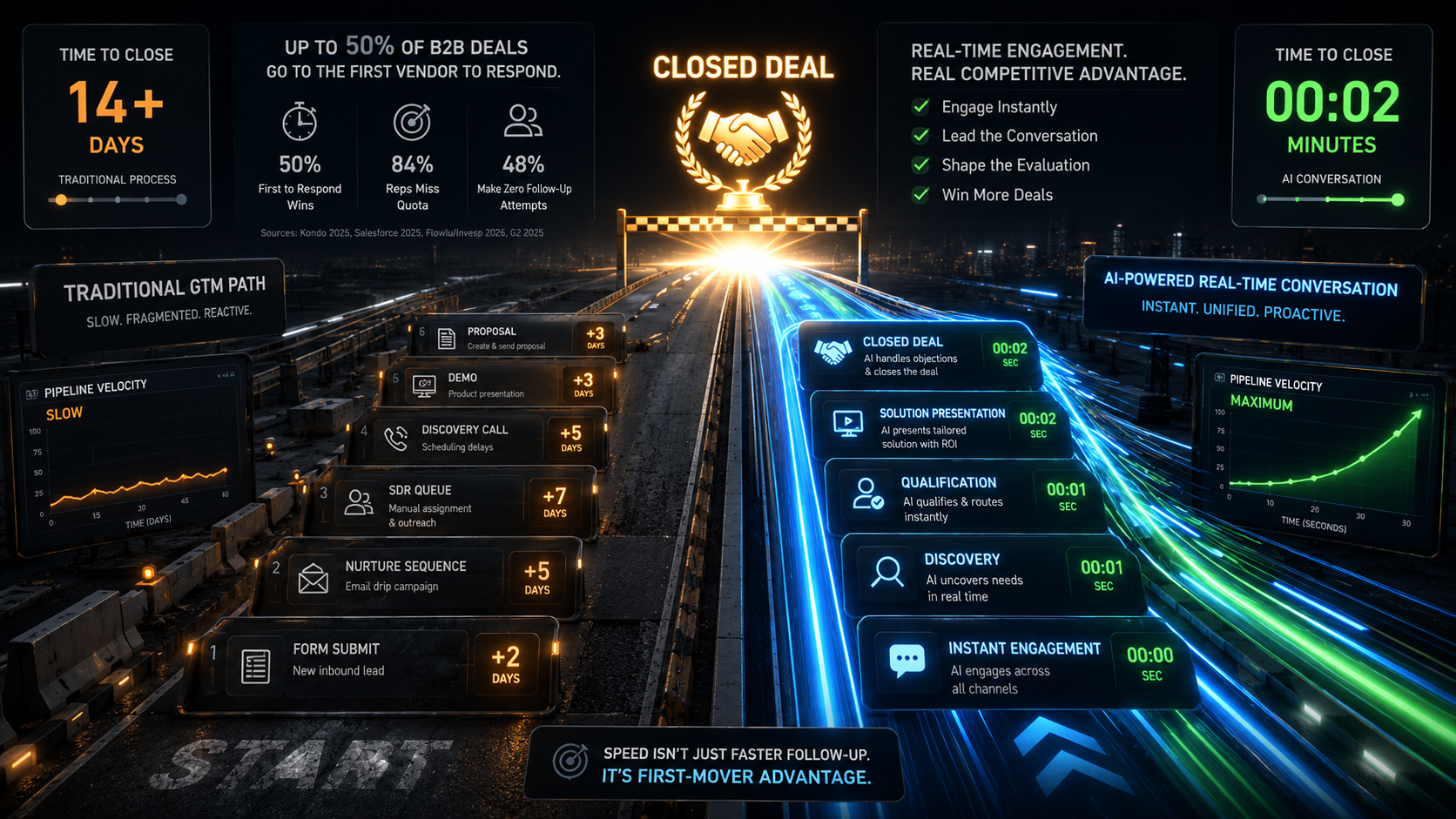
Faster engagement can improve a buyer’s experience by reducing the time spent waiting for information, scheduling meetings, and completing qualification.
However, speed creates the most value when it helps customers make informed decisions.
Faster Responses Reduce Buyer Friction
A potential customer requesting pricing or a product demonstration usually expects a relevant response.
If the inquiry goes into a queue without clear ownership, the buyer may continue researching alternatives.
A faster process allows the company to acknowledge the request, answer appropriate questions, and arrange the next action.
For example, a software buyer asking about Salesforce integration may need a technical answer before agreeing to a demonstration.
Providing that answer promptly can remove a barrier to further evaluation.
Buyers Often Have Preferences Before Contacting Sales
The 2025 6sense Buyer Experience Report provides important context about B2B purchasing behavior.
Based on research involving nearly 4,000 buyers, it found that:
-
94% of buying groups ranked preferred vendors before contacting sales.
-
79% of first seller engagements were initiated by buyers.
-
The preferred vendor before seller contact ultimately won 77% of purchases.
These findings show why companies need to be helpful throughout the buying journey, not only after a demo request.
They also challenge the idea that the fastest responding vendor automatically wins.
Buyers often contact their preferred vendor first. Therefore, the relationship between first contact and winning may reflect existing buyer preference rather than response speed alone.
Speed-to-Value Matters More Than Speed-to-Contact
Speed-to-contact measures how quickly a business reaches a prospect.
Speed-to-value measures how quickly the buyer receives something useful.
For example, an immediate automated email confirming receipt of a question provides limited value if a detailed answer arrives three days later.
A relevant response explaining product capabilities, answering a concern, or providing a suitable next step can be more useful.
This distinction is especially important for complex B2B purchases where buyers need technical, financial, and operational information.
What Does Research Say About B2B Lead Response Time?
Research has repeatedly identified an association between faster response and successful lead qualification.
However, many widely quoted studies are historical. Their findings should not be presented as guaranteed conversion rates for every B2B industry in 2026.
What Happens When Sales Responds Within Five Minutes?
In its 2021 Lead Response Study, InsideSales analyzed more than 55 million sales activities involving 5.7 million inbound leads across over 400 companies.
The vendor reported that conversion rates were approximately eight times higher when contact was attempted during the first five minutes than when attempts occurred between five minutes and 24 hours.
This is a vendor-reported observational finding.
It supports testing faster engagement, but it does not prove that every business will experience an eightfold improvement or that faster contact alone caused the difference.
Why Does the First Hour Matter?
A 2011 study published in Harvard Business Review examined 1.25 million sales leads received by 42 U.S. companies.
The researchers found that companies attempting contact within one hour were nearly seven times as likely to qualify leads as those waiting at least another hour.
They were more than 60 times as likely to qualify leads as companies waiting 24 hours or longer.
The study defined qualification as a meaningful conversation with a key decision-maker.
It did not measure guaranteed sales revenue, and its sample included both B2B and B2C organizations.
How Quickly Should Your Sales Team Respond?
For high-intent inbound inquiries, a practical operational target is to provide meaningful initial engagement within five minutes when possible.
This is a suggested service standard, not a universal industry requirement.
Different inquiries deserve different handling.
A buyer requesting a product demonstration may need immediate attention. Someone downloading educational material may prefer relevant information without direct sales contact.
Measure response-time performance by lead source, customer fit, intent, and business hours.
Where Do B2B Sales Teams Lose the Most Time?
Many sales delays come from disconnected workflows rather than representatives intentionally responding slowly.
These problems often occur between departments, systems, and pipeline stages.
Delayed Inbound Lead Routing
A prospect submits a form, but the CRM does not immediately assign an owner.
Marketing may review the inquiry before transferring it to an SDR, who then schedules a follow-up.
Each transfer adds potential delay.
Automated routing can reduce unnecessary waiting by assigning inquiries according to territory, account ownership, product interest, or qualification criteria.
Slow Initial Qualification
Some sales teams require representatives to collect basic information manually before they can schedule a meaningful meeting.
This may involve several emails about company size, business requirements, budget, and purchase timing.
A more efficient process gathers relevant information during the initial interaction.
The objective is to establish whether the buyer needs human sales assistance, not force every prospect through a long questionnaire.
Poor Marketing-to-Sales Handoffs
Buyers may explain their needs to marketing, an SDR, and an account executive in separate conversations.
If their information does not move between teams, they must repeat themselves.
This wastes time and creates unnecessary friction.
A useful handoff should include the buyer’s requirements, relevant questions, confirmed purchase timeline, decision-makers, and agreed next action.
Meeting and Proposal Delays
Sales opportunities can also stall after qualification.
Common causes include scheduling conflicts, missing technical information, slow proposal preparation, and unclear commercial approvals.
For example, a buyer may be ready to review a proposal while the seller waits for internal pricing approval.
Companies should examine these delays separately from initial lead response.
Stalled Buying-Group Decisions
A qualified buyer may still need agreement from finance, procurement, IT, and executive leadership.
Faster sales execution cannot eliminate every internal purchasing requirement.
However, representatives can help by providing clear business cases, implementation details, security documentation, and other information that supports stakeholder decisions.
How to Improve Sales Speed in 7 Steps
Improving sales responsiveness requires consistent processes, clear ownership, and reliable information.
The following seven steps help B2B companies reduce unnecessary delays without sacrificing qualification quality.
Step 1: Audit Current Lead Response Times
Start by examining recent inbound inquiries in Salesforce, HubSpot, or your existing CRM.
Record the time between inquiry submission and the first meaningful sales response.
Separate automated acknowledgments from genuine engagement.
Measure both average and median response times.
The median shows the middle value and is less affected by a few unusually slow responses.
Also examine the percentage of inquiries that receive no meaningful response.
Step 2: Prioritize High-Intent Buyer Signals
Not every lead requires the same response.
A prospect researching general industry information may not be ready for direct contact.
Someone asking about pricing, implementation, contracts, or a product demonstration may deserve higher priority.
Useful buying signals include:
-
A request for a product demonstration.
-
Specific pricing or proposal questions.
-
An identified business problem.
-
Confirmed implementation requirements.
-
A planned purchasing timeline.
-
Participation from relevant decision-makers.
Combine buying intent with ideal customer profile fit.
This helps representatives prioritize suitable prospects rather than simply responding to the newest contact.
Step 3: Establish Lead Response Service Standards
Create a service-level agreement (SLA) that defines how quickly different inquiry types should receive attention.
An illustrative policy might look like this:
|
Inquiry type |
Suggested initial response target |
|---|---|
|
High-intent demo or pricing request |
Within 5 minutes |
|
Qualified product inquiry |
Within 30 minutes |
|
General business inquiry |
Within 4 business hours |
|
Educational content engagement |
Relevant nurturing rather than forced sales contact |
These are example operating targets, not verified industry benchmarks.
Assign clear responsibility for responding, including during employee absences and outside business hours.
Track whether teams meet the agreed standards.
Step 4: Automate Initial Buyer Engagement
Automation can reduce delays between inquiry submission and the first useful response.
For example, a workflow can detect a product inquiry, check account ownership, create a CRM record, and alert the appropriate representative.
Conversational AI can also answer approved questions or gather requirements where supported.
The system should avoid sending irrelevant messages simply because a prospect has entered a database.
Step 5: Qualify Buyers Through Conversations
Use the first meaningful interaction to understand the customer’s problem.
Rather than immediately asking a series of budget questions, start with what the buyer needs.
For example:
“What problem are you trying to solve with your current sales process?”
If the buyer explains that missed inquiries are creating revenue problems, the conversation can explore when those inquiries occur and how the organization currently handles them.
Relevant follow-up questions can establish company fit, urgency, purchasing responsibilities, and the next useful step.
This approach can support structured qualification frameworks without making the buyer feel interrogated.
Step 6: Streamline Sales Handoffs
When a buyer qualifies for direct sales assistance, transfer the relevant information to the responsible representative.
The CRM record should contain the buyer’s requirements, known objections, decision-making context, and agreed follow-up.
Clear account ownership helps prevent duplicate outreach.
Scheduling systems should check calendar availability before confirming meetings.
For technical or commercial questions outside the automation’s authority, the system should provide an appropriate human escalation.
Step 7: Measure Conversion Quality Alongside Speed
Faster responses are useful only when they support better sales outcomes.
Track whether quicker engagement produces more meaningful conversations, accepted opportunities, qualified meetings, and closed revenue.
Review situations where faster outreach created poor buyer experiences or low-quality meetings.
Use these findings to improve qualification and routing.
For related guidance, see How to Improve B2B Sales Pipeline Quality Without More Leads or Headcount.
How Can AI Help B2B Sales Teams Respond Faster?
AI sales agents can help companies engage prospects, collect qualification information, and handle some repetitive sales tasks without waiting for a human representative.
The specific capabilities depend on the platform, integrations, and configured permissions.
Around-the-Clock Buyer Engagement
A properly deployed conversational AI system can handle supported buyer inquiries outside normal business hours.
For example, a U.S. software company might receive a question from a European prospect while its sales team is offline.
The system can provide approved information, collect relevant requirements, or arrange an appropriate follow-up.
However, immediate availability does not guarantee that every question can be resolved automatically.
Real-Time Lead Qualification
AI can ask questions about customer needs, company fit, purchasing timelines, and decision-making responsibilities.
It can then organize responses according to defined qualification criteria.
This helps representatives identify suitable opportunities without manually collecting every piece of basic information.
The system should preserve uncertainty rather than assume that missing information confirms purchasing readiness.
Personalized Buyer Conversations
Context-aware AI can use authorized CRM information and approved product knowledge to make interactions more relevant.
For example, a returning prospect may already have explained their implementation requirements.
An integrated system can use that information instead of asking the same questions again.
However, inaccurate CRM records or outdated product documentation can lead to incorrect responses.
Reliable data and human oversight remain important.
Human Handoffs and Scheduling
AI can support qualified meeting scheduling and transfer buyer context to account executives.
Human assistance remains appropriate for complex negotiations, sensitive commercial terms, unusual technical requirements, and strategic relationships.
The goal is to reduce unnecessary administrative work while keeping qualified employees involved where their expertise matters.
What Does Recent Research Say About AI Sales Productivity?
Salesforce’s February 2026 State of Sales research surveyed 4,050 sales professionals.
It found that 87% of surveyed sales organizations used some form of AI, while the average seller spent 40% of working time selling.
The report also found that sellers expected fully implemented AI agents to reduce prospect research time by 34% and email drafting time by 36%.
Those reductions were expectations, not independently verified savings.
The findings support examining whether administrative automation can provide sales teams with more capacity for useful buyer engagement.
What Is the Difference Between Sales Response Speed and Sales Velocity?
These metrics measure different parts of sales performance.
Sales response speed measures how quickly a business engages a prospect after an inquiry.
Sales velocity estimates the rate at which a qualified pipeline generates revenue based on opportunity count, average deal value, win rate, and sales cycle length.
A standard sales velocity formula is:
For example, suppose a sales team has:
-
40 opportunities.
-
An average deal value of $15,000.
-
A 25% win rate.
-
A 60-day sales cycle.
Its calculated sales velocity is $2,500 per day.
If the average sales cycle decreases to 50 days while the other inputs remain unchanged, the calculated velocity increases to $3,000 per day.
That represents a 20% increase in modeled sales velocity.
This is an illustrative calculation, not a revenue forecast or a guaranteed outcome.
Faster lead response may improve one part of the process, but sales velocity also depends on qualification, deal value, buyer decisions, and conversion performance.
Which Sales Speed Metrics Should Revenue Leaders Track?
Chief revenue officers and revenue operations teams should measure engagement speed alongside opportunity quality and sales outcomes.
|
KPI |
What it measures |
|---|---|
|
Median first-response time |
Typical time between inquiry and meaningful engagement |
|
Five-minute response rate |
Share of eligible inquiries receiving a response within five minutes |
|
SLA compliance rate |
Percentage of inquiries handled within the agreed response window |
|
Lead-to-conversation rate |
Percentage of inquiries resulting in meaningful buyer discussions |
|
Qualified conversation rate |
Share of conversations meeting agreed sales criteria |
|
Time to qualified meeting |
Time between inquiry and a scheduled qualified meeting |
|
Stage duration |
Time opportunities spend in each sales stage |
|
Opportunity win rate |
Share of completed opportunities resulting in closed-won deals |
|
Sales velocity |
Modeled revenue movement through the sales pipeline |
How Do You Calculate Average Lead Response Time?
Use this formula:
Average Response Time = Total Response Time Across Eligible Inquiries ÷ Number of Eligible Inquiries
Suppose five inquiries receive meaningful responses after 5, 10, 15, 20, and 50 minutes.
The average response time is 20 minutes.
The median is 15 minutes.
Both measures are useful, but they describe different aspects of performance.
Revenue teams should also track the longest delays and unanswered inquiries so that poor experiences are not hidden inside averages.
How Can You Measure the Effect of Faster Responses on Conversion?
Compare similar inquiries handled under different response processes.
For example, one group may receive the existing response workflow while another receives faster automatic routing.
Measure the percentage of leads that become qualified conversations, sales-accepted opportunities, and customers.
Control for factors such as lead source, buyer intent, time of day, company size, and sales representative availability.
High-intent leads may naturally receive faster responses and convert more often.
Therefore, a simple correlation between response speed and sales conversion does not prove that speed alone caused the improvement.
What Does a 30-Day Sales Speed Improvement Plan Look Like?
A focused 30-day pilot can help businesses improve an important part of the sales process without changing every workflow simultaneously.
Days 1 to 7: Identify Response Bottlenecks
Review recent CRM data and calculate response times by inquiry type.
Identify delayed or unanswered high-intent leads.
Interview representatives to understand problems with routing, ownership, scheduling, and missing buyer information.
Choose one measurable bottleneck for the pilot.
Days 8 to 14: Improve Routing and Engagement
Establish response standards based on buyer intent.
Configure automatic assignment and notifications.
Prepare approved answers to common questions.
Where appropriate, test an AI qualification system on a limited group of suitable inquiries.
Keep human escalation available.
Days 15 to 21: Test the Faster Workflow
Use the new process for a defined set of incoming leads.
Maintain a comparable group using the previous workflow when possible.
Measure response time, qualified conversations, meeting attendance, and buyer feedback.
Check for duplicate messages, incorrect answers, and CRM errors.
Days 22 to 30: Evaluate and Refine
Compare results with the baseline.
Investigate whether response speed improved without lowering qualification quality.
Review any problems with routing, handoffs, or buyer experience.
Expand the workflow only when evidence supports doing so.
Closed-revenue results may require more time because B2B opportunities can take weeks or months to complete.
How Can Sales Teams Improve Speed Without Sacrificing Buyer Trust?
Speed should make the buying process easier, not create pressure.
In March 2026, Gartner reported that 67% of surveyed B2B buyers preferred a sales experience without direct representative involvement.
Its research involved 646 buyers surveyed in August and September 2025.
This finding shows why immediate engagement should not mean forcing every website visitor into a sales conversation.
Some buyers prefer self-service product information. Others want a detailed discussion with a representative.
A responsive sales process should support both.
Businesses should provide accurate information, respect communication preferences, maintain access to human assistance, and avoid unnecessary follow-ups.
For U.S. commercial email, the Federal Trade Commission’s CAN-SPAM guidance explains requirements concerning truthful sender information, clear opt-out options, and handling unsubscribe requests. These rules also apply to B2B commercial email.
Companies using AI or automated outreach must continue following applicable privacy and communication requirements.
How Does XYNEXI Support Faster B2B Sales Engagement?
XYNEXI is an autonomous AI SDR and BDR platform designed to support B2B outbound prospecting, buyer conversations, qualification, and sales pipeline development.
Its published platform information describes the AIRPEC multi-agent reasoning engine, which supports prospect research, lead enrichment, personalized outbound engagement, discovery, and objection handling.
XYNEXI also describes capabilities for identifying buyer intent during conversations and escalating opportunities when prospects are ready to move forward.
Moving From Manual Outreach to Relevant Conversations
Traditional outbound workflows may require sales representatives to research accounts, prepare messages, schedule follow-ups, and manually qualify interested prospects.
XYNEXI is designed to automate portions of that process through conversational engagement.
Its stated capabilities include outreach through email and SMS, two-way buyer discussions, qualification, and context-aware responses.
For sales teams, the potential benefit is reducing delays between a prospect’s response and the next useful interaction.
Preserving Buyer Context for Sales Teams
XYNEXI describes a Human-In-The-Loop model in which AI handles parts of early sales execution while employees retain responsibility for relationships, strategy, pricing authority, and contract execution.
Its Curated Buyer Decision Tool (CBDT) is also designed to analyze completed buyer conversations and identify objections, purchasing triggers, and reasons for hesitation.
This information may help teams improve future engagement and qualification.
XYNEXI’s current public positioning focuses primarily on outbound sales workflows. Businesses seeking automatic handling of every inbound website, social media, or advertising inquiry should confirm those specific integrations and capabilities before deployment.
The right performance measures remain response quality, accepted opportunities, buyer experience, and closed revenue.
Explore how XYNEXI works to understand its conversational sales approach and evaluate whether it fits your existing sales process.
Conclusion
Speed creates a competitive advantage in B2B sales when it helps buyers receive useful information, complete qualification, and move through purchasing decisions with fewer unnecessary delays.
Research associates faster inbound lead response with better qualification outcomes, while modern B2B buying studies show that customers often form vendor preferences before contacting sales.
Both findings matter.
Companies need to become visible and useful during early buyer research, then respond efficiently when prospects request assistance.
Sales leaders can improve performance through better lead routing, faster qualification, clear handoffs, reduced administrative work, and appropriate automation.
AI can support these changes, but accurate information, buyer choice, and human judgment remain essential.
The strongest competitive advantage is not simply being first to contact a prospect. It is being ready to help when the buyer needs an answer.
Frequently Asked Questions
1. Why Is Speed Important in B2B Sales?
Speed matters in B2B sales because buyers often evaluate several vendors and need timely information to make purchasing decisions. Faster engagement can reduce delays, help qualify interested prospects, and make the sales experience easier. However, response quality, customer fit, product value, and buyer trust also influence whether a deal closes.
2. How Quickly Should a B2B Sales Team Respond to an Inbound Lead?
For high-intent inquiries, responding within five minutes is a useful operational target when practical. Historical research from InsideSales and Harvard Business Review found associations between faster contact attempts and higher lead qualification rates. Companies should establish different response standards for demo requests, product inquiries, and educational engagement based on buyer needs.
3. Does Faster Lead Response Improve B2B Conversion Rates?
Faster responses can support higher lead qualification and conversion, but results vary. Historical studies found substantially better qualification outcomes among quickly contacted leads. However, those findings do not guarantee increased closed revenue. Sales teams should compare similar inquiries and measure qualified conversations, opportunities created, win rates, and customer outcomes.
4. What Is the Difference Between Speed to Lead and Sales Velocity?
Speed to lead measures how quickly a business responds after someone expresses interest. Sales velocity measures the rate at which a qualified sales pipeline can generate revenue using opportunity count, average deal value, win rate, and sales cycle length. Improving lead response may support sales velocity, but the two metrics are not interchangeable.
5. How Can AI Sales Agents Reduce B2B Lead Response Time?
AI sales agents can provide supported buyer engagement, answer approved questions, collect qualification information, and route suitable prospects to representatives. Some platforms also support CRM updates and meeting scheduling. Their effectiveness depends on reliable integrations, accurate product information, clear qualification rules, and human escalation when needed.
6. How Can Businesses Improve Sales Speed Without Sacrificing Lead Quality?
Businesses can improve sales speed by prioritizing high-intent inquiries, defining qualification standards, automating routing, and reducing unnecessary handoffs. Representatives should continue verifying customer fit, business requirements, and purchasing readiness. Measure both response times and qualified-opportunity outcomes to ensure faster engagement produces useful sales conversations rather than more low-quality activity.