
B2B teams keep generating leads, yet qualified pipeline and revenue often fail to follow. Buyers now research vendors independently, consult buying groups, and form preferences before talking to sales. Traditional lead-based GTM can miss these decisions while rewarding contact volume over genuine demand.
Why Is Traditional Lead Generation Failing B2B GTM Teams?
Traditional B2B lead generation often underperforms because it focuses on collecting individual contacts rather than understanding how organizations make purchasing decisions. Buyers research independently, involve several stakeholders, and develop vendor preferences before engaging sales. Modern go-to-market teams need to combine demand creation, account-level buying signals, relevant conversations, and qualified opportunity measurement instead of relying on lead volume alone.
Lead generation still serves an important purpose. Businesses need ways to identify prospects, capture inquiries, and connect with potential customers.
The problem begins when companies treat the number of leads generated as the main measure of go-to-market (GTM) success.
A contact submitting a form does not confirm that an organization has approved a purchase, identified decision-makers, or started evaluating vendors.
For B2B SaaS companies, the difference between attracting attention and identifying purchasing activity affects campaign spending, sales productivity, pipeline quality, and revenue forecasts.
Modernizing GTM therefore requires more than improving lead scoring or increasing outreach. It requires connecting marketing and sales activities to how buyers actually research, evaluate, and purchase solutions.
What Is Traditional B2B Lead Generation?
Traditional B2B lead generation is a marketing and sales approach that identifies potential customers, captures their contact information, and moves them through a qualification process.
Companies use channels such as search engines, paid advertising, webinars, email marketing, industry events, and gated content to attract prospects.
These activities can generate meaningful business opportunities.
However, the traditional operating model often gives too much importance to individual contact activity.
How Does the Traditional Lead Generation Funnel Work?
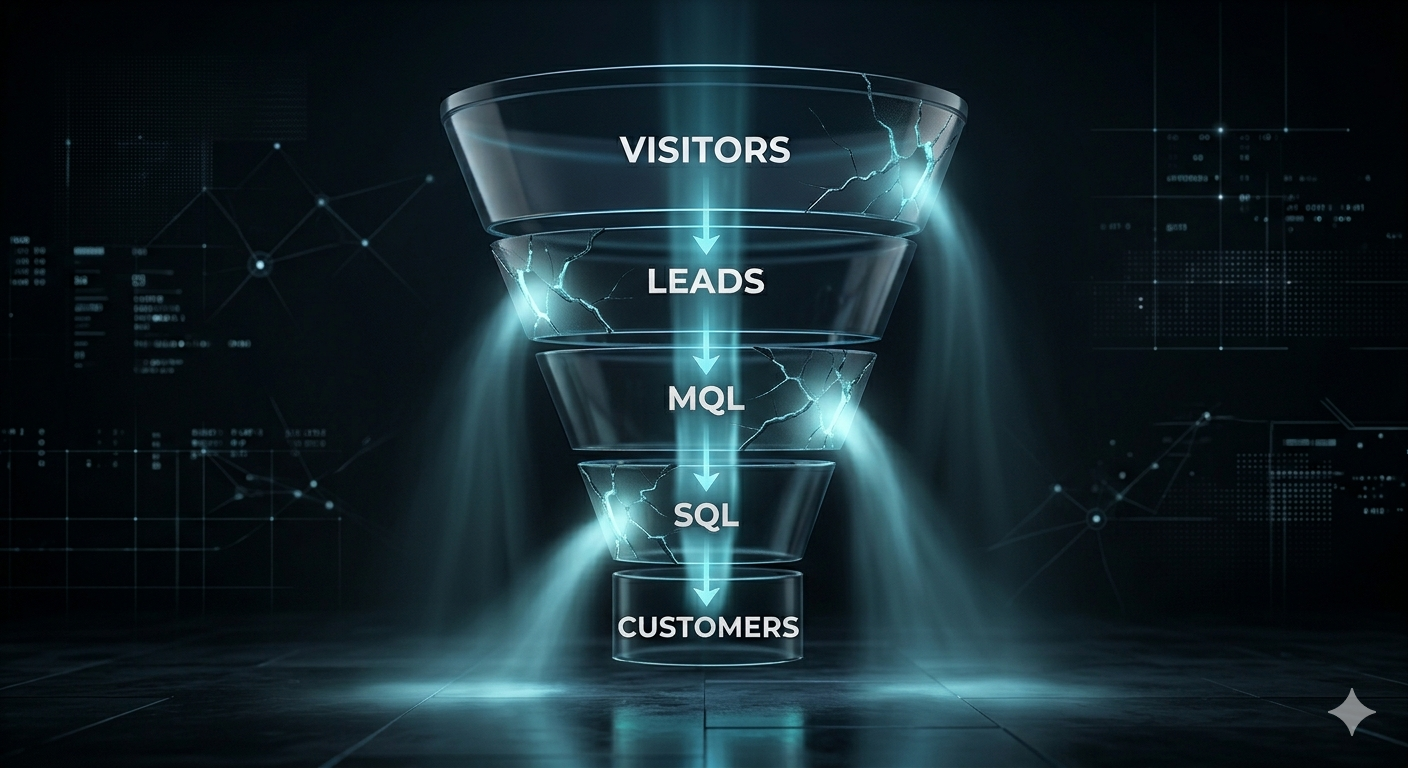
A common B2B lead generation process follows a sequence.
First, marketing attracts visitors through campaigns or content.
A visitor then completes a form, downloads a resource, or registers for an event.
The marketing automation platform records the contact and may assign a score based on activity and customer fit.
Once the score reaches a defined threshold, the system labels the contact a marketing-qualified lead (MQL).
Sales development representatives (SDRs) then attempt to determine whether the prospect is ready for a sales discussion.
If qualification succeeds, the contact may become a sales-qualified lead (SQL) and eventually connect to an opportunity.
This process provides useful structure, but its limitations become visible when lead scoring does not reflect purchasing readiness.
Why Does the Traditional Funnel Not Always Match B2B Buying?
Traditional funnels often present a simple progression from awareness to interest, consideration, and purchase.
Real B2B buying is rarely so orderly.
An organization may research solutions for months, pause its evaluation, revisit an existing vendor, or involve additional stakeholders before making a decision.
Different employees can also enter the buying process at different times.
For example, an IT manager may review security requirements while a finance director evaluates costs and a sales leader compares product features.
Those employees are participating in one organizational decision, even if marketing systems record them as separate leads.
A contact-based funnel can struggle to represent that shared purchasing activity.
What Is the Difference Between Lead Generation and Demand Generation?
Lead generation focuses on identifying potential customers and capturing expressions of interest.
Demand generation is broader. It includes activities that build awareness, educate potential buyers, develop brand preference, and create or capture interest in a solution.
Demand creation helps people understand a problem and remember relevant vendors before they are ready to purchase.
Demand capture connects with buyers who are already expressing active interest.
Both serve important purposes.
A company that focuses entirely on collecting leads may miss opportunities to influence buyers before they begin a formal evaluation.
Likewise, a company that invests only in brand awareness may struggle to convert active interest into sales.
A strong GTM strategy connects both activities.
Why Is Traditional Lead Generation Struggling in Modern B2B Sales?
Traditional lead generation becomes less effective when businesses assume that more captured contacts will automatically produce more qualified opportunities.
The weakness is not necessarily the acquisition channel.
It is often the way the organization interprets engagement, qualifies prospects, and measures results.
Lead Volume Does Not Establish Purchasing Demand
A lead is a contact or inquiry that meets a company’s recording criteria.
It may represent curiosity, future interest, active research, or immediate purchasing need.
Those situations are not equivalent.
Consider a SaaS company that generates 1,000 leads from an educational webinar.
Some attendees may be students, consultants, competitors, or professionals collecting information for future use.
Others may work for suitable organizations actively evaluating software.
If marketing reports all 1,000 contacts as potential revenue opportunities, leadership may overestimate the amount of genuine demand.
The company needs further qualification to separate suitable buyers from general audience engagement.
Behavioral Lead Scores Cannot Fully Explain Buyer Intent
Traditional lead scoring often uses activities such as website visits, email clicks, and content downloads.
These signals can indicate engagement, but they do not independently prove purchasing readiness.
For example, one prospect visits a pricing page five times because they are researching market costs.
Another prospect requests a technical discussion because their company has an approved implementation project.
The second interaction may provide stronger buying evidence despite producing fewer recorded activities.
Reliable qualification should combine customer fit, relevant behavior, and verified buyer context.
Cost Per Lead Can Create Misleading Incentives
Cost per lead (CPL) measures how much a company spends to generate a recorded lead.
Cost Per Lead = Lead Acquisition Spending ÷ Leads Generated
This metric helps marketers evaluate acquisition efficiency.
However, it does not show whether the leads become sales opportunities or paying customers.
Suppose Campaign A generates 800 leads for $20,000, while Campaign B generates 300 leads for the same amount.
Campaign A has the lower CPL.
Yet if Campaign B produces more suitable purchasing opportunities, the lower lead cost may not translate into better commercial results.
Marketing teams should evaluate lead acquisition costs alongside qualification, opportunity progression, and revenue.
MQL Targets Can Conflict With Sales Requirements
Marketing and sales teams may define success differently.
Marketing is often evaluated using lead volume, MQL production, and campaign costs.
Sales is usually responsible for creating opportunities, progressing deals, and closing revenue.
When these measurements are disconnected, the two teams can disagree about lead quality.
Marketing may report strong results while sales finds that many contacts lack a confirmed business need or purchasing timeline.
The solution is a shared qualification standard and consistent reporting from first engagement through commercial outcomes.
For a closer examination of this problem, read XYNEXI’s article on why B2B leads aren’t converting.
How Has Modern B2B Buying Changed?
Modern B2B buyers can research vendors, compare products, review independent information, and consult colleagues before speaking with a sales representative.
This changes when sellers become involved and what buyers expect from them.
Buyers Research Vendors Before Contacting Sales
The 2025 6sense Buyer Experience Report studied nearly 4,000 B2B buyers.
It found that buyers first contacted sellers around 61% of the way through their purchasing journey, compared with approximately 69% in the previous study.
The report also found that the winning vendor appeared on the buyer’s initial shortlist in 95% of the purchases studied.
These results suggest that important vendor preferences often form before the first direct sales conversation.
For marketing teams, that creates a problem with strategies focused mainly on capturing contact details.
A company may become visible only after the buying group has already developed a shortlist.
By that point, generating a new lead may not be enough to change the purchasing decision.
Buyers Increasingly Prefer Self-Directed Research
B2B buyers can now access product documentation, software reviews, pricing information, industry analysis, and competitor comparisons without contacting sales.
In March 2026, Gartner reported that 67% of surveyed B2B buyers preferred a sales representative-free purchasing experience.
The research surveyed 646 buyers and found that 45% had used AI during a recent purchase.
These findings do not mean buyers have stopped needing sales representatives.
They show that many buyers want to control when and how they interact with vendors.
Businesses should provide useful information before requiring a sales conversation.
Product comparisons, implementation details, security documentation, and clear explanations of capabilities can help buyers evaluate solutions independently.
AI-Assisted Research Changes Vendor Discovery
Generative AI tools have introduced another way for B2B buyers to research products and services.
Buyers can use AI to summarize software categories, compare features, identify possible vendors, and develop evaluation questions.
This can happen without visiting a vendor’s website or completing a traditional lead form.
However, AI-generated information can be incomplete or inaccurate.
Human expertise therefore remains important.
A separate Gartner survey published in May 2026 found that 69% of surveyed buyers preferred validating AI-generated insights with sales representatives.
Respondents reported using an average of seven information sources during a recent purchase.
Together, these findings support a balanced approach.
Buyers need reliable self-service information, but they also value knowledgeable people who can clarify important details and reduce decision uncertainty.
B2B Purchasing Decisions Involve Buying Groups
A major limitation of contact-focused lead generation is that it often represents a purchasing decision through one person’s activity.
Many B2B purchases involve several internal and external stakeholders.
According to Forrester’s January 2026 State of Business Buying research, a typical purchasing decision involved 13 internal stakeholders and nine external influencers.
The numbers vary with purchasing complexity.
An enterprise software buying group may include department leaders, financial approvers, IT teams, procurement professionals, legal specialists, and outside advisers.
Each participant evaluates different risks and benefits.
A single employee downloading a guide cannot fully represent those requirements.
GTM teams need visibility into the organization, its purchasing initiative, and the people involved in reaching a decision.
Brand Preference Can Form Before a Lead Exists
Many potential customers are not actively purchasing when they first encounter a company.
They may remember a useful article, industry report, event, or product explanation and return when a relevant business need develops.
The LinkedIn B2B Institute’s 95-5 framework emphasizes the importance of building brand familiarity among buyers who are not currently in the market.
The framework uses an illustrative market split in which only a small share of potential customers is ready to buy during a given period.
It should not be treated as an exact percentage for every B2B industry.
Its practical message is that future customers matter.
A marketing strategy focused only on immediate lead acquisition may underinvest in the awareness and trust that influence later purchasing decisions.
Why Do Traditional Lead-Based GTM Workflows Break Down?
Modern buying behavior creates problems when marketing, sales, and revenue operations continue managing customers through disconnected contact-based processes.
The result can be lost context, repeated qualification, and misleading performance reporting.
Disconnected Systems Create Gaps in Buyer Context
B2B companies often use multiple platforms to manage customer engagement.
Google Ads may track campaign conversions. Marketing automation records email activity. Salesforce or HubSpot stores contacts and opportunities. Separate tools manage chat, meetings, and outreach.
These platforms can work together, but integration and data quality matter.
When information remains disconnected, sales representatives may not see what buyers have already researched or discussed.
Several employees from the same account may also appear as unrelated prospects.
Connecting relevant records helps teams understand the broader purchasing situation.
Generic Outreach Ignores Buyer Readiness
Traditional lead workflows frequently trigger predefined email sequences after a form submission or lead score change.
These sequences can be useful for routine communication.
However, they may become ineffective when the messages do not match the buyer’s needs.
A prospect asking about technical integration may receive introductory marketing content.
Another researching basic concepts may receive repeated requests to schedule a demonstration.
Neither response necessarily supports the buyer’s current task.
Better engagement uses available context to determine whether the appropriate action is education, qualification, technical assistance, or human sales support.
Lead Forms Do Not Capture Every Potential Buyer
Some buyers prefer to research anonymously before identifying themselves.
Others may visit product pages, compare vendor information, or discuss solutions internally without submitting a form.
Those activities do not automatically establish purchase intent.
However, they demonstrate why a company’s known lead database cannot represent every possible purchasing decision in its market.
Marketing should provide useful information and low-friction ways to ask questions.
Buyers should be able to contact sales when they need assistance, without being forced through unnecessary qualification steps.
Engagement Is Not the Same as Vendor Preference
A prospect may repeatedly interact with marketing content while favoring another vendor.
Engagement measures interaction.
Preference reflects which solution or provider the buyer is more likely to consider or select.
A useful GTM process should investigate both.
For example, a buyer may attend a product webinar but later explain that their organization prefers a competitor because of an existing integration.
That conversation reveals more about the purchase decision than webinar attendance alone.
Marketing teams should therefore avoid treating high engagement as proof of competitive advantage.
What Should Modern B2B GTM Teams Do Instead?
Modern GTM should connect demand creation, buyer engagement, purchasing context, and sales execution.
The objective is not to eliminate lead generation.
It is to make contact acquisition one part of a broader process centered on buyer needs and commercial outcomes.
Balance Demand Creation and Demand Capture
Demand creation and demand capture serve different stages of market development.
Demand creation helps suitable audiences understand problems and remember relevant solutions.
Examples include educational articles, industry research, product education, events, and brand campaigns.
Demand capture responds to active interest through pricing inquiries, demonstration requests, product evaluations, and direct buyer conversations.
Companies need both.
Focusing only on future awareness may weaken near-term pipeline creation.
Focusing only on immediate inquiries may leave the business dependent on existing demand and reduce opportunities to build long-term preference.
Identify Buying Groups and Purchasing Initiatives
Instead of measuring every contact independently, GTM teams should connect relevant people to accounts and purchasing initiatives.
For example, three employees researching the same CRM implementation may represent one potential opportunity.
A useful account record should show known stakeholders, business requirements, buying activity, and unresolved questions.
However, several engaged employees do not automatically prove that a purchase is underway.
The purchasing initiative still requires verification.
Use Conversations to Understand Buyer Needs
Direct conversations help establish why buyers are interested.
A sales representative may discover that an organization has a specific operational problem, a planned technology review, or an upcoming contract renewal.
Those details can clarify whether the prospect needs education or is ready for an active evaluation.
Conversations can also reveal objections, competing priorities, implementation concerns, and decision requirements.
These insights help marketing and sales coordinate useful next actions.
The important measure is not the number of conversations alone.
It is whether those conversations improve understanding and help suitable opportunities progress.
Qualify Opportunities Using Verified Evidence
A qualified sales opportunity should represent a credible purchasing initiative rather than an isolated contact reaching an arbitrary score.
Relevant evidence may include:
-
Suitable company and product fit.
-
A confirmed business need.
-
Meaningful evaluation or purchasing activity.
-
Identified decision participants.
-
A realistic purchasing context.
-
An appropriate agreed next action.
Not every opportunity will have an approved budget or confirmed closing date immediately.
Teams should record uncertainty instead of treating missing information as proof that no opportunity exists.
The goal is consistent, evidence-based qualification.
Engage Buyers When Human Support Adds Value
Self-service research and human sales conversations are complementary.
Buyers may prefer to gather introductory information independently.
When they need technical guidance, commercial negotiations, implementation planning, or clarification of conflicting information, human support may become important.
AI and automation can assist with approved product information, routing, and routine qualification.
However, those systems require accurate knowledge, appropriate controls, and clear paths to human assistance.
A buyer-centered GTM process should make engagement useful rather than forcing every prospect into the same sequence.
How Does Buyer-Centered GTM Compare With Traditional Lead Generation?
Traditional lead-focused GTM and buyer-centered GTM are not completely separate systems.
Both can use advertising, CRM software, email, content marketing, and sales representatives.
The difference is what the organization treats as evidence of progress.
| Dimension | Traditional lead-focused GTM | Buyer-centered GTM |
|---|---|---|
| Primary unit | Individual lead | Account, buying group, and opportunity |
| Main objective | Generate and qualify contacts | Build demand and progress purchasing initiatives |
| Primary marketing metrics | Leads, MQLs, cost per lead | Engagement quality, qualified opportunities, and demand development |
| Qualification | Lead scores and predefined criteria | Customer fit, buying context, and validated evidence |
| Sales handoff | Often triggered by lead status | Triggered by agreed qualification and buyer needs |
| Customer engagement | Scheduled sequences and sales follow-up | Relevant assistance based on buyer context |
| CRM organization | Contact-centered | Connected contacts, accounts, and opportunities |
| Revenue evaluation | Lead-to-sales conversion | Opportunity progression, customers, revenue, and profitability |
| Main limitation | Can mistake engagement for demand | Requires stronger data coordination and consistent governance |
A well-managed traditional process can already contain buyer-centered practices.
Likewise, a company adopting account-based marketing or conversational AI can still make qualification errors.
The operating model matters more than its label.
For a deeper explanation of the transition, read How to Transition From Lead-Based to Conversation-Based GTM.
How Can Companies Transition From Traditional Lead Generation to Buyer-Centered GTM?
Businesses do not need to replace their entire revenue operation immediately.
A practical transition starts with identifying where the current process loses qualified demand and testing improvements before expanding them.
Step 1: Audit the Existing Lead-to-Revenue Process
Review lead acquisition, MQL creation, sales acceptance, opportunity conversion, and completed sales.
Identify where suitable contacts stop progressing.
Compare campaign costs with accepted opportunities and customer outcomes.
Use historical CRM data to distinguish qualification problems from delayed purchasing decisions.
The result should be a reliable baseline showing how the current GTM process performs.
Step 2: Define Contacts, Accounts, and Buying Opportunities
Marketing, sales, and revenue operations should agree on shared definitions.
A contact is a person.
An account represents an organization.
A buying group includes relevant people involved in a purchasing initiative.
An opportunity represents a distinct potential purchase supported by agreed qualification criteria.
These distinctions help prevent duplicate reporting and clarify what each department should measure.
Step 3: Connect Buyer and Account Data
Configure the CRM to associate relevant contacts, account activities, conversations, and purchasing opportunities.
Review duplicates, incorrect associations, and missing information.
Capture important details such as business needs, stakeholder roles, decision requirements, and confirmed next actions.
Only collect and use information that the organization is permitted to process.
Good account data supports better qualification, but unreliable associations can create misleading conclusions.
Step 4: Balance Future Demand and Active Buyer Engagement
Separate marketing activities intended to build future interest from those designed to capture existing demand.
For example, educational industry content may help prospective customers understand a problem long before purchasing.
A technical comparison page may serve organizations already evaluating solutions.
Both types of content can contribute to revenue, but their measurement periods differ.
Avoid judging every awareness campaign by immediate demo bookings.
Step 5: Improve Buyer Engagement and Qualification
Review what happens when suitable prospects express meaningful interest.
Provide relevant information, answer questions, and identify the right next action.
For a buyer asking about integration requirements, technical documentation may be more valuable than a generic sales pitch.
For an organization discussing an active implementation, direct qualification may be appropriate.
A real-time go-to-market model can help explain how timely responses, connected customer information, and coordinated sales actions fit together.
Step 6: Establish Shared Revenue Metrics
Marketing and sales should share accountability for accepted opportunities and commercial outcomes.
Keep useful acquisition metrics, but add measures for buying-group engagement, qualification, opportunity progression, and customer acquisition efficiency.
Finance should help validate spending and revenue figures.
Consistent definitions prevent teams from reporting different versions of the same results.
Step 7: Test, Measure, and Refine
Introduce the revised process within a defined customer segment or acquisition channel.
Compare outcomes with an appropriate baseline or control group.
Track qualification quality, opportunity progression, acquisition costs, and eventual gross profit.
Allow enough time for normal sales cycles to complete.
If the revised process produces reliable improvement, expand it gradually.
If results do not improve, investigate the qualification criteria, buyer experience, and operating costs before adding more tools.
Which Metrics Should Modern B2B GTM Teams Measure?
Modern GTM performance should be measured through qualified purchasing activity, opportunity progression, customer acquisition efficiency, and revenue outcomes.
Lead volume can remain useful, but it should not determine commercial success on its own.
Engaged-Account-to-Opportunity Rate
This metric measures how often engaged target accounts develop into accepted purchasing opportunities.
Account-to-Opportunity Rate = (Engaged Accounts Producing Accepted Opportunities ÷ Eligible Engaged Target Accounts) × 100
An eligible engaged account should meet the company’s predefined customer-fit and engagement criteria.
Count each account once in the numerator, even if several contacts participate.
Report distinct opportunities separately because one organization may have more than one purchasing initiative.
This is a defined operational metric, not a universal industry benchmark.
Cost Per Qualified Opportunity
Cost per qualified opportunity measures how much the business spends to create accepted purchasing opportunities.
Cost Per Qualified Opportunity = Allocated Acquisition and Qualification Costs ÷ Distinct Accepted Opportunities
Costs should include relevant marketing spending and qualification resources without double-counting.
A lower cost may indicate greater efficiency, but the resulting opportunities must still be validated against win rates and revenue.
Opportunity Progression and Win Rate
Opportunity progression measures whether accepted purchasing initiatives move through verified sales stages.
Opportunity Progression Rate = (Opportunities Reaching the Next Validated Stage ÷ Eligible Opportunities) × 100
Win rate measures the share of concluded opportunities that become customers.
Win Rate = (Closed-Won Opportunities ÷ Closed-Won and Closed-Lost Opportunities) × 100
These measures help teams evaluate both purchasing progress and final sales outcomes.
Why Can Fewer Leads Produce Better Commercial Results?
Consider two hypothetical marketing approaches.
The first generates 1,000 leads and engages 300 eligible target accounts.
Eighteen of those accounts produce accepted opportunities, giving an account-to-opportunity rate of 6%.
The second generates 450 leads and engages 240 eligible accounts.
Thirty-six accounts produce accepted opportunities, resulting in a 15% rate.
Although the second approach generates fewer contacts, it produces twice as many accounts with accepted opportunities.
This example shows why contact volume and purchasing demand should be measured separately.
It does not prove that changing the GTM model caused the improvement.
Differences in audience quality, spending, product fit, and sales execution would need to be considered.
Revenue and Gross Profit
Closed-won revenue shows the value of completed sales.
Gross profit accounts for the direct cost of delivering products or services.
For financial evaluation, gross profit can provide a more useful picture of economic contribution than revenue alone.
An improvement program can use a simplified ROI calculation:
ROI = [(Incremental Gross Profit − Incremental Program Costs) ÷ Incremental Program Costs] × 100
Incremental costs may include additional software, campaign spending, implementation, and operating expenses.
The company should compare actual outcomes with a credible baseline before attributing additional profit to a new GTM process.
How Should Future Demand Be Measured?
Demand creation may influence purchasing decisions months or years after the first marketing interaction.
Immediate lead conversion is therefore not an adequate measure of every campaign.
Companies can evaluate awareness, relevant audience reach, brand consideration, and longer-term account engagement.
For example, a brand study may examine whether suitable business buyers recognize and consider a vendor over time.
These measures should be interpreted alongside subsequent sales outcomes, not treated as guaranteed future revenue.
Google Ads also supports qualified-lead and converted-lead goals, allowing advertisers to connect certain downstream CRM outcomes with earlier campaign interactions.
This can improve visibility into later sales stages when properly configured, but it does not independently prove incremental revenue.
What Is the GTM Operating Model Alignment Audit?
A GTM Operating Model Alignment Audit helps identify whether a company’s marketing and sales process reflects how its target customers actually purchase.
The framework below is a practical diagnostic, not a proprietary scoring algorithm.
| Audit dimension | Question leadership should ask |
|---|---|
| Buyer journey | Does our process reflect how target organizations research and make decisions? |
| Qualification | Do our rules distinguish engagement from genuine purchasing activity? |
| Data relationships | Can we connect contacts, accounts, buying groups, and opportunities? |
| Engagement | Are we responding to relevant buyer needs or simply triggering more outreach? |
| Revenue accountability | Do marketing and sales share opportunity and customer outcomes? |
| Future demand | Are we building awareness and preference before buyers are ready to purchase? |
| Measurement | Can we connect spending with accepted opportunities, customers, and gross profit? |
Revenue leaders can review each dimension using CRM records, campaign data, sales conversations, and financial outcomes.
For example, an organization may have reliable acquisition reporting but poor account-level visibility.
Another may identify real opportunities accurately but fail to provide timely technical information during evaluation.
These are different problems requiring different solutions.
The audit helps teams identify what should change before investing in additional automation.
What Are the Risks of Moving Beyond Lead-Based GTM?
A buyer-centered operating model can improve how teams interpret demand, but it introduces new requirements.
Companies must manage data quality, qualification consistency, buyer preferences, and measurement carefully.
Abandoning Lead Generation Too Quickly
Lead generation remains useful for identifying suitable contacts and capturing active demand.
Removing forms, campaigns, or nurturing programs without understanding their contribution can reduce useful customer engagement.
A phased transition allows companies to keep effective acquisition channels while improving account and opportunity reporting.
Treating Every Engaged Account as an Opportunity
Several contacts researching the same product may indicate organizational interest.
However, that activity does not automatically establish a purchasing initiative.
Teams should verify customer fit, business requirements, and appropriate next actions before accepting opportunities.
Otherwise, opportunity-based reporting can develop the same inflation problems as poorly managed MQL systems.
Using Automation Without Buyer Context
Automated outreach can help teams manage routine communication.
However, poorly configured systems may send irrelevant messages, repeat questions, or incorrectly classify prospects.
AI-based qualification can also produce inaccurate assessments when customer information is incomplete.
Use approved knowledge, clear qualification rules, human escalation, and regular evaluation.
The purpose of automation should be more useful engagement, not simply more interactions.
Measuring Long Buying Cycles Too Early
Complex B2B opportunities can take months to progress.
Evaluating a recent acquisition cohort before normal sales cycles have matured can make conversion performance appear weaker than it is.
Revenue teams should use consistent observation windows and compare similar customer segments.
Early operational improvements should be distinguished from eventual revenue outcomes.
Ignoring Privacy and Data Accuracy
Account-level GTM may combine information from CRM systems, marketing activity, sales conversations, and third-party sources.
Organizations should establish appropriate consent and lawful processing practices, access permissions, data retention policies, and security controls.
Recorded conversations and personal information deserve particular care.
Reliable buyer intelligence requires trustworthy data and responsible handling.
When Does Traditional Lead Generation Still Work?
Traditional lead generation can remain effective when the company’s sales process is relatively simple and individual contacts have meaningful purchasing authority.
For example, a small business evaluating an inexpensive monthly software subscription may complete most of its buying process without a large committee.
A clear product page, simple inquiry form, and useful follow-up may work well.
Contact-based acquisition can also support event marketing, content distribution, and early-stage nurturing.
The question is not whether lead generation should exist.
It is whether the business can connect acquired contacts with suitable accounts, actual purchasing needs, and measurable commercial outcomes.
A mature GTM strategy uses the appropriate process for its customers instead of applying one model to every market.
Conclusion
Traditional lead generation is struggling in many B2B GTM organizations because contact-focused processes do not always reflect how companies make purchasing decisions.
Buyers increasingly research vendors independently, use digital and AI-assisted information, consult multiple stakeholders, and form preferences before talking to sales.
A strategy built mainly around form submissions, MQL counts, and lead scores may overlook those activities.
That does not make lead generation obsolete.
Marketing teams still need to attract suitable audiences, create future demand, and capture existing purchasing interest.
The more important change is how companies connect those activities with buyer needs and commercial results.
A modern GTM operating model should bring marketing, sales, customer data, and revenue operations together around accounts, buying groups, qualified purchasing initiatives, and customer outcomes.
It should also provide useful self-service information and human assistance when buyers need it.
Revenue leaders can evaluate this approach through qualified opportunity creation, opportunity progression, customer acquisition costs, win rates, revenue, and gross profit.
The goal is not to generate fewer leads or automate more outreach. It is to understand genuine buyer demand, support purchasing decisions, and turn marketing and sales activity into measurable business growth.
Frequently Asked Questions
1. Is Traditional B2B Lead Generation Dead?
No. Traditional B2B lead generation remains useful for attracting prospects, collecting inquiries, and supporting marketing campaigns. Its limitations become clear when businesses rely on contact volume as the primary measure of purchasing demand. Modern GTM teams should combine lead generation with demand creation, buying-group engagement, evidence-based qualification, and revenue measurement.
2. Why Do B2B Leads Often Fail to Become Sales Opportunities?
B2B leads may fail to become opportunities because engagement does not always indicate purchasing readiness. A prospect may download content or attend a webinar without having a confirmed business need, suitable customer profile, or active evaluation. Poor qualification, delayed follow-up, inaccurate CRM data, and missing buying-group context can also reduce conversion. Teams should examine these factors before assuming the acquisition channel is responsible.
3. What Is the Difference Between Lead Generation and Demand Generation?
Lead generation focuses on identifying potential customers and capturing contact information or inquiries. Demand generation covers a broader set of activities that build awareness, educate buyers, develop brand consideration, and capture existing demand. Lead generation can be part of demand generation, but contact acquisition alone does not explain whether a business is creating future interest or progressing active purchasing opportunities.
4. How Does Modern B2B Buying Affect GTM Strategy?
Modern B2B buying often involves independent research, multiple stakeholders, early vendor comparisons, and selective interaction with sales representatives. Buyers may establish requirements and preferences before contacting vendors. GTM teams should therefore provide useful self-service information, connect contacts with buying accounts, support buying groups, and offer relevant human assistance when needed. Performance should be measured across the purchasing process rather than only through lead counts.
5. What Should GTM Teams Measure Instead of MQL Volume?
GTM teams should measure accepted qualified opportunities, engaged-account conversion, opportunity progression, customer acquisition cost, win rate, closed-won revenue, and gross profit. Future-demand programs may also require brand awareness and consideration measurements. MQL volume can remain a supporting metric, but it should not be treated as proof of revenue performance without downstream validation.
6. How Can Companies Modernize GTM Without Losing Existing Leads?
Companies can modernize GTM gradually by keeping effective acquisition channels while introducing better account relationships, shared qualification standards, and opportunity-centered reporting. Start with a review of existing leads and revenue outcomes. Connect contacts with accounts, improve buyer engagement, and test revised qualification rules in a limited segment. Expand only after the new process demonstrates reliable operational and commercial value.