
Your B2B sales team is making more calls, updating more CRM records, and booking more meetings, yet revenue remains flat. Before hiring more reps or buying software, sales leaders need to identify which stage loses qualified buyers and fix that bottleneck first.
What Should You Change First in Your Sales Process?
The first change in an underperforming B2B sales process should address its biggest revenue bottleneck. Start by auditing lead qualification, response times, opportunity conversion, and stalled deals. If poor-quality leads dominate, improve qualification first. If suitable buyers are waiting too long, fix engagement speed. Then improve discovery conversations and sales handoffs.
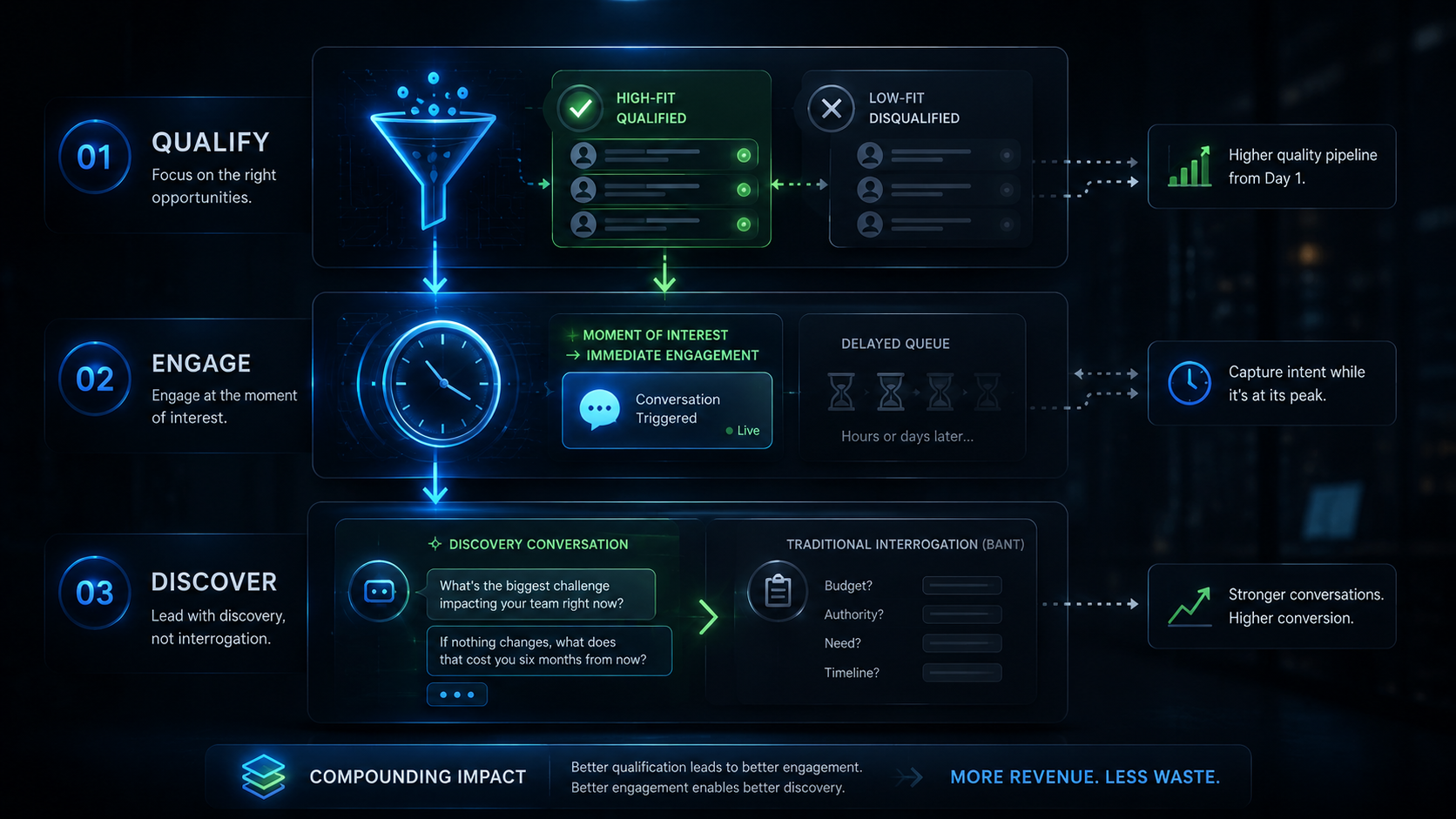
A sales process connects buyer interest with closed revenue. Problems at one stage can affect every stage that follows.
For example, generating more leads will not solve a qualification problem. Faster outreach may also deliver limited value if representatives spend their time contacting companies that cannot purchase the product.
The goal is to improve sales conversion and revenue from existing resources, rather than simply increase activity.
How to Audit Your B2B Sales Process
A sales process audit shows where qualified buyers stop progressing and where representatives spend time without producing results.
Start with your existing CRM data rather than changing tools or adding new sales activities.
Review the last three to six months of leads, opportunities, and closed deals. For businesses with longer sales cycles, include enough history to capture completed buying journeys.
Focus on three areas: conversion, response speed, and opportunity progression.
Check Lead-to-Opportunity Conversion
Lead-to-opportunity conversion shows how many incoming leads become legitimate sales opportunities.
Use this formula:
Lead-to-Opportunity Conversion Rate = (Opportunities Created ÷ Total Leads) × 100
For example, suppose a B2B software company receives 500 leads and creates 75 qualified opportunities.
Its conversion rate is 15%.
If conversion is falling, review which leads were rejected and why.
Poor customer fit, weak purchasing intent, and missing qualification information may indicate problems before the sales process begins.
However, if qualified leads reach sales but fail to advance, the issue may involve discovery, sales execution, or the buying process.
Review Lead Response Times
Measure how long it takes representatives to contact prospects after they express interest.
Use the timestamp of the buyer’s inquiry and the first meaningful sales response.
An automated acknowledgment does not necessarily count as a qualified conversation.
A study published in Harvard Business Review analyzed approximately 1.25 million sales leads across 42 companies.
Researchers found that companies attempting contact within one hour were nearly seven times as likely to qualify a lead as companies waiting at least another hour.
This 2011 study measured lead qualification, not completed purchases. Still, it provides evidence that response delays can affect sales opportunities.
If suitable buyers regularly wait hours or days for contact, improving response speed may deserve immediate attention.
Examine Qualification and Stalled Deals
Review opportunities that repeatedly miss their expected closing dates or remain inactive.
Look for missing decision-makers, unclear purchase requirements, and opportunities without scheduled next steps.
An interested prospect does not automatically represent a real sales opportunity.
A sales leader should establish whether the buyer has a business problem, a suitable solution, a possible funding path, and a realistic reason to purchase.
If these details are missing, the team may be filling its pipeline with opportunities that are unlikely to close.
How Do You Identify the Biggest Sales Process Bottleneck?
A bottleneck is the stage where a problem prevents sales opportunities from moving forward efficiently.
The largest drop in opportunity count is not always the most costly bottleneck. Sales leaders should also consider deal value, buyer intent, time lost, and the potential effect on revenue.
A useful diagnostic compares each problem with the action needed to fix it.
|
Sales process problem |
Warning sign |
First action |
|---|---|---|
|
Poor lead quality |
Many leads rejected by sales |
Improve qualification criteria |
|
Slow response |
High-intent inquiries wait for contact |
Automate routing and engagement |
|
Weak discovery |
Meetings occur but few opportunities progress |
Improve buyer conversations |
|
Poor handoffs |
Buyers repeatedly explain the same requirements |
Improve CRM information sharing |
|
Stalled opportunities |
Close dates repeatedly move forward |
Establish stage exit criteria |
|
Administrative overload |
Reps spend excessive time updating records |
Simplify or automate repetitive tasks |
Compare results across similar customer segments and historical periods.
For example, enterprise software opportunities may have longer sales cycles than smaller subscription purchases. Evaluating them against the same timelines can produce misleading conclusions.
How Can You Tell Whether Lead Quality or Sales Execution Is the Problem?
The distinction comes from examining where suitable buyers stop progressing.
If most incoming leads do not fit your ideal customer profile, marketing qualification may need improvement.
If suitable buyers regularly enter the pipeline but disappear after discovery, the sales conversation or follow-up process may be the problem.
If opportunities progress until procurement and then stall, sales leaders should investigate commercial approval, contract requirements, or access to decision-makers.
Fix the stage responsible for the loss rather than treating every conversion problem as a lead generation problem.
What Are the 5 Sales Process Changes to Prioritize?
Once the main bottleneck is clear, sales leaders can choose the most useful improvement.
Five changes frequently address common problems in B2B sales development and pipeline management.
1. Respond Faster to High-Intent Leads
A potential customer requesting a product demonstration has expressed a different level of interest from someone downloading a general guide.
Sales teams should prioritize contacts who show both strong customer fit and clear buying signals.
For high-intent inquiries, replace delayed manual assignment with automatic routing and timely engagement.
Salesforce provides lead assignment rules that can route incoming leads to representatives or queues based on defined conditions.
HubSpot also supports record-owner assignment through workflows, with available options depending on the subscription and configuration.
The goal is to shorten the gap between buyer interest and a meaningful conversation.
2. Strengthen Lead Qualification Before Increasing Volume
Sales representatives may appear busy while spending time on unsuitable prospects.
Better qualification prevents these contacts from entering the active sales pipeline too early.
A marketing-qualified lead (MQL) may meet marketing engagement criteria, but that does not automatically make the contact sales-ready.
A sales-qualified lead (SQL) should meet agreed sales criteria that indicate an appropriate next step.
Teams can use established frameworks such as BANT or MEDDICC.
BANT evaluates budget, authority, need, and timing. MEDDICC provides a more detailed assessment for complex B2B opportunities.
Representatives should confirm relevant details through discovery rather than assume that an email reply or content download proves purchasing intent.
Disqualify prospects who cannot reasonably benefit from the product. Nurture suitable prospects who are not ready to purchase.
3. Improve Handoffs Between Marketing, SDRs, and Account Executives
Poor sales handoffs create unnecessary work and can damage buyer confidence.
For example, a prospect may explain their requirements to an SDR before meeting an account executive.
If that information is not transferred, the account executive may repeat the same basic questions.
This makes the sales process feel disconnected.
A complete handoff should include the buyer’s business problem, company details, purchase timeline, decision-makers, concerns, and agreed next action.
CRM systems such as Salesforce and HubSpot can store this information in shared records.
Sales leaders should also define who owns the lead at every stage.
Clear ownership helps prevent duplicate outreach, missed follow-ups, and confusion between teams.
4. Remove Unnecessary Sales Activities
Not every sales activity contributes equally to revenue.
Representatives may spend substantial time preparing reports, copying meeting notes, researching basic company information, and updating CRM fields.
Salesforce’s February 2026 State of Sales findings reported that the average seller spends approximately 40% of working time selling.
The research also found that 87% of surveyed sales organizations used some form of AI.
This creates an opportunity to examine administrative tasks that could be simplified.
For example, teams can use approved tools to capture meeting notes, prepare summaries, update CRM records, and schedule follow-ups.
However, automation should not create additional reporting requirements or unnecessary approvals.
Remove tasks that provide little value before automating them.
5. Define Clear Deal Progression Criteria
Every sales pipeline stage should represent measurable progress in the buyer’s purchasing process.
For example, a deal should not move into the proposal stage simply because a representative has prepared a document.
The buyer should have confirmed relevant requirements and expressed interest in reviewing a proposal.
Set stage exit criteria based on evidence.
Discovery may require a documented business problem and an identified next step.
Proposal review may require confirmation that the buyer received the proposal and understands the evaluation process.
Later stages may require procurement or legal approval.
Clear criteria help managers identify deals that are progressing and separate them from opportunities that only appear active.
Which Sales Workflow Should You Automate First?
For many B2B teams, initial lead engagement and qualification are strong candidates for early automation.
These activities often follow repeatable patterns and have a direct connection to opportunity creation.
However, the first workflow to automate should depend on your audit.
If buyers already receive fast responses but qualification is poor, automating more messages may produce little benefit.
Similarly, if deals regularly stall during procurement, automating inbound lead engagement will not directly resolve that problem.
Start with a workflow that has a clear owner, reliable data, repeated manual work, and measurable outcomes.
How Can AI Conversations Improve Initial Sales Engagement?
Conversational AI can help businesses engage prospects and gather qualification information before a human representative joins the discussion.
Unlike a fixed questionnaire, a conversational AI agent can ask follow-up questions based on the buyer’s responses.
For example, a buyer may ask whether a software product supports an existing CRM.
An AI system with access to verified product information can answer that question and ask about the buyer’s implementation requirements.
It can then record the conversation and prepare a handoff if the prospect meets the company’s criteria.
AI may also help with meeting scheduling, follow-up reminders, and CRM updates.
However, conversational AI should not make unsupported claims about product capabilities, pricing, or contractual commitments.
Human escalation remains necessary when buyers require complex advice or commercial approval.
Should You Use AI Sales Agents or Hire More SDRs?
The decision should depend on the work your current team cannot complete efficiently.
If representatives are overwhelmed by repetitive qualification, research, and administrative tasks, AI may help increase capacity.
If the team needs deeper industry knowledge, stronger relationships, or complex negotiation skills, additional experienced employees may be more useful.
Compare the full costs of both options, including software, implementation, supervision, salaries, benefits, and training.
Measure the results through qualified opportunities and revenue, not just activity volume.
How Do You Prioritize Sales Process Changes by Revenue Impact?
Sales leaders should avoid changing several workflows at the same time without clear priorities.
A practical approach is to score each improvement using four factors: expected revenue impact, number of opportunities affected, implementation effort, and confidence in the available evidence.
Consider the following example.
A company receives 120 qualified inquiries each month, but many wait until the next business day for a response.
At the same time, representatives spend several hours preparing weekly reports.
Both problems deserve attention.
However, fixing delayed engagement may have a more direct effect on buyer qualification and opportunity creation.
That makes it a reasonable first test.
Use an Impact-and-Effort Matrix
|
Priority |
Expected impact |
Required effort |
Recommended approach |
|---|---|---|---|
|
High |
High |
Low |
Test immediately |
|
Medium |
High |
High |
Plan and pilot |
|
Medium |
Low |
Low |
Simplify when practical |
|
Low |
Low |
High |
Defer unless required |
This framework is a decision tool, not a statistical prediction.
Use CRM evidence and a clearly defined business outcome to support each priority.
For example, calculate how many suitable inquiries experience delayed follow-up and how those leads convert compared with similar inquiries receiving timely contact.
Avoid assuming that improving one metric will automatically increase revenue.
What Does a 30-Day Sales Process Improvement Plan Look Like?
Sales leaders can begin testing one focused change within 30 days without rebuilding their entire sales operation.
The first month should establish a baseline, introduce one controlled improvement, and check whether the results support further investment.
Days 1–7: Audit the Existing Process
Review CRM records, recent opportunities, lead sources, response times, and conversion rates.
Identify the largest avoidable problem affecting suitable buyers.
Speak with representatives and managers to understand why opportunities stall.
Select one measurable outcome for the pilot.
For example, the goal might be to reduce delayed responses to qualified demonstration requests.
Days 8–14: Improve Qualification and Routing
Update qualification criteria using real customer and closed-won data.
Clarify which leads require immediate contact and which should enter nurturing.
Configure CRM ownership, routing rules, and appropriate notifications.
Check that representatives receive enough buyer context to conduct useful conversations.
Test the changes with sample records before using them with live inquiries.
Days 15–21: Test Faster Engagement or AI Qualification
Launch the selected workflow with a limited group of suitable leads.
If appropriate, use conversational AI to answer approved questions, capture requirements, and prepare handoffs.
Keep a comparable group on the existing process when possible.
Track response speed, qualification accuracy, and buyer feedback.
Do not replace the entire sales process during the initial pilot.
Days 22–30: Evaluate Results and Adjust
Compare the pilot against the baseline.
Review accepted leads, qualified meetings, created opportunities, and CRM data quality.
Check whether the change reduced manual work or created new problems.
Some B2B sales cycles extend well beyond 30 days. Therefore, a one-month pilot may demonstrate better engagement or qualification without proving an increase in closed revenue.
Continue tracking the same opportunity cohorts until enough deals reach an outcome.
How Do You Measure Sales Process Improvements?
A successful sales process change should improve measurable results.
Sales leaders and revenue operations teams should track the indicators connected to their selected bottleneck.
|
KPI |
How to calculate it |
What it reveals |
|---|---|---|
|
Lead-to-opportunity conversion |
Opportunities ÷ leads × 100 |
Lead conversion quality |
|
MQL-to-SQL conversion |
SQLs ÷ MQLs × 100 |
Marketing and sales alignment |
|
Average response time |
Average time from inquiry to meaningful response |
Engagement speed |
|
Stage conversion rate |
Deals advancing ÷ deals entering a stage × 100 |
Pipeline progression |
|
Opportunity win rate |
Closed-won ÷ all closed opportunities × 100 |
Deal conversion performance |
|
Sales cycle length |
Average days from opportunity creation to close |
Time required to complete deals |
|
Revenue per representative |
Revenue ÷ number of representatives |
Sales productivity |
Use consistent opportunity definitions and compare similar periods or lead cohorts.
How Can Stage Conversion Analysis Identify Bottlenecks?
Suppose a B2B company produces 100 qualified opportunities.
Of those, 50 reach the demonstration stage and 10 eventually close.
The opportunity-to-demonstration conversion rate is 50%.
The demonstration-to-close conversion rate is 20%, assuming all 50 opportunities have reached a final outcome.
These figures alone do not prove which stage is underperforming. Compare them with historical results, buyer segments, and expected sales cycle lengths.
If demo conversion has declined while qualification remains stable, review discovery quality, product fit, commercial requirements, and follow-up practices.
How Can RevOps Measure Revenue Impact?
Revenue operations should compare opportunity outcomes before and after the change, accounting for differences in lead quality, deal size, and sales cycles.
For example, a team closes 20 deals from 100 completed opportunities with an average value of $10,000.
That produces $200,000 in revenue.
If the team later closes 25 comparable deals at the same average value, revenue increases to $250,000.
That is a 25% increase in revenue from the same opportunity count.
This is an illustrative calculation, not a guaranteed result.
For stronger evidence, compare similar lead groups receiving different processes and track whether improvement continues over time.
If automation improves response time but does not improve qualified opportunities, investigate the qualification criteria, buyer experience, and quality of sales handoffs before expanding it.
How Can Xynexi Support Sales Process Improvements?
Xynexi provides an AI sales development platform that focuses on conversational buyer engagement and qualification.
Its published platform information describes a process that combines lead enrichment, personalized outbound engagement, buyer discovery, objection handling, and qualification.
Xynexi’s AIRPEC system is designed to support conversations that identify buyer needs and prepare prospects for human sales engagement.
This approach may be relevant for businesses whose audits reveal excessive manual prospecting or early-stage qualification work.
Rather than evaluating the platform only by how many contacts it reaches, sales leaders should examine whether the conversations produce better-qualified opportunities and useful buyer context.
Xynexi emphasizes outbound workflows, so companies seeking inbound automation should confirm that their specific use case and CRM requirements are supported.
Explore how Xynexi’s AI sales platform works to review its conversational approach and assess where it may fit into your existing sales process.
Conclusion
The first change in your B2B sales process should address the problem causing the greatest avoidable loss of qualified revenue opportunities.
Start by examining lead quality, engagement speed, qualification standards, and stalled deals.
Then fix the most important bottleneck before introducing additional tools or generating more leads.
For many teams, the foundational improvements involve identifying suitable buyers, responding at the right moment, and conducting better discovery conversations.
AI can support these changes through automated engagement, qualification, and CRM administration, but it should be introduced only when it addresses a proven workflow problem.
A better sales process is measured by qualified opportunities, reliable deal progression, and closed revenue—not simply more sales activity.
Frequently Asked Questions
1. What Should a B2B Sales Leader Change First in an Underperforming Sales Process?
A B2B sales leader should first identify the stage causing the greatest loss of qualified opportunities. Review lead qualification, response times, stage conversion rates, and stalled deals. Improve the largest avoidable bottleneck before increasing prospecting, hiring more representatives, or implementing new software. The correct first action depends on evidence from the company’s actual sales pipeline.
2. Should Sales Teams Fix Lead Qualification Before Generating More Leads?
Yes, when poor lead quality is the main problem. Better qualification helps representatives focus on buyers with suitable business needs, customer fit, and purchasing potential. Increasing lead volume before fixing qualification may create more work without producing additional revenue. However, teams with strong qualification but insufficient demand may still need more lead generation.
3. How Can You Identify the Biggest Bottleneck in a B2B Sales Funnel?
Calculate conversion rates between sales stages and compare them with historical performance. Review lead response times, opportunity age, buyer engagement, and reasons for lost deals. The most important bottleneck is the one creating the largest avoidable business impact, not necessarily the stage with the lowest conversion percentage.
4. Which Sales Workflow Should a Company Automate First With AI?
Initial lead engagement and qualification are strong candidates when representatives spend significant time on repetitive conversations or high-intent buyers experience delays. AI can help answer approved questions, collect business requirements, and prepare sales handoffs. Businesses should first confirm that the workflow has clear qualification rules and measurable outcomes.
5. How Can Sales Teams Increase Revenue Without Hiring More Representatives?
Sales teams can improve revenue per representative by increasing opportunity quality, reducing sales cycle delays, improving discovery, and removing low-value administrative work. Better lead routing and qualification help existing representatives spend more time with suitable buyers. Track opportunity win rates, average deal value, and closed revenue to determine whether these improvements are working.
6. How Long Does It Take to Improve a B2B Sales Process?
A focused process improvement can be tested within 30 days, but measurable revenue results may take longer. The timeline depends on sales cycle length, CRM data quality, implementation complexity, and the change being tested. Response time and qualification improvements can often be evaluated earlier, while closed-revenue impact requires enough opportunities to finish the buying process.